MCQ
Consider a moving coil galvanometer (MCG) :
A : The torsional constant in moving coil galvanometer has dimensions $\left[ ML ^2 T^{-2}\right]$
B : Increasing the current sensitivity may not necessarily increase the voltage sensitivity.
C : If we increase number of turns $( N )$ to its double $(2 N)$, then the voltage sensitivity doubles.
D : MCG can be converted into an ammeter by introducing a shunt resistance of large value in parallel with galvanometer.
E : Current sensitivity of MCG depends inversely on number of turns of coil.
Choose the correct answer from the options given below :
  • A, B only
  • B
    A, D, only
  • C
    B, D, E only
  • D
    A, B, E only

Answer

Correct option: A.
A, B only
(A)
(A) $\tau= C \theta \Rightarrow\left[ ML ^2 T^{-2}\right]=[ C ][1]$
(B) $C \cdot S =\frac{\theta}{ I }=\frac{ BNA }{ C }$;
V.S. $=\frac{ BNA }{ RC }[ R$ also depends on ' N ' $]$
(C) V.S. $\propto \frac{ NAB }{ CR } \quad R \rightarrow NR$
(D) False [Theory]
(E) E [False]
C. $S \propto N$$
\Rightarrow \because C . S .=\frac{NAB}{C}
$

Need a full question paper?

Generate a complete, print-ready paper with questions like this in minutes — across 16+ boards, with answer keys.

Start Generating Free

Similar questions

A rod of length $l$ is oscillating as a physical pendulum about one of its end with small angular amplitude $\alpha$ in a crossed magnetic field $B.$ The maximum $emf$ induced in the rod will be :-
A polyatomic ideal gas has $24$ vibrational modes. What is the value of $\gamma$ ?
A ball of mass $150\,g$ starts moving with an acceleration of $20m/{s^2}$. When hit by a force, which acts on it for $0.1\, sec$. The impulsive force is ........ $N-s$
The magnitude of the de-Broglie wavelength $(\lambda)$ of electron $(e)$, proton $(p)$, neutron $(n)$ and $\alpha-$ particle $(\alpha)$ all having the same energy of $1\,MeV$, in the increasing order will follow the sequence
Sol.
Image
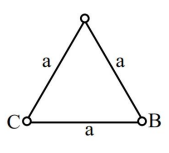
Three equal masses $m$ are kept at vertices (A, B, C) of an equilateral triangle of side $a$ in free space. At $t =0$, they are given an initial velocity $\vec{V}_A=V_0 \overrightarrow{A C}, \quad \vec{V}_B=V_0 \overrightarrow{B A}$ and $\vec{V}_C=V_0 \overrightarrow{C B}$.
Here, $\overrightarrow{ AC }, \overrightarrow{ CB }$ and $\overrightarrow{ BA }$ are unit vectors along the edges of the triangle. If the three masses interact gravitationally, then the magnitude of the net angular momentum of the system at the point of collision is :
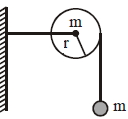
As shown in the figure, a bob of mass $\mathrm{m}$ is tied by a massless string whose other end portion is wound on a fly wheel (disc) of radius $\mathrm{r}$ and mass $m$. When released from rest the bob starts falling vertically. When it has covered a distance of $h$. the angular speed of the wheel will be
In a concave mirror experiment, an object is placed at a distance ${x_1}$ from the focus and the image is formed at a distance ${x_2}$ from the focus. The focal length of the mirror would be
$5.6$ $liter$ of helium gas at $STP$ is adiabatically compressed to $0.7$ $liter$. Taking the initial temperature to be $T_1$, the work done in the process is
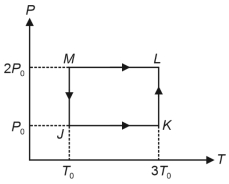
One mole of a monatomic ideal gas undergoes the cyclic process $J \rightarrow K \rightarrow L \rightarrow M \rightarrow J$, as shown in the $P - T$ diagram.

Match the quantities mentioned in $List-I$ with their values in $List-II$ and choose the correct option. [ $R$ is the gas constant]

$List-I$ $List-II$
($P$) Work done in the complete cyclic process ($1$) $R T_0-4 \ R T_0 \ln 2$
($Q$) Change in the internal energy of the gas in the process $JK$ ($2$) $0$
($R$) Heat given to the gas in the process $KL$ ($3$) $3 \ R T_0$
($S$) Change in the internal energy of the gas in the process $MJ$ ($4$) $-2 \ R T_0 \ln 2$
  ($5$) $-3 \ R T_0 \ln 2$

The angle between two vectors $ - 2\hat i + 3\hat j + \hat k$ and $\hat i + 2\hat j - 4\hat k$ is ....... $^o$