MCQ 14 Marks
Consider a circular disc of radius 20 cm with centre located at the origin. A circular hole of a radius 5 cm is cut from this disc in such a way that the edge of the hole touches the edge of the disc. The distance of centre of mass of residual or remaining disc from the origin will be-
Answer(D)
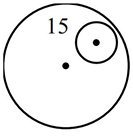
$\begin{array}{l}\text { mass of disc }=m \\ \text { mass of cut part }=\frac{m}{16} \\ X_{ com }=\frac{ m \times 0-\frac{ m }{16} \times 15}{m-\frac{ m }{16}} \\ =1 cm .\end{array}$ View full question & answer→MCQ 24 Marks
Answer(D)
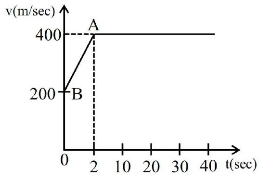
Total Area under curve.
View full question & answer→MCQ 34 Marks
The electric field of an electromagnetic wave in free space is
$
\overrightarrow{E}=57 \cos \left[7.5 \times 10^6 t-5 \times 10^{-3}(3 x+4 y)\right]
$
$
(4 \hat{i}-3 \hat{j}) N / C
$
The associated magnetic field in Tesla is-
- A
$\overrightarrow{ B }=\frac{57}{3 \times 10^8} \cos \left[7.5 \times 10^6 t -5 \times 10^{-3}(3 x +4 y )\right](5 \hat{ k })$
- B
$\overrightarrow{ B }=\frac{57}{3 \times 10^8} \cos \left[7.5 \times 10^6 t -5 \times 10^{-3}(3 x +4 y )\right](\hat{ k })$
- ✓
$\overrightarrow{ B }=-\frac{57}{3 \times 10^8} \cos \left[7.5 \times 10^6 t -5 \times 10^{-3}(3 x +4 y )\right](5 \hat{ k })$
- D
$\overrightarrow{ B }=-\frac{57}{3 \times 10^8} \cos \left[7.5 \times 10^6 t -5 \times 10^{-3}(3 x +4 y )\right]$ $(\hat{ k })$
AnswerCorrect option: C. $\overrightarrow{ B }=-\frac{57}{3 \times 10^8} \cos \left[7.5 \times 10^6 t -5 \times 10^{-3}(3 x +4 y )\right](5 \hat{ k })$
(C)
$\begin{array}{l}\overrightarrow{ K }=3 \hat{ i }+4 \hat{ j } \\ \hat{ K }=\frac{3 \hat{ i }+4 \hat{ j }}{5} \\ \hat{ E }=\frac{4 \hat{ i }-3 \hat{ j }}{5} \\ \hat{B}=\hat{ K } \times \hat{ E } \\ \hat{ B }=-\hat{ Z } \\ B _0=\frac{ E _0}{ C }=\frac{57}{3 \times 10^8}\end{array}$
View full question & answer→MCQ 44 Marks
Given a thin convex lens (refractive index $\mu_2$ ), kept in a liquid (refractive index $\mu_1, \mu_1<\mu_2$ ) having radii of curvature $\left|R_1\right|$ and $\left|R_2\right|$. Its second surface is silver polished. Where should an object be placed on the optic axis so that a real and inverted image is formed at the same place?
- A
$\frac{\mu_1\left| R _1\right| \cdot\left| R _2\right|}{\mu_2\left(\left| R _1\right|+\left| R _2\right|\right)-\mu_1\left| R _1\right|}$
- ✓
$\frac{\mu_1\left| R _1\right| \cdot\left| R _2\right|}{\mu_2\left(\left| R _1\right|+\left| R _2\right|\right)-\mu_1\left| R _2\right|}$
- C
$\frac{\mu_1\left| R _1\right| \cdot\left| R _2\right|}{\mu_2\left(2\left| R _1\right|+\left| R _2\right|\right)-\mu_1 \sqrt{\left| R _1\right| \cdot\left| R _2\right|}}$
- D
$\frac{\left(\mu_2+\mu_1\right)\left|R_1\right|}{\left(\mu_2-\mu_1\right)}$
AnswerCorrect option: B. $\frac{\mu_1\left| R _1\right| \cdot\left| R _2\right|}{\mu_2\left(\left| R _1\right|+\left| R _2\right|\right)-\mu_1\left| R _2\right|}$
(B)
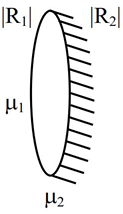
$\begin{array}{l}\frac{1}{ f _{ eq }}=\frac{2}{ f _{ L }}-\frac{1}{ f _{ m }} \\ f _{ m }=-\frac{\left| R _2\right|}{2} \\ \frac{1}{ f _{ L }}=\left(\frac{\mu_2}{\mu_1}-1\right)\left(\frac{1}{ R _1}+\frac{1}{ R _2}\right)\end{array}
$
$
\begin{array}{l}
\frac{1}{f_{eq}}=2\left(\frac{\mu_2-\mu_1}{\mu_1}\right)\left(\frac{R_1+R_2}{R_1 R_2}\right)+\frac{2}{R_2} \\
=\frac{2}{R_2}\left[\frac{\left(\mu_2-\mu_1\right)\left(R_1+R_2\right)+\mu_1 R_1}{\mu_1 R_1}\right] \\
=\frac{2}{R_2}\left[\frac{\mu_2 R_1+\mu_2 R_2-\mu_1 R_1-\mu_1 R_2+\mu_1 R_1}{\mu_1 R_1}\right] \\
\frac{1}{f_{eq}}=\frac{2\left[\mu_2 R_1+\mu_2 R_2-\mu_1 R_2\right]}{\mu_1 R_1 R_2}
\end{array}
$
For same size of image
$
\begin{array}{l}
u=2 f \\
u=\frac{\mu_1 R_1 R_2}{\mu_2 R_1+\mu_2 R_2-\mu_1 R_2}
\end{array}
$ View full question & answer→MCQ 54 Marks
The electric flux is $\phi=\alpha \sigma+\beta \lambda$ where $\lambda$ and $\sigma$ are linear and surface charge density, respectively, $\left(\frac{\alpha}{\beta}\right)$ represents
Answer(C)
$\begin{array}{l}\phi=\alpha \sigma+\beta \lambda \\ {[\phi]=[\alpha \sigma]=[\beta \lambda]} \\ {[\alpha]=\frac{[\phi]}{[\sigma]}} \\ {[\beta]=\frac{[\phi]}{[\lambda]}=\frac{[ Q / L ]}{[ Q / \text { Area }]}=\left[\frac{\alpha}{\beta}\right]=\frac{[\lambda]}{[\sigma]}} \\ {\left[\frac{\alpha}{\beta}\right]= L }\end{array}$
View full question & answer→MCQ 64 Marks
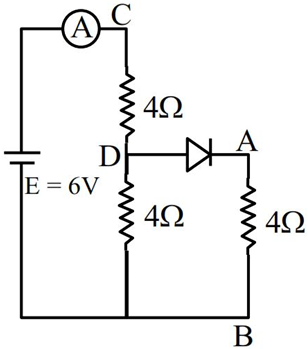
Refer to the circuit diagram given in the figure,
which of the following observation are correct?
A. Total resistance of circuit is $6 \Omega$.
B. Current in Ammeter is 1 A
C. Potential across AB is 4 Volts.
D. Potential across CD is 4 Volts.
E. Total resistance of the circuit is $8 \Omega$.
Choose the correct answer from the options given below:
Answer(D)
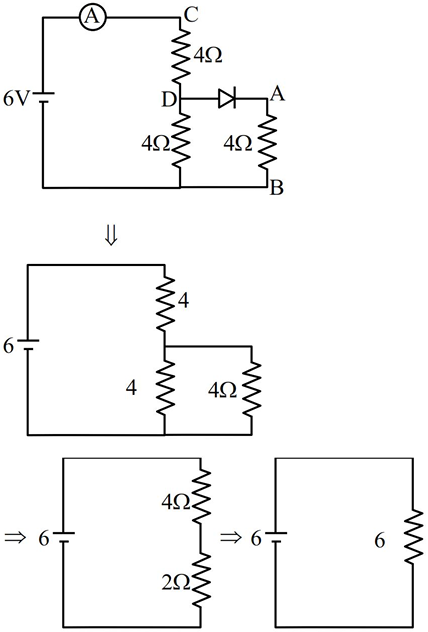
Current through ammeter $=1 A$
$
R_{net}=6 \Omega$
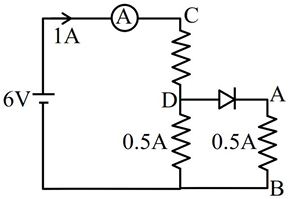
$
\begin{array}{l}
V_{AB}=0.5 \times 4=2 volt \\
V_{CD}=1 \times 4=4 volt
\end{array}
$
$A , B \& D$ are correct View full question & answer→MCQ 74 Marks
A solid sphere of mass ' $m$ ' and radius ' $r$ ' is allowed to roll without slipping from the highest point of an inclined plane of length ' $L$ ' and makes an angle $30^{\circ}$ with the horizontal. The speed of the particle at the bottom of the plane is $v _1$. If the angle of inclination is increased to $45^{\circ}$ while keeping L constant. Then the new speed of the sphere at the bottom of the plane is $v_2$. The ratio of $v_1{ }^2: v_2{ }^2$ is
- ✓
$1: \sqrt{2}$
- B
$1: 3$
- C
$1: 2$
- D
$1: \sqrt{3}$
AnswerCorrect option: A. $1: \sqrt{2}$
(A)
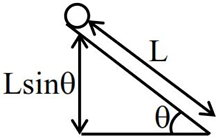 using WET
$
\begin{array}{l}
W_{g}=k_{f}-k_{i} \\
Mg L \sin \theta=k_{f}-k_{i} \\
\text { K.E. in pure rolling } \frac{1}{2} mV_{cm}^2+\frac{1}{2} I_{cm} \omega^2 \\
=\frac{1}{2} mV^2+\frac{1}{2} \times \frac{2}{5} mR^2 \frac{V^2}{R^2} \\
\frac{7}{10} mV^2 \\
mgL \sin \theta=\frac{7}{10} mV_{f}^2-0 \\
V_{f}^2 \propto \sin \theta \\
\left(\frac{V_1}{V_2}\right)^2=\frac{\sin \theta_1}{\sin \theta_2}=\frac{\sin 30^{\circ}}{\sin 45^{\circ}}=\frac{1}{\sqrt{2}}
\end{array}
$ View full question & answer→MCQ 84 Marks
What is the lateral shift of a ray refracted through a parallel-sided glass slab of thickness ' $h$ ' in terms of the angle of incidence ' $i$ ' and angle of refraction ' $r$ ', if the glass slab is placed in air medium ?
- A
$\frac{h \tan (i-r)}{\tan r}$
- B
$\frac{h \cos (i-r)}{\sin r}$
- C
- ✓
$\frac{h \sin (i-r)}{\cos r}$
AnswerCorrect option: D. $\frac{h \sin (i-r)}{\cos r}$
(D)
Formula base
$\frac{h \sin (i-r)}{\cos r}$
View full question & answer→MCQ 94 Marks
A gun fires a lead bullet of temperature 300 K into a wooden block. The bullet having melting temperature of 600 K penetrates into the block and melts down. If the total heat required for the process is 625 J , then the mass of the bullet is __________ grams.
(Latent heat of fusion of lead $=2.5 \times 10^4 JKg ^{-1}$ and specific heat capacity of lead $=125 JKg ^{-1} K^{-1}$ )
Answer(C)
$
\text { } \begin{aligned}
625 & =ms \Delta T+mL \\
625 & =m\left[125 \times 300+2.5 \times 10^4\right] \\
625 & =m[37500+25000] \\
625 & =m[62500] \\
m & =\frac{1}{100} kg \\
M & =10 \text { grams }
\end{aligned}
$
View full question & answer→MCQ 104 Marks
A point particle of charge Q is located at P along the axis of an electric dipole 1 at a distance $r$ as shown in the figure. The point P is also on the equatorial plane of a second electric dipole 2 at a distance $r$. The dipoles are made of opposite charge $q$ separated by a distance 2 a . For the charge particle at P not to experience any net force, which of the following correctly describes the situation ?
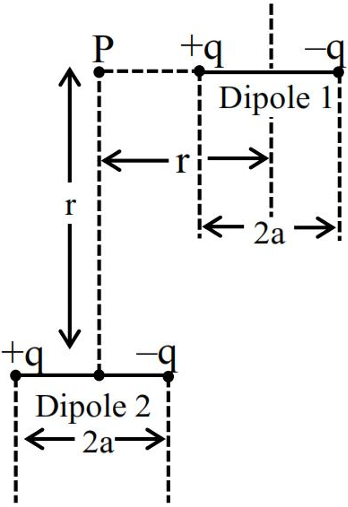
AnswerCorrect option: D. $\frac{a}{r} \sim 3$
(D)
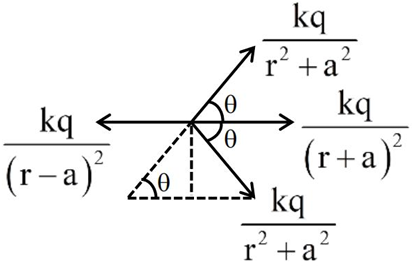
$\begin{array}{l}\frac{ kq }{( r - a )^2}=\frac{ kq }{( r + a )^2}+\frac{2 kq }{\left( r ^2+ a ^2\right)} \cos \theta \\ \frac{1}{( r - a )^2}=\frac{1}{( r + a )^2}+\frac{2 a }{\left( r ^2+ a ^2\right)^{\frac{3}{2}}} \\ \frac{1}{( r - a )^2}-\frac{1}{( r + a )^2}=\frac{2 a }{\left( r ^2+ a ^2\right)^{\frac{3}{2}}} \\ \frac{4 ra }{\left( r ^2- a ^2\right)^2}=\frac{2 a }{\left( r ^2+ a ^2\right)^{\frac{3}{2}}} \\ \Rightarrow \frac{2 r }{\left( r ^2- a ^2\right)^2}=\frac{1}{\left( r ^2+ a ^2\right)^{\frac{3}{2}}}\end{array}$
$\begin{array}{l}\frac{4 r^2}{\left(r^2-a^2\right)^4}=\frac{1}{\left(r^2+a^2\right)^3} \\ \Rightarrow 4 r^2\left(r^2+a^2\right)^3=\left(r^2-a^2\right)^4 \\ 4 r^8\left(1+\frac{a^2}{r^2}\right)^3=r^8\left(1-\frac{a^2}{r^2}\right)^4 \\ 4\left(1+\frac{a^2}{r^2}\right)^3=\left(1-\frac{a^2}{r^2}\right)^4\end{array}$
Exact value cannot be solved in exam for this equation to be true
$
\left|\frac{a}{r}\right|>1 \Rightarrow a>r
$
But point charge $Q$ lies between charges of dipole 1 hence electric field cannot be zero.There for it should be bonus.
But by solving from mathematical software we are getting $a / r \approx 3$. View full question & answer→MCQ 114 Marks
Consider a moving coil galvanometer (MCG) :
A : The torsional constant in moving coil galvanometer has dimensions $\left[ ML ^2 T^{-2}\right]$
B : Increasing the current sensitivity may not necessarily increase the voltage sensitivity.
C : If we increase number of turns $( N )$ to its double $(2 N)$, then the voltage sensitivity doubles.
D : MCG can be converted into an ammeter by introducing a shunt resistance of large value in parallel with galvanometer.
E : Current sensitivity of MCG depends inversely on number of turns of coil.
Choose the correct answer from the options given below :
Answer(A)
(A) $\tau= C \theta \Rightarrow\left[ ML ^2 T^{-2}\right]=[ C ][1]$
(B) $C \cdot S =\frac{\theta}{ I }=\frac{ BNA }{ C }$;
V.S. $=\frac{ BNA }{ RC }[ R$ also depends on ' N ' $]$
(C) V.S. $\propto \frac{ NAB }{ CR } \quad R \rightarrow NR$
(D) False [Theory]
(E) E [False]
C. $S \propto N$$
\Rightarrow \because C . S .=\frac{NAB}{C}
$
View full question & answer→MCQ 124 Marks
Match the list - i with list - ii
| LIST - I | LIST - II |
| A. Pressure varies inversely with volume of an ideal gas. | I.Adiabatic process |
| B. Heat absorbed goes partly to increase internal energy and partly to do work. | II. Isochoric process |
| C. Heat is neither absorbed nor released by a system | III. Isothermal process |
| D.No work is done on or by a gas | IV. Isobaric brocess |
Choose the correct answer from the option given below :
Answer(D)$
\begin{array}{l}
A \rightarrow P \propto \frac{1}{V} \\
\Rightarrow PV=\text { constant } \\
\Rightarrow nRT=\text { const. } \Rightarrow T=\text { const. }
\end{array}
$
Hence Isothermal III
B $\rightarrow$ IV
$W \neq 0, \Delta U \neq 0, \Delta Q \neq 0$ [only isobaric]
$C \rightarrow I \Delta Q =0$ Adiabatic
$D \rightarrow$ II w$=0$ Isochoric
III IV I II
View full question & answer→MCQ 134 Marks
The position of a particle moving on $x$-axis is given by $x(t)=A \sin t+B \cos ^2 t+ Ct ^2+D$, where $t$ is time. The dimension of $\frac{A B C}{D}$ is-
- A
- B
$L^3 T^{-2}$
- ✓
$L ^2 T^{-2}$
- D
$L^2$
AnswerCorrect option: C. $L ^2 T^{-2}$
(C)
Dimension $[x(t)]=[L]$
$
\begin{array}{l}
{[ A ]=[L]} \\
{[B]=[L]} \\
{[ C ]=\left[LT^{-2}\right]} \\
{[ D ]=[L]} \\
{\left[\frac{ABC}{D}\right]=\left[\frac{L \times L \times LT^{-2}}{L}\right]=\left[L^2 T^{-2}\right]}
\end{array}
$
View full question & answer→MCQ 144 Marks
Identify the valid statements relevant to the given circuit at the instant when the key is closed.
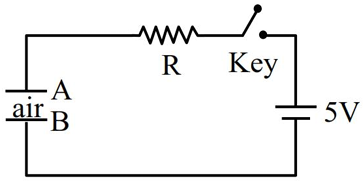
A. There will be no current through resistor R.
B. There will be maximum current in the connecting wires.
C. Potential difference between the capacitor plates A and B is minimum.
D. Charge on the capacitor plates is minimum.Choose the correct answer from the options given below :
Answer(B)
Initially capacitor behave as a short circuit.
So current will be maximum.
Charge on capacitor will be zero.
Potential difference across capacitor will be zero.
View full question & answer→MCQ 154 Marks
A radioactive nucleus $n_2$ has 3 times the decay constant as compared to the decay constant of another radioactive nucleus $n_1$. If initial number of both nuclei are the same, what is the ratio of number of nuclei of $n_2$ to the number of nuclei of $n _1$, after one half-life of $n _1$ ?
AnswerCorrect option: A. $1 / 4$
(A)
$
\begin{array}{l}
N_2=N_0 e^{-3 \lambda t} \\
N_1=N_0 e^{-\lambda t} \\
\frac{N_2}{N_1}=e^{-2 \lambda t} \\
t_{\text {balf lifeon } N_{t}} t=\frac{\ln 2}{\lambda}{ }_{n} 1 \\
\frac{N_0}{2}=N_0 e^{-\lambda t} \\
\lambda t=\ln 2 \\
t=\frac{\ln 2}{\lambda} \\
=e^{-2 \lambda \cdot \frac{\ln 2}{\lambda}} \\
\frac{N_2}{N_1}=\frac{1}{4}
\end{array}
$
View full question & answer→MCQ 164 Marks
A spherical surface of radius of curvature $R$, separates air from glass (refractive index $=1.5$ ). The centre of curvature is in the glass medium. A point object ' O ' placed in air on the optic axis of the surface, so that its real image is formed at ' I ' inside glass. The line OI intersects the spherical surface at P and $PO = PI$. The distance PO equals to-
Answer(A)
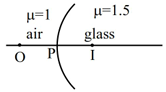
$\begin{array}{l} PO = u =- x \\ PI = v = x \\ PO = PI \\ \frac{\mu_2}{ v }-\frac{\mu_1}{ u }=\frac{\mu_2-\mu_1}{ R } \\ \frac{1.5}{ x }+\frac{1}{ x }=\frac{1}{2 R } \\ \frac{5}{2 x }=\frac{1}{2 R } \\ X =5 R \end{array}$ View full question & answer→MCQ 174 Marks
A sub-atomic particle of mass $10^{-30} kg$ is moving with a velocity $2.21 \times 10^6 m / s$. Under the matter wave consideration, the particle will behave closely like __________. $\left( h =6.63 \times 10^{-34} J . s \right)$
Answer(B)
$
\begin{array}{l}
\lambda=\frac{h}{p}=\frac{6.63 \times 10^{-34}}{10^{-30} \times 2.21 \times 10^6} \\
=3 \times 10^{-10} m
\end{array}
$
Hence particle will behave as x-ray.
View full question & answer→MCQ 184 Marks
Given below are two statements :
Statement - I : The hot water flows faster than cold water.
Statement-II : Soap water has higher surface tension as compared to fresh water.
In the light above statements, choose the correct answer from the options given below
- A
Statement-I is false but Statement II is true
- ✓
Statement-I is true but Statement II is false
- C
Both Statement-I and Statement-II are true
- D
Both Statement-I and Statement-II are false
AnswerCorrect option: B. Statement-I is true but Statement II is false
(B)
Hot water is less viscous then cold water.
Surfactant reduces surface tension.
View full question & answer→MCQ 194 Marks
A light hollow cube of side length 10 cm and mass 10 g , is floating in water. It is pushed down and released to execute simple harmonic oscillations. The time period of oscillations is $y \pi \times 10^{-2} s$, where the value of $y$ is (Acceleration due to gravity, $g=10 m / s ^2$, density of water $=10^3 kg / m ^3$ )
Answer(A)
$a^2 x \rho g=m a_{\text {net }}$
$
\begin{array}{l}
\frac{L^2 \rho g}{m} x=a_{\text {net }} \\
T=2 \pi \sqrt{\frac{m}{L^2 \rho g}}
\end{array}
$
where $m =10 g, L =10 cm, \rho=1000 kg / m ^3$
View full question & answer→MCQ 204 Marks
Regarding self-inductance :
A : The self-inductance of the coil depends on its geometry.
B : Self-inductance does not depend on the permeability of the medium.
C : Self-induced e.m.f. opposes any change in the current in a circuit.
D : Self-inductance is electromagnetic analogue of mass in mechanics.
E : Work needs to be done against self-induced e.m.f. in establishing the current.
Choose the correct answer from the options given below:
Answer(B)
Self inductance of coil
$
L=\frac{\mu_0 N^2 A}{2 \pi R}
$
View full question & answer→