Question
Consider a neutron and an electron bound to each other due to gravitational force. Assuming Bohr's quantization rule for angular momentum to be valid in this case, derive an expression for the energy of the neutron-electron system.

Answer

$\text{m}_\text{e}\text{Vr}=\frac{\text{nh}}{2\pi}\ ...(\text{i})$

$\frac{\text{GM}_\text{n}\text{M}_\text{e}}{\text{r}^2}=\frac{\text{m}_\text{e}\text{V}^2}{\text{r}}$

$\frac{\text{GM}_\text{n}}{\text{r}}=\text{v}^2\ ...(\text{ii})$

Squaring (ii) and dividing it with (i)

$\frac{\text{m}_\text{e}^2\text{v}^2\text{r}^2}{\text{v}^2}=\frac{\text{n}^2\text{h}^2\text{r}}{4\pi^2\text{Gm}_\text{n}}$

$\text{me}^2\text{r}=\frac{\text{n}^2\text{h}^2\text{r}}{4\pi^2\text{Gm}_\text{n}}$

$\text{r}=\frac{\text{n}^2\text{h}^2\text{r}}{4\pi^2\text{Gm}_\text{n}\text{me}^2}$

$\text{v}=\frac{\text{nh}}{2\pi\text{rm}_\text{e}}$ [from (i)]

$\text{v}=\frac{\text{nh4}\pi^2\text{GM}_\text{n}\text{M}^2_\text{e}}{2\pi\text{M}_\text{e}\text{n}^2\text{h}^2}=\frac{2\pi\text{GM}_\text{n}\text{M}_\text{e}}{\text{nh}}$

$\text{KE}=\frac{1}{2}\text{m}_\text{e}\text{V}^2$

$=\frac{1}{2}\text{m}_\text{e}\frac{\big(2\pi\text{GM}_\text{n}\text{M}_\text{e}\big)^2}{\text{nh}}=\frac{4\pi^2\text{G}^2\text{M}^2_\text{n}\text{M}^3_\text{e}}{2\text{n}^2\text{h}^2}$

$\text{PE}=\frac{-\text{GM}_\text{n}\text{M}_\text{e}}{\text{r}}$

$=\frac{-\text{GM}_\text{n}\text{M}_\text{e}4\pi^2\text{GM}_\text{n}\text{M}^2_\text{e}}{\text{n}^2\text{h}^2}=\frac{-4\pi^2\text{G}^2\text{M}^2_\text{n}\text{M}^3_\text{e}}{\text{n}^2\text{h}^2}$

Total energy $=\text{KE}+\text{PE}=\frac{2\pi^2\text{G}^2\text{M}^2_\text{n}\text{M}^3_\text{e}}{2\text{n}^2\text{h}^2}$

Need a full question paper?

Generate a complete, print-ready paper with questions like this in minutes — across 16+ boards, with answer keys.
Start Generating Free

Similar questions

A regular polygon of n sides is formed by bending a wire of total length $27\pi\text{r}$ which carries a current i.
  1. Find the magnetic field B at the centre of the polygon.
  2. By letting $\text{n}\rightarrow\infty,$ deduce the expression for the magnetic field at the centre of a circular current.
A car weighs 1800 kg . The distance between its front and back axles is 1.8 m . Its centre of gravity is 1.05 m behind the front axle. Determine the force exerted by the level ground on each front wheel and each back wheel.
A vessel of volume V0 contains an ideal gas at pressure P0 and temperature T. Gas is continuously pumped out of this vessel at a constant volume-rate dV I dt = r keeping the temperature constant. The pressure of the gas being taken out equals the pressure inside the vessel. Find, (1) the pressure of the gas as a function of time. (2) the time taken before half the original gas is pumped out.
A star of mass twice the solar mass and radius 106km rotates about its axis with an angular speed of 10‑6 rad per sec. What is the angular speed of the star when it collapses (due to inward gravitational forces) to a radius of 104km? Solar mass = 1.99 × 10²³kg.
Explain the reason for capillarity and mention some practical examples based on capillarity.
If x, y and z are distances moved by a particle moving with a constant acceleration during the lth, mth and nth second of its motion respectively. Show that,
x(m - n) + y(n - l) + z(l - m) = 0
Define gravitational potential energy of a body. Derive an expression for the gravitational potential energy of a body of mass 'm' located at a distance 'r' from the centre of the earth.
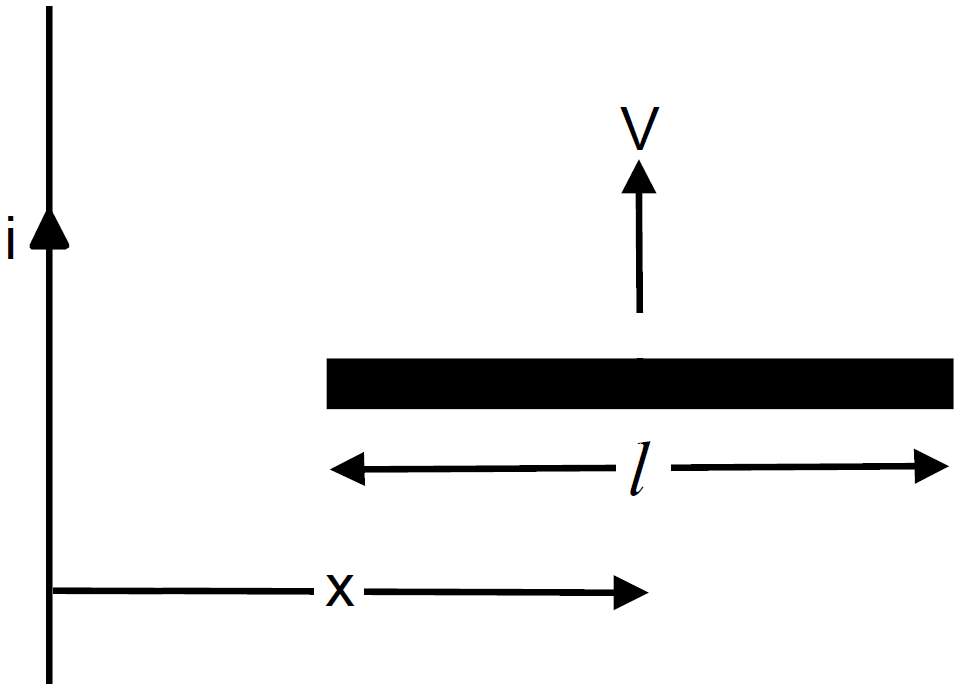
Figure shows a straight, long wire carrying a current i and a rod of length l coplanar with the wire and perpendicular to it. The rod moves with a constant velocity v in a direction parallel to the wire. The distance of the wire from the centre of the rod is x. Find motional emf induced in the rod.

Write Pascal's law and verify it. Write the names of two devices working on this basis and describe them.
A venturimeter is connected to two points in the mains where its radii are 20cm and 10cm, respectively, and the levels of water column in the tubes differ by 10cm. How much water flows through the pipe per minute?