Question
Consider a neutron and an electron bound to each other due to gravitational force. Assuming Bohr's quantization rule for angular momentum to be valid in this case, derive an expression for the energy of the neutron-electron system.

Answer

$\text{m}_\text{e}\text{Vr}=\frac{\text{nh}}{2\pi}\ ...(\text{i})$
$\frac{\text{GM}_\text{n}\text{M}_\text{e}}{\text{r}^2}=\frac{\text{m}_\text{e}\text{V}^2}{\text{r}}$
$\frac{\text{GM}_\text{n}}{\text{r}}=\text{v}^2\ ...(\text{ii})$
Squaring (ii) and dividing it with (i)
$\frac{\text{m}_\text{e}^2\text{v}^2\text{r}^2}{\text{v}^2}=\frac{\text{n}^2\text{h}^2\text{r}}{4\pi^2\text{Gm}_\text{n}}$
$\text{me}^2\text{r}=\frac{\text{n}^2\text{h}^2\text{r}}{4\pi^2\text{Gm}_\text{n}}$
$\text{r}=\frac{\text{n}^2\text{h}^2\text{r}}{4\pi^2\text{Gm}_\text{n}\text{me}^2}$
$\text{v}=\frac{\text{nh}}{2\pi\text{rm}_\text{e}}$ [from (i)]
$\text{v}=\frac{\text{nh4}\pi^2\text{GM}_\text{n}\text{M}^2_\text{e}}{2\pi\text{M}_\text{e}\text{n}^2\text{h}^2}=\frac{2\pi\text{GM}_\text{n}\text{M}_\text{e}}{\text{nh}}$
$\text{KE}=\frac{1}{2}\text{m}_\text{e}\text{V}^2$
$=\frac{1}{2}\text{m}_\text{e}\frac{\big(2\pi\text{GM}_\text{n}\text{M}_\text{e}\big)^2}{\text{nh}}=\frac{4\pi^2\text{G}^2\text{M}^2_\text{n}\text{M}^3_\text{e}}{2\text{n}^2\text{h}^2}$
$\text{PE}=\frac{-\text{GM}_\text{n}\text{M}_\text{e}}{\text{r}}$
$=\frac{-\text{GM}_\text{n}\text{M}_\text{e}4\pi^2\text{GM}_\text{n}\text{M}^2_\text{e}}{\text{n}^2\text{h}^2}=\frac{-4\pi^2\text{G}^2\text{M}^2_\text{n}\text{M}^3_\text{e}}{\text{n}^2\text{h}^2}$
Total energy $=\text{KE}+\text{PE}=\frac{2\pi^2\text{G}^2\text{M}^2_\text{n}\text{M}^3_\text{e}}{2\text{n}^2\text{h}^2}$

Need a full question paper?

Generate a complete, print-ready paper with questions like this in minutes — across 16+ boards, with answer keys.
Start Generating Free

Similar questions

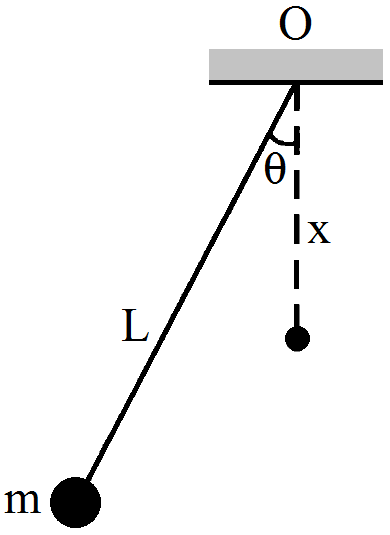
A simple pendulum of length L having a bob of mass m is deflected from its rest position by an angle $\theta$ and released (figure). The string hits a peg which is fixed at a distance x below the point of suspension and the bob starts going in a circle centred at the peg.
  1. Assuming that initially the bob has a height less than the peg, show that the maximum height reached by the bob equals its initial height.
  2. If the pendulum is released with $\theta=90^\circ$ and $\text{x}=\frac{\text{L}}{2}$ find the maximum height reached by the bob above its lowest position before the string becomes slack.
  3. Find the minimum value of $\frac{\text{x}}{\text{L}}$ for which the bob goes in a complete circle about the peg when the pendulum is released from $\theta=90^\circ.$
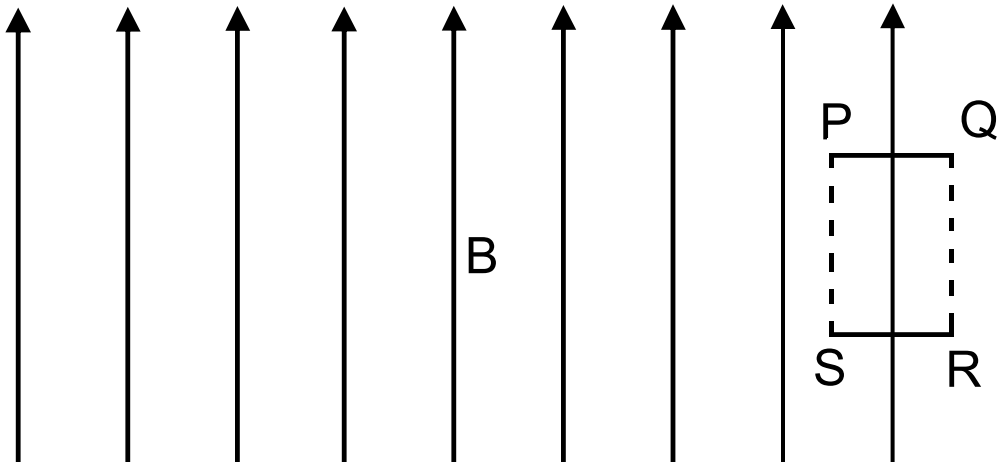
Sometimes we show an idealised magnetic field which is uniform in a given region and falls to zero abruptly. One such field is represented in figure. Using Ampere's law over the path PQRS, show that such a field is not possible.
The densities of wood and benzene at $0^{\circ} \mathrm{C}$ are $880 \mathrm{~kg} \mathrm{~m}^{-3}$ and $900 \mathrm{~kg} \mathrm{~m}^{-3}$ respectively. The coefficients of volume expansion are $1.2 \times 10^{-3}{ }^{\circ} \mathrm{C}^{-1}$ for wood and $1.5 \times 10^{-3}{ }^{\circ} \mathrm{C}^{-1}$ for benzene. At what temperature will a piece of wood just sink in benzene?
How many wavelengths are emitted by atomic hydrogen in visible range (380nm-780nm)? In the range 50nm to 100nm?
A hollow metallic sphere of radius 20cm surrounds a concentric metallic sphere of radius 5cm. The space between the two spheres is filled with a nonmetallic material. The inner and outer spheres are maintained at $50^\circ C$ and $10^\circ C$ respectively and it is found that 100J of heat passes from the inner sphere to the outer sphere per second. Find the thermal conductivity of the material between the spheres.
In a Young's double slit experiment, the separation between the slits = 2.0mm, the wavelength of the light = 600nm and the distance of the screen from the slits = 2.0m. If the intensity at the centre of the central maximum is $0.20W/ m^2,$ what will be the intensity at a point 0.5cm away from this centre along the width of the fringes?
Two large conducting plates are placed parallel to each other with a separation of 2.00cm between them. An electron starting from rest near one of the plates reaches the other plate in 2.00 microseconds. Find the surface charge density on the inner surfaces.
An empty plastic box of mass m is found to accelerate up at the rate of $\frac{\text{g}}{6}$ when placed deep inside water. How much sand should be put inside the box so that it may accelerate down at the rate of $\frac{\text{g}}{6}?$
Write the expression for the force, $\vec{\text{F}}$ acting on a charged particle of charge ‘q’, moving with a velocity $\vec{\text{v}}$ in the presence of both electric field $\vec{\text{E}}$ and magnetic field $\vec{\text{B}}$. Obtain the condition under which the particle moves undeflected through the fields.
How is the working of a telescope different from that of a microscope?
The focal lengths of the objective and eyepiece of a microscope are 1.25 cm and 5 cm respectively. Find the position of the object relative to the objective in order to obtain an angular magnification of 30 in normal adjustment.