How is the working of a telescope different from that of a microscope?
The focal lengths of the objective and eyepiece of a microscope are 1.25 cm and 5 cm respectively. Find the position of the object relative to the objective in order to obtain an angular magnification of 30 in normal adjustment.
The focal lengths of the objective and eyepiece of a microscope are 1.25 cm and 5 cm respectively. Find the position of the object relative to the objective in order to obtain an angular magnification of 30 in normal adjustment.
CBSE DELHI - SET 1 2012
Download our app for free and get started
Working differences:
Given: $\text{f}_{o} = 1.25\text{cm}$
$\text{f}_{e} = 5 \text{cm}$
Angular magnification m= 30
Now, $m = m_e \times m_o$
In normal adjustment, angular magnification of eyepiece
$\text{m}_{e} = \text{d} / \text{f}_{e} = + \frac{25}{5} = 5 $
Hence, $m_o = 6$
But $\text{m}_{o} = \frac{\text{v}_{o}}{\text{u}_{o}} = > -6 =\frac{\text{v}_{o}}{\text{u}_{o}}$
$ = > \text{v}_{o} = - 6 \text{u}_{o}$
Applying lens equation to the objective lens:
$\frac{1}{\text{f}_{o}} = \frac{1}{\text{v}_{o}} - \frac{1}{\text{u}_{o}}$
$\frac{1}{1.25} = \frac{1}{-6\text{u}_{o}} - \frac{1}{\text{u}_{o}}$
$\frac{1}{1.25} = \frac{-1-6}{6\text{u}_{o}}$
$6\text{u}_{o} = 1.25\times(-7)$
$\text{u}_{o} = \frac{-1.25\times7}{6}\text{ cm}$
$ = - 1.46\text{cm}.$
- Objective of a telescope forms the image of a very far off object at, or within, the focus of its eyepiece. The microscope does the same for a small object kept just beyond the focus of its objective.
- The final image formed by a telescope is magnified relative to its size as seen by the unaided eye while the final image formed by a microscope is magnified relative to its absolute size.
- The objective of a telescope has large focal length & large aperture while the corresponding for a microscope have very small values.
| Telescope | Microscope |
|
|
$\text{f}_{e} = 5 \text{cm}$
Angular magnification m= 30
Now, $m = m_e \times m_o$
In normal adjustment, angular magnification of eyepiece
$\text{m}_{e} = \text{d} / \text{f}_{e} = + \frac{25}{5} = 5 $
Hence, $m_o = 6$
But $\text{m}_{o} = \frac{\text{v}_{o}}{\text{u}_{o}} = > -6 =\frac{\text{v}_{o}}{\text{u}_{o}}$
$ = > \text{v}_{o} = - 6 \text{u}_{o}$
Applying lens equation to the objective lens:
$\frac{1}{\text{f}_{o}} = \frac{1}{\text{v}_{o}} - \frac{1}{\text{u}_{o}}$
$\frac{1}{1.25} = \frac{1}{-6\text{u}_{o}} - \frac{1}{\text{u}_{o}}$
$\frac{1}{1.25} = \frac{-1-6}{6\text{u}_{o}}$
$6\text{u}_{o} = 1.25\times(-7)$
$\text{u}_{o} = \frac{-1.25\times7}{6}\text{ cm}$
$ = - 1.46\text{cm}.$

Download our appand get started for free
Experience the future of education. Simply download our apps or reach out to us for more information. Let's shape the future of learning together!No signup needed.*
Similar Questions
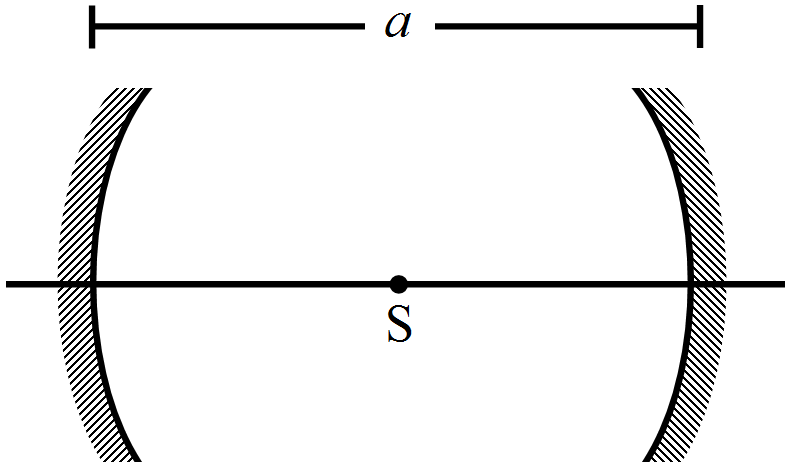
- 1View SolutionA point source S is placed midway between two converging mirrors having equal focal length f. Find the values of d for which only one image is formed.
- 2A point object 'O' is kept in a medium of refractive index $n_1$ in front of a convex spherical surface of radius of curvature R which separates the second medium of refractive index $n_2$ from the first one, as shown in the figure.View Solution
- Draw the ray diagram showing the image formation and deduce the relationship between the object distance and the image distance in terms of $n_1, n_2$ and R.
- When the image formed above acts as a virtual object for concave spherical, surface separating the medium $n_2$ from $n_1 (n_2> n_1)$, draw this ray diagram and write the similar (similar to (a) relation. Hence obtain the expression for the lens maker's formula.
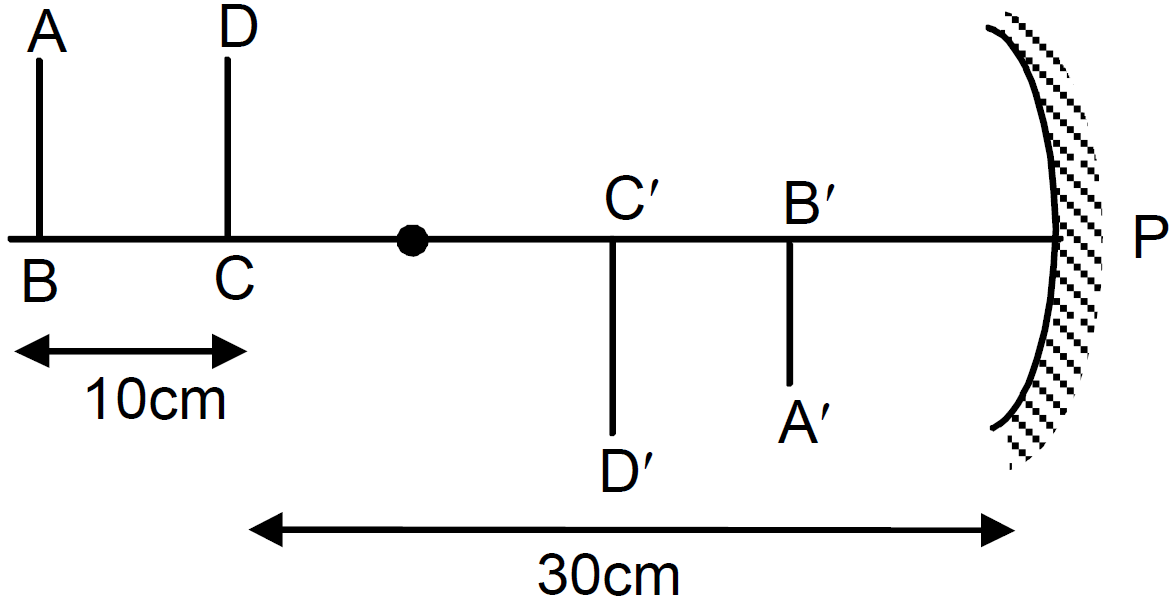
- 3View SolutionA U-shaped wire is placed before a concave mirror having radius of curvature 20cm. Find the total length of the image.
- 4The refractive index of a material $M_1$ changes by 0.014 and that of another material $M_2$ changes by 0.024 as the colour of the light is changed from red to violet. Two thin prisms one made of $M_1(A = 5.3^\circ)$ and other made of $M_2(A = 3.7^\circ)$ are combined with their refracting angles oppositely directed.View Solution
- Find the angular dispersion produced by the combination.
- The prisms are now combined with their refracting angles similarly directed. Find the angular dispersion produced by the combination.
- 5View SolutionA small object is placed at the centre of the bottom of a cylindrical vessel of radius 3cm and height 4cm filled completely with water. Consider the ray leaving the vessel through a corner. Suppose this ray and the ray along the axis of the vessel are used to trace the image. Find the apparent depth of the image and the ratio of real depth to the apparent depth under the assumptions taken. Refractive index of water = 1.33
- 6View SolutionMrs. Rashmi Singh broke her reading glasses. When she went to the shopkeeper to order new spects, he suggested that she should get spectacles with plastic lenses instead of glass lenses. On getting the new spectacles, she found that the new ones were thicker than the earlier ones. She asked this question to the shopkeeper but he could not offer satisfactory explanation for this. At home, Mrs. Singh raised the same question to her daughter Anuja who explained why plastic lenses were thicker.
- Write two qualities displayed each by Anuja and her mother.
- How do you explain this fact using lens maker's formula?
- 7View SolutionA Cassegrain telescope uses two mirrors. Such a telescope is built with the mirrors 20 mm apart. If the radius of curvature of the large mirror is 220 mm and the small mirror is 140 mm, where will the final image of an object at infinity be?
- 8View SolutionAn angular magnification (magnifying power) of 30X is desired using an objective of focal length 1.25 cm and an eyepiece of focal length 5 cm. How will you set up the compound microscope?
- 9View SolutionAn object 1.5 cm in size is placed on the side of the convex lens in the arrangement (a) above. The distance between the object and the convex lens is 40 cm. Determine the magnification produced by the two-lens system, and the size of the image.
- 10View SolutionA concave mirror forms an image of 20cm high object on a screen placed 5.0m away from the mirror. The height of the image is 50cm. Find the focal length of the mirror and the distance between the mirror and the object.