MCQ
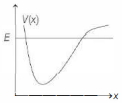
Consider a one-dimensional potential $V(x)$ as shown in the figure below. A classical particle of mass $m$ moves under its influence and has total energy $E$ as shown below. The motion is
  • A
    non-periodic
  • B
    stationary
  • periodic but not a simple harmonic
  • D
    simple harmonic

Answer

Correct option: C.
periodic but not a simple harmonic
c
(c)

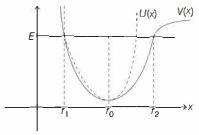
Given, potential energy curve closely represents potential energy of a simple harmonic oscillator $\left(U=\frac{1}{2} k x^2\right.$, shown in dotted line $)$

In region $r_1 < x < r_2$, the potential energy is less than total energy, so motion of particle in this region is oscillatory.

Also, the potential energy curve is not symmetric about $x=r_{\text {. }}$.

$\therefore$ Motion is not a simple harmonic.

Need a full question paper?

Generate a complete, print-ready paper with questions like this in minutes — across 16+ boards, with answer keys.

Start Generating Free

Similar questions

An engine is supposed to operate between two reservoirs at temperature $727°C$ and $227°C.$ The maximum possible efficiency of such an engine is
The coefficient of linear expansion of brass and steel are ${\alpha _1}$ and ${\alpha _2}$. If we take a brass rod of length ${l_1}$ and steel rod of length ${l_2}$ at $0°C$, their difference in length $({l_2} - {l_1})$ will remain the same at a temperature if
A constant power is supplied to a rotating disc. Angular velocity $\left( \omega  \right)$ of disc varies with number of rotations $(n)$ made by the disc as
A string of mass 2.5kg is under a tension of 200N. The length of the stretched string is 20.0m. If the transverse jerk is struck at one end of the string, the disturbance will reach the other end in:
  1. One second
  2. 0.5 second
  3. 2 seconds
  4. Data given is insufficient.
Three different objects of masses ${m_1},{m_2}$ and ${m_3}$ are allowed to fall from rest and from the same point $‘O’$ along three different frictionless paths. The speeds of the three objects, on reaching the ground, will be in the ratio of
A missile is fired in horizontal direction from a height of $20\,m$ at a speed of $1000\, m/s.$ At what distance of ground will the missile land ?
In a collinear collision, a particle with an initial speed $v_0$ strikes a stationary particle of the same mass. If the final total kinetic energy is $50\%$ greater than the original kinetic energy, the magnitude of the relative velocity between the two particles, after collision, is:
When you speak to your friend, which of the following parameters have a unique value in the sound produced?
  1. Frequency.
  2. Wavelength.
  3. Amplitude.
  4. Wave velocity.
A rope 1cm in diameter breaks if the tension in it exceeds 500N. The maximum tension that may be given to a similar rope of diameter 2cm is:
  1. 500N
  2. 250N
  3. 1000N
  4. 2000N.
A particle is executing simple harmonic motion $(SHM)$ of amplitude $A,$ along the $x-$ axis, about $x = 0.$ When its potential energy $(PE)$ equals kinetic energy $(KE),$ the position of the particle will be