MCQ
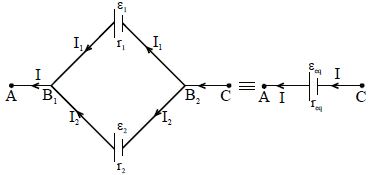
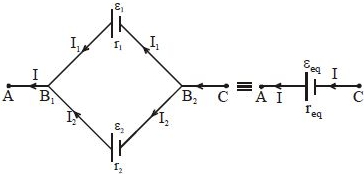
Consider a parallel combination of the cellsshown in the figure.The potential difference in between $B_1$ and $B_2$ is
  • ${\rm{V  =  }}{\varepsilon _{eq}} - I{r_{eq}}$
  • B
    ${\rm{V  =  }}{\varepsilon _2} - I{r_2}$
  • C
    ${\rm{V  =  }}{2\varepsilon _{eq}} - I{r_{eq}}$
  • D
    ${\rm{V  =  }}{\varepsilon _1} - 2I{r_1}$

Answer

Correct option: A.
${\rm{V  =  }}{\varepsilon _{eq}} - I{r_{eq}}$
a
$\mathrm{I}=\mathrm{I}_{1}+\mathrm{I}_{2}$

$I_{1}=\frac{\varepsilon_{2}-V}{r_{1}} \Rightarrow I_{2}=\frac{\varepsilon_{2}-V}{r_{2}}$

Combining the last three equations

$\mathrm{I}=\mathrm{I}_{1}+\mathrm{I}_{2}=\frac{\varepsilon_{1}-\mathrm{V}}{\mathrm{r}_{1}}+\frac{\varepsilon_{2}-\mathrm{V}}{\mathrm{r}_{2}}$

$=\left(\frac{\varepsilon_{1}}{\mathrm{r}_{1}}+\frac{\varepsilon_{2}}{\mathrm{r}_{2}}\right)-\mathrm{V}\left(\frac{1}{\mathrm{r}_{1}}+\frac{1}{\mathrm{r}_{2}}\right)$

Hence, $\mathrm{V}$ is given by, $\mathrm{V}=\frac{\varepsilon_{1} \mathrm{r}_{2}+\varepsilon_{2} \mathrm{r}_{1}}{\mathrm{r}_{1}+\mathrm{r}_{2}}-\mathrm{I} \frac{\mathrm{r}_{1} \mathrm{r}_{2}}{\mathrm{r}_{1}+\mathrm{r}_{2}}$

If we want to replace the combination by a single cell, between $\mathrm{B}_{1}$ and $\mathrm{B}_{2}$ of emf $\varepsilon_{\mathrm{eq}}$ and internal resistance $\mathrm{r}_{\mathrm{eq}},$

we would have $\mathrm{V}=\varepsilon_{\mathrm{eq}}-\mathrm{Ir}_{\mathrm{eq}}$
Need a full question paper?

Generate a complete, print-ready paper with questions like this in minutes — across 16+ boards, with answer keys.

Start Generating Free

Similar questions

Two light sources are said to be coherent if they are obtained from
The refractive index of water is $1.33.$ What will be the speed of light in water
In $X-$ ray spectrum wavelength  $\lambda$ of line ${K_\alpha }$ depends on atomic number $Z$ as
A distant hot air balloon subtends $0.25^o$ at the objective lens of an astronomical teleseope. The image subtends $1.5^o$ at  eyepiece when viewed with relaxed eye.The objective and eyepiece are in a $35\  cm$ long tube. Find the focal length of the eyepiece lens.....$cm$
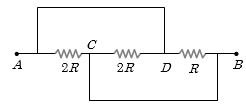
What is the equivalent resistance between $A$ and $B$
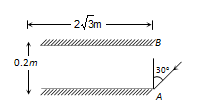
Two plane mirrors. A and B are aligned parallel to each other, as shown in the figure. A light ray is incident at an angle of 30° at a point just inside one end of A. The plane of incidence coincides with the plane of the figure. The maximum number of times the ray undergoes reflections (including the first one) before it emerges out is
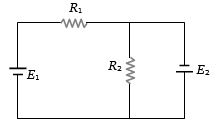
Two resistances ${R_1}$ and ${R_2}$ are joined as shown in the figure to two batteries of $e.m.f.$ ${E_1}$ and ${E_2}$. If ${E_2}$ is short-circuited, the current through ${R_1}$ is
A particle is rotated in a vertical circle by connecting it to a string of length l and keeping the other end of the string fixed. The minimum speed of the particle when the string is horizontal for which the particle will complete the circle is:
In the middle of the depletion layer of a reverse-biased PN junction, the
If the forward voltage in a semiconductor diode is doubled, the width of the depletion layer will