Consider a parallel plate capacitor of $10\,\mu \,F$ (micro-farad) with air filled in the gap between the plates. Now one half of the space between the plates is filled with a dielectric of dielectric constant $4$, as shown in the figure. The capacity of the capacitor changes to.......$\mu \,F$
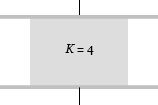
Medium
Download our app for free and get started
(a) ${C_1} = \frac{{{\varepsilon _0}\left( {\frac{A}{4}} \right)}}{d},\,{C_2} = \frac{{K{\varepsilon _0}\left( {\frac{A}{2}} \right)}}{d},\,{C_3} = \frac{{{\varepsilon _0}\left( {\frac{A}{4}} \right)}}{d}$
${C_{eq}} = {C_1} + {C_2} + {C_3} = \left( {\frac{{K + 1}}{2}} \right)\frac{{{\varepsilon _0}A}}{d}$$ = \left( {\frac{{4 + 1}}{2}} \right) \times 10 = 25\,\mu F$
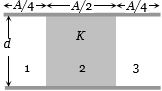
${C_{eq}} = {C_1} + {C_2} + {C_3} = \left( {\frac{{K + 1}}{2}} \right)\frac{{{\varepsilon _0}A}}{d}$$ = \left( {\frac{{4 + 1}}{2}} \right) \times 10 = 25\,\mu F$

Download our appand get started for free
Experience the future of education. Simply download our apps or reach out to us for more information. Let's shape the future of learning together!No signup needed.*
Similar Questions
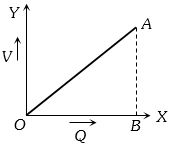
- 1Change $Q$ on a capacitor varies with voltage $V$ as shown in the figure, where $Q$ is taken along the $X$-axis and $V$ along the $Y$-axis. The area of triangle $OAB$ representsView Solution
- 2Two parallel plates have equal and opposite charge. When the space between them is evacuated, the electric field between the plates is $2 \times {10^5}\,V/m$. When the space is filled with dielectric, the electric field becomes $1 \times {10^5}\,V/m$. The dielectric constant of the dielectric materialView Solution
- 3View SolutionWhen a lamp is connected in series with capacitor, then
- 4A parallel plate capacitor is charged and then disconnected from the source steady $E.M.F.$ The plates are then drawn apart farther. Again it is connected to the same source. Then :View Solution
- 5An alpha particle is accelerated through a potential difference of ${10^6}\,volt$. Its kinetic energy will be......$MeV$View Solution
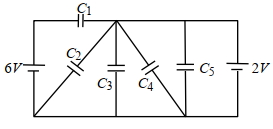
- 6In the following circuit $C_1=12 \mu F, C_2=C_3=4 \mu F$ and $C_4=C_5=2 \mu F$. The Charge stored in $C_3$ is. . . . . $\mu C$.View Solution
- 7If the dielectric constant and dielectric strength be denoted by $k$ and $x$ respectively, then a material suitable for use as a dielectric in a capacitor must haveView Solution
- 8A parallel plate capacitor with plates of area $1\,m^2$ each, are at a separation of $0.1\,m.$ If the electric field between the plates is $100\,N/C,$ the magnitude of charge on each plateView Solution
- 9A parallel plate capacitor has a plate separation of $0.01\, mm$ and use a dielectric (whose dielectric strength is $19\, KV/mm$) as an insulator. The maximum potential difference that can be applied to the terminals of the capacitor is......$V$View Solution
- 10View SolutionAn uncharged capacitor is connected to a battery. On charging the capacitor