A parallel plate capacitor with plates of area $1\,m^2$ each, are at a separation of $0.1\,m.$ If the electric field between the plates is $100\,N/C,$ the magnitude of charge on each plate
JEE MAIN 2019, Medium
Download our app for free and get started
$\mathrm{E}=\frac{\mathrm{q}}{\mathrm{A} \varepsilon_{0}}$
$\Rightarrow \quad \mathrm{q}=\mathrm{E} \mathrm{A} \varepsilon_{0}$
$\Rightarrow \quad \mathrm{q}=100 \times 1 \times 8.85 \times 10^{-12}$
$\Rightarrow \mathrm{q}=8.85 \times 10^{-10}\, \mathrm{C}$

Download our appand get started for free
Experience the future of education. Simply download our apps or reach out to us for more information. Let's shape the future of learning together!No signup needed.*
Similar Questions
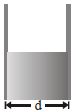
- 1A parallel plate air capacitor has a capacitance $C$. When it is half filled with a dielectric of dielectric constant $5$, the percentage increase in the capacitance will be......$\%$View Solution
- 2An uncharged parallel plate capacitor having a dielectric of constant $K$ is connected to a similar air cored parallel capacitor charged to a potential $V$. The two capacitors share charges and the common potential is $V$. The dielectric constant $K$ isView Solution
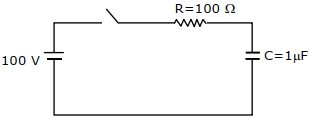
- 3A capacitor of capacitance $C=1\, \mu \,{F}$ is suddenly connected to a battery of $100\, volt$ through a resistance ${R}=100\, \Omega$. The time taken for the capacitor to be charged to get $50 \,{V}$ is $....\,\times \,10^{-4}\,s.$View Solution
[Take $\ln 2=0.69]$
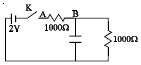
- 4In the circuit shown, when the key $k $ is pressed at time $t = 0$, which of the following statements about current $I$ in the resistor $AB $ is trueView Solution
- 5A capacitor of capacitance $10\, mF$ is connected to a battery of emf $2\,V.$ It is found that it takes $50\, ms$ for the charge on the capacitor to become $12.6 \,mC.$ Then the resistance of the circuit is :.......$\, k \Omega$ (Take $1/e = 0.37$):-View Solution
- 6View SolutionWhich of the following figure shows the correct equipotential surfaces of a system of two positive charges?
- 7View SolutionForce of attraction between the plates of a parallel plate capacitor is
- 8A proton of mass $m$ and charge $e$ is projected from a very large distance towards an $\alpha$-particle with velocity $v$. Initially $\alpha$-particle is at rest, but it is free to move. If gravity is neglected, then the minimum separation along the straight line of their motion will beView Solution
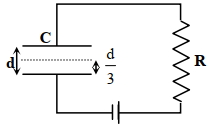
- 9A parallel plate capacitor $\mathrm{C}$ with plates of unit area and separation $\mathrm{d}$ is filled with a liquid of dielectric constant $\mathrm{K}=2$. The level of liquid is $\frac{\mathrm{d}}{3}$ initially. Suppose the liquid level decreases at a constant speed $V,$ the time constant as a function of time $t$ is Figure: $Image$View Solution
- 10Three point charges $q, q$ and $-2 q$ are placed at the corners of an equilateral triangle of side '$L$'. Calculate work done by extemal force in moving all the charges far apart without accelerationView Solution