MCQ
Consider a rectangular sheet of solid material of length $\ell=9 cm$ and width $d =4 cm$. The coefficient of linear expansion is $\alpha=3.1 \times 10^{-5} K^{-1}$ at room temperature and one atmospheric pressure. The mass of sheet $m =0.1 kg$ and the specific heat capacity $C _{ v }=900 J kg ^{-1} K^{-1}$. If the amount of heat supplied to the material is $8.1 \times 10^2 J$ then change in area of the rectangular sheet is :-
  • $2.0 \times 10^{-6} m^2$
  • B
    $3.0 \times 10^{-7} m^2$
  • C
    $6.0 \times 10^{-7} m^2$
  • D
    $4.0 \times 10^{-7} m^2$

Answer

Correct option: A.
$2.0 \times 10^{-6} m^2$
(A) $2.0 \times 10^{-6} m^2$
$
\begin{array}{l}
\Delta Q=ms \Delta T \\
8.1 \times 10^2=0.1 \times 900 \times \Delta T \\
\Delta A=A_0 2 \alpha \Delta T=2.0 \times 10^{-6} m^2
\end{array}
$

Need a full question paper?

Generate a complete, print-ready paper with questions like this in minutes — across 16+ boards, with answer keys.

Start Generating Free

Similar questions

In a transformer, number of turns in the primary are $140$ and that in the secondary are $280$. If current in primary is $4\,A$, then that in the secondary is......$A$
The following table provides the set of values of $V$ and $I$ obtained for a given diode. Let the characteristics $\alpha $ be nearly linear, over this range, the forward and reverse bias resistance of the given diode respectively are

  $V$ $I$
Forward biasing $2.0\,V$ $60\,mA$
  $2.4\,V$ $80\,mA$
Reverse biasing $0\,V$ $0\,\mu A$
  $-2\,V$ $-0.25\,\mu A$


When a wave travelling in medium is reflected from the boundary of a denser medium, which of the following will not change?
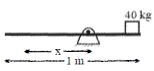
A mass $M= 40\  kg$ is fixed at the very edge of a long plank of mass $80\  kg$ and length $1\ m$ which is pivoted such that it is in equilibrium. How far (approx.) from the pivot should a mass of $100\  kg$ be attached so that the plank starts rotating with an angular acceleration of $1\ rad/s^2$?
A uniform wooden stick of mass $1.6 \mathrm{~kg}$ and length $l$ rests in an inclined manner on a smooth, vertical wall of height $h( < l)$ such that a small portion of the stick extends beyond the wall. The reaction force of the wall on the stick is perpendicular to the stick. The stick makes an angle of $30^{\circ}$ with the wall and the bottom of the stick is on a rough focr. The reaction of the wall on the stick is equal in magnitude to the reaction of the floor on the st $ck$. The ratio $h / l$ and the frictional force $f$ at the bottom of the stick are $\left(g=10 \mathrm{~m} \mathrm{~s}^{-2}\right)$
Two wires of equal diameters, of resistivities ${\rho _1}$ and ${\rho _2}$ and lengths $l_1$ and $l_2$, respectively, are joined in series. The equivalent resistivity of the combination is
A proton is projected with velocity $\overrightarrow{ V }=2 \hat{ i }$ in a region where magnetic field $\overrightarrow{ B }=(\hat{i}+3 \hat{j}+4 \hat{k})\; \mu T$ and electric field $\overrightarrow{ E }=10 \hat{ i } \;\mu V / m .$ Then find out the net acceleration of proton (in $m / s ^{2}$)
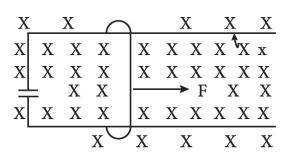
A wire having mass $m$ and length $1$ can freely slide on a pair or parallel smooth horizontal rails placed in vertical magnetic field $B$. The rails are connected by a capacitor of capacitance $C$. The electric resistance of the rails and the wire is zero. If a constant force $F$ acts on the wire as shown in the figure. Then, the acceleration of the wire can be given as
A Container having $1\ mole$ of a gas at a temperature $27\ ^oC$ has a movable piston which maintains at constant pressure in container of $1\ atm.$ The gas is compressed until temperature becomes $127^oC.$ The work done is ........ $J$ $(C_p\ for\  gas\  is\  7.03\ cal/mol-K)$
Two Carnot engines $A$ and $B$ are operated in series. The first one, $A,$ receives heat at $T_1(= 600\,K)$ and rejects to a reservoir at temperature $T_2.$ The second engine $B$ receives heat rejected by the first engine and, in turns, rejects to a heat reservoir at $T_3 (=400\,K).$ Calculate the temperature $T_2$ if the work outputs of the two engines are equal   ..... $K$