MCQ
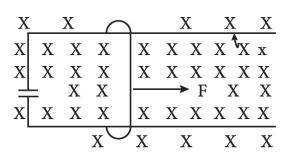
A wire having mass $m$ and length $1$ can freely slide on a pair or parallel smooth horizontal rails placed in vertical magnetic field $B$. The rails are connected by a capacitor of capacitance $C$. The electric resistance of the rails and the wire is zero. If a constant force $F$ acts on the wire as shown in the figure. Then, the acceleration of the wire can be given as
  • $a=\frac{F}{m+C^2 F ^2}$
  • B
    $a=\frac{F}{m+C B 1}$
  • C
    $a=\frac{F^2 B^2 1}{m}$
  • D
    $a=\frac{F}{m+C^2 B^2 1}$

Answer

Correct option: A.
$a=\frac{F}{m+C^2 F ^2}$
a
(a)

Due to the movement of rail with instantaneous velocity $v$, the e.m.f produced across the capacitor, $V = Bv l$

Charge stored in the capacitor $=q= CV = CBvl$

Therefore the current through the capacitor, $i =\frac{ dq }{ dt }= CBl \frac{ dv }{ dt }= CBla$

This same current passes through the wire

Hence the magnetic force on it, $F = Bil = CB ^2 I ^2 a$

Hence, $ma = F - F$

$\Rightarrow ma = F - CB ^2 l ^2 a$

$\Rightarrow a=\frac{F}{m+C^2 F ^2}$

Need a full question paper?

Generate a complete, print-ready paper with questions like this in minutes — across 16+ boards, with answer keys.

Start Generating Free

Similar questions

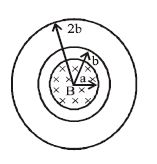
A uniform magnetic field $B$ that is perpendicular to the plane of the page now passes through the loops, as shown. The field is confined to a region of radius $a$ , where $a < b$ , and is changing at a constant rate. The induced emf in the wire loop of radius $b$ is $\varepsilon $. What is the induced emf in the wire loop of radius $2b$ 
$A$ projectile of mass $"m"$ is projected from ground with a speed of $50 \,m/s$ at an angle of $53^o$ with the horizontal. It breaks up into two equal parts at the highest point of the trajectory. One particle coming to rest immediately after the explosion. The distance between the pieces of the projectile when they reach the ground are:
A current of $0.1\, A$ circulates around a coil of $100$ $turns$ and having a radius equal to $5\,cm$. The magnetic field set up at the centre of the coil is ($\mu_0 = 4\pi \times 10^{-7} weber/amp-metre$)
A liquid column of height $0.04 \mathrm{~cm}$ balances excess pressure of soap bubble of certain radius. If density of liquid is $8 \times 10^3 \mathrm{~kg} \mathrm{~m}^{-3}$ and surface tension of soap solution is $0.28 \mathrm{Nm}^{-1}$, then diameter of the soap bubble is . . . . . . .. . $\mathrm{cm}$.

$\text { (if } g=10 \mathrm{~ms}^{-2} \text { ) }$

A hydrogen like atom of atomic number $Z$ is in an excited state of quantum number $2n$. It can emit a maximum energy photon of $204\, eV$. If it makes a transition to quantum state $n,$ a photon of energy $40.8\, eV$ is emitted. The value of $n$ will be
A metal wire of length $0.5 m$ and cross-sectional area $10^{-4}\; m ^{2}$ has breaking stress $5 \times 10^{8}\; Nm ^{-2}$. A block of $10\; kg$ is attached at one end of the string and is rotating in a horizontal circle. The maximum linear velocity of block will be $ms ^{-1}$.
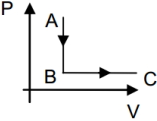
If one mole of an ideal gas goes through the process $A \rightarrow B$ and $B \rightarrow C .$ Given that $T _{ A }=400\, K ,$ and $T _{ C }=400 \,K .$ If $\frac{ P _{ B }}{ P _{ A }}=\frac{1}{5},$ then find the heat supplied to the gas (in $J$)
Two rods of different materials having coefficient of linear expansion $\alpha_1$and $\alpha_2$ and  Young's modulii $Y_1$ and $Y_2$ respectively are fixed between two rigid massive walls. The rods are heated such that they undergo the same increase in temperature. There is no bending of rods. If  $\alpha_1:\alpha_2= 2 : 3$, the thermal stress developed in two rods are equal provided $Y_1 : Y_2$ is equal to
Two identical fuses are rated at $10\,A$. If they are joined
A uniform rope of length l lies on a table. If the coefficient of friction is $\mu $, then the maximum length ${l_1}$ of the part of this rope which can overhang from the edge of the table without sliding down is