MCQ
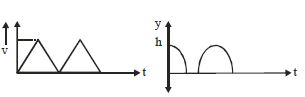
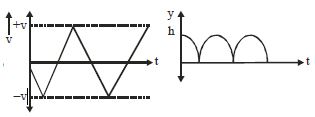
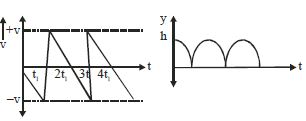
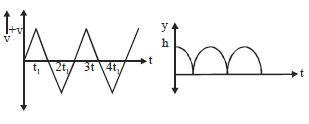
Consider a rubber ball freely falling from a height $h = 4.9\, m$ on a horizontal elastic plate. Assume that the duration of collision is negligible and the collision with the plate is totally elastic. Which one of the following graph represents the velocity as a function of time and the height as a function of time ?
  • A

  • B


  • D

Answer

Correct option: C.

c
$h=\frac{1}{2} g t^{2} v=-g t$ and after the collision, $v=g t$

(parabolic)(straight line)

Collision is perfectly elastic then ball reaches to same height again with same velocity.

Need a full question paper?

Generate a complete, print-ready paper with questions like this in minutes — across 16+ boards, with answer keys.

Start Generating Free

Similar questions

Find the ratio of specific heat at constant pressure to the specific heat constant volume for $N{H_3}$
Pick the correct options.
  1. All electrons have magnetic moment.
  2. All protons have magnetic moment.
  3. All nuclei have magnetic moment.
  4. All atoms have magnetic moment.
The beats are produced by two sound sources of same amplitude and of nearly equal frequencies. The maximum intensity of beats will be ...... that of one source
The string of pendulum of length $l$ is displaced through ${90^o}$ from the vertical and released. Then the minimum strength of the string in order to withstand the tension, as the pendulum passes through the mean position is
The resultant of $\vec{A} \times 0$ will be equal to
A ball of mass $160\, g$ is thrown up at an angle of $60^{\circ}$ to the horizontal at a speed of $10 \,m / s$. The angular momentum of the ball at the highest point of the trajectory with respect to the point from which the ball is thrown is nearly $\left(g=10\, m / s ^{2}\right)$ (in $kgm ^{2} / s$)
A bomb of mass $m$ is projected from the ground with speed $v$ at angle $\theta$ with the horizontal. At the maximum height from the ground it explodes into two fragments of equal mass. If one fragment comes to rest immediately after explosion, then the horizontal range of centre of mass is ..............
What is the angular velocity of earth
What displacement must be added to the displacement $25\hat i - 6\hat j\,\,m$ to give a displacement of $7.0\, m$ pointing in the $X- $direction
A block with mass $M$ is connected by a massless spring with stiffiess constant $k$ to a rigid wall and moves without friction on a horizontal surface. The block oscillates with small amplitude $A$ about an equilibrium position $x_0$. Consider two cases: ($i$) when the block is at $x_0$; and ($ii$) when the block is at $x=x_0+A$. In both the cases, a perticle with mass $m$ is placed on the mass $M$ ?

($A$) The amplitude of oscillation in the first case changes by a factor of $\sqrt{\frac{M}{m+M}}$, whereas in the second case it remains unchanged

($B$) The final time period of oscillation in both the cases is same

($C$) The total energy decreases in both the cases

($D$) The instantaneous speed at $x_0$ of the combined masses decreases in both the cases