Question
Consider a sample of a pure beta-active material:

Answer

  1. The active nucleus changes to one of its isobars after the beta decay.
Explanation:
In a beta decay, either a neutron is converted to a proton or a proton is converted to a neutron such that the mass number does not change. Also, the number of the nucleons present in the nucleus remains the same. Thus, the active nucleus gets converted to one of its isobars after beta decay.

Need a full question paper?

Generate a complete, print-ready paper with questions like this in minutes — across 16+ boards, with answer keys.
Start Generating Free

Similar questions

When the intensity of a light source is increased:
  1. The number of photons emitted by the source in unit time increases.
  2. The total energy of the photons emitted per unit time increases.
  3. More energetic photons are emitted.
  4. Faster photons are emitted.
If the bandgap between valence band and conduction band in a material is 0eV, then the material is:
According to Bohr hypothesis, discrete quantity is:
An infinitely long cylinder is kept parallel to an uniform magnetic field B directed along positive z axis. The direction of induced current as seen from the z axis will be(a)  Clockwise of the +ve z axis        (b) Anticlockwise of the +ve z axis  (c) Zero(d) Along the magnetic field
   
   
A metal sheet is placed in front of a strong magnetic pole. A force needed to:
  1. Hold the sheet there if the metal is magnetic.
  2. Hold the sheed there if the metal is nonmagnetic.
  3. Move the sheet away from the pole with uniform velocity if the metal is magnetic.
  4. Move the sheet away from the pole with uniform velocity if the metal is nonmagnetic. Negative any effect if oaramagnetism, diamagnetism and gravity.
Two particle of mass m and 2m moving in opposite direction collide head on. They have same de-Broglie wavelength before collision after the collision.
Which of the following statements are true?
In which disintegration out of the following disintegration atomic number decreases ?
Which of the following is used as a moderator in nuclear reactors(a) Uranium(b) Heavy water(c) Cadmium(d) Plutonium
       
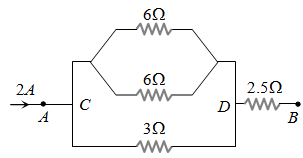
The equivalent resistance and potential difference between $A$ and $B$ for the circuit is respectively