Question
Consider a solid sphere of radius r and mass m that has a charge q distributed uniformly over its volume. The sphere is rotated about its diameter with an angular speed $\omega.$ Show that the magnetic moment $\mu$ and the angular momentum l of the sphere are related as $\mu=\frac{\text{q}}{2\text{m}}\text{l}.$
Answer


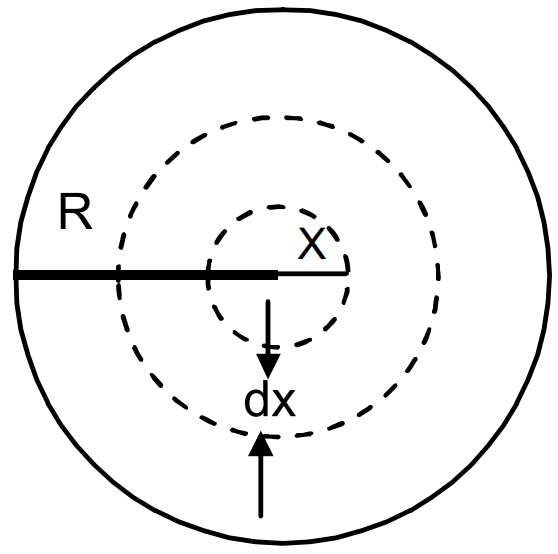
Considering a strip of width dx at a distance x from centre,
$\text{di}\frac{\text{dp}}{\text{dt}}=\frac{\text{q}4\pi\text{x}^2\text{dx}}{\Big(\frac{4}{3}\Big)\pi\text{R}^3\text{}}4\pi\text{x}^2\text{dx}$
$\text{di}=\frac{\text{dq}}{\text{dt}}=\frac{\text{q}4\pi\text{x}^2\text{dx}}{\Big(\frac{4}{3}\Big)\pi\text{R}^3\text{t}}=\frac{3\text{q}\text{x}^2\text{dx}\omega}{\text{R}^32\pi}$
$\text{d}\mu=\text{di}\times\text{A}=\frac{3\text{q}\text{x}^2\text{d}\text{x}\omega}{\text{R}^32\pi}\times4\pi\text{x}^{2\ =\ \frac{6\text{q}\omega}{\text{R}^3}\text{x}^4\text{dx}}$
$\mu=\int\limits_0^{\mu}\text{d}\mu\int\limits_0^{\text{R}}\frac{6\text{q}\omega}{\text{R}^3}\text{x}^4\text{dx}=\frac{6\text{q}\omega}{\text{R}^3}\Big[\frac{\text{x}^5}{5}\Big]_0$
$\text{R}=\frac{\text{6}\text{q}\omega\text{R}^5}{\text{R}^3}\frac{\text{R}^5}{5}=\frac{6}{5}\text{q}\omega\text{R}^2$

Need a full question paper?

Generate a complete, print-ready paper with questions like this in minutes — across 16+ boards, with answer keys.

Start Generating Free

Similar questions

What do you understand by a solenoid? Obtain an expression for magnetic field of a solenoid of infinite length.###Establish a formula for magnetic field on the axis inside of a straight and long solenoid. Show the direction of magnetic field inside it and what is the magnitude of magnetic field outside the solenoid.###Establish a formula for magnetic field inside a long solenoid. Represent produced force lines by diagram.###Write Ampere's circuital law. Obtain an expression for magnetic field on the axis of a very long current carrying solenoid. Draw necessary diagram also.
Figure shows a circular coil of N turns and radius a, connected to a battery of emf ϵ through a rheostat. The rheostat has a total length L and resistance R. The resistance of the coil is r. A small circular loop of radius a' and resistance r' is pl-aced coaxially with the coil. The centre of the loop is at a distance x from the centre of coil. the In the beginning, the sliding contact of the rheostat is at the left end and then onwards it is moved towards right at a constant speed u. Find the emf induced in the small circular loop at the instant:
  1. The contact begins to slide.
  2. It has slide through half the length of the rheostat.
Explain graphically the flow of current in semiconductors in the presence of an external electric field.
State Gauss theorem in electrostatics. Apply this theorem to obtain the expression for the electric field at a point due to an infinitely long, thin, uniformly charged straight wire of linear charge density $\lambda\text{Cm}^{-1}.$
When a dielectric is placed in an electric field, it gets polarized. The electric field in a polarized material is less than the applied field. When a paramagnetic substance is kept in a magnetic field, the field in the substance is more than the applied field. Explain the reason of this opposite behaviour.
In semiconductors, thermal collisions are responsible for taking a valence electron to the conduction band. Why does the number of conduction electrons not go on increasing with time as thermal collisions conμnuously take place?
Figure shows a heavy block kept on a frictionless surface and being pulled by two ropes of equal mass $m.$
 At $t = 0,$ the force on the left rope is withdrawn but the
force on the right end continues to act.
Let $F_1$ and $F_2$ be the magnitudes of the forces by the right rope and the left rope on the block respectively:
Figure shows a square loop ABCD with edgelength a. The resistance of the wire ABC is r and that of ADC is 2r. Find the magnetic field B at the centre of the loop assuming uniform wires.
The plates of a capacitor are 2.00cm apart. An electronproton pair is released somewhere in the gap between the plates and it is found that the proton reaches the negative plate at the same time as the electron reaches the positive plate. At what distance from the negative plate was the pair released?
What is the difference between cathode rays and beta rays? When the two are travelling in space, can you make out which is the cathode ray and which is the beta ray?