MCQ
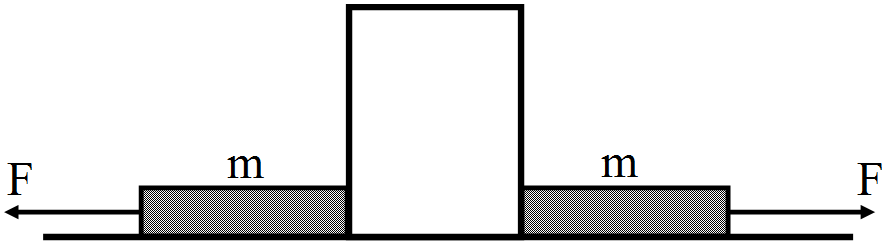
Figure shows a heavy block kept on a frictionless surface and being pulled by two ropes of equal mass $m.$
 At $t = 0,$ the force on the left rope is withdrawn but the
force on the right end continues to act.
Let $F_1$ and $F_2$ be the magnitudes of the forces by the right rope and the left rope on the block respectively:
  • $F_{1 }= F_2 = F$ for $t < 0.$
  • B
    $F_1 = F_2 = F + mg$ for $t < 0.$
  • C
    $F_1= F, F_2 = F$ for $t > 0.$
  • D
    $F_1< F, F_2 = F$ for $t > 0.$

Answer

Correct option: A.
$F_{1 }= F_2 = F$ for $t < 0.$
At $t < 0,$ the block is in equilibrium in the horizontal direction.
So, $F_1= F_2 = F$
At $t > 0, F_2= 0$ and $F_1= F.$

Need a full question paper?

Generate a complete, print-ready paper with questions like this in minutes — across 16+ boards, with answer keys.

Start Generating Free

Similar questions

Calculate the smallest wavelength of radiation that may be emitted by $(a)$ hydrogen$, (b) He^+$ and $(c) Li^{++}$​​​​​​​
(a) For circuits used for transporting electric power, a low power factor implies large power loss in transmission. Explain.
(b) Power factor can often be improved by the use of a capacitor of appropriate capacitance in the circuit. Explain.
Mrs. Rashmi Singh broke her reading glasses. When she went to the shopkeeper to order new spects, he suggested that she should get spectacles with plastic lenses instead of glass lenses. On getting the new spectacles, she found that the new ones were thicker than the earlier ones. She asked this question to the shopkeeper but he could not offer satisfactory explanation for this. At home, Mrs. Singh raised the same question to her daughter Anuja who explained why plastic lenses were thicker.
  1. Write two qualities displayed each by Anuja and her mother.
  2. How do you explain this fact using lens maker's formula?
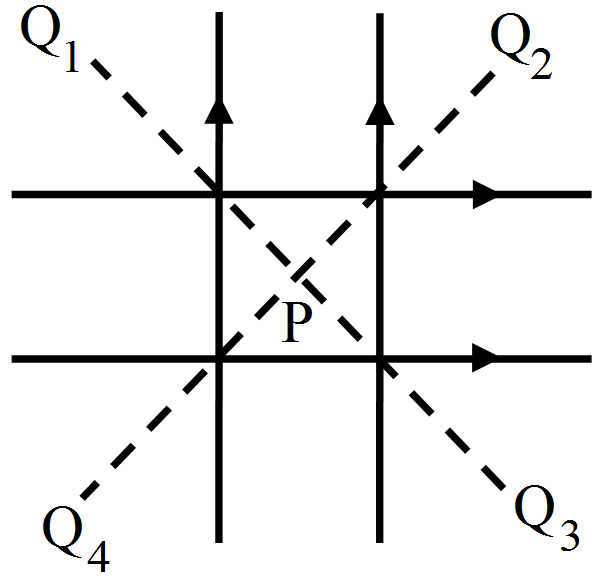
Four long, straight wires, each carrying a current of $5.0A,$ are placed in a plane as shown in figure. The points of intersection form a square of side $5.0\ cm$.
  1. Find the magnetic field at the centre $P$ of the square.
  2. $Q_1, Q_2, Q_3,$ and $Q_4$ are points situated on the diagonals of the liquare and at a distance from $P$ that is equal to the length of the diagonal of the square. Find the magnetic fields at these points.
It is desired to measure the magnitude of field between the poles of a powerful loud speaker magnet. $A$ small flat search coil of area $2\ cm^2$ with $25$ closely wound turns, is positioned normal to the field direction, and then quickly snatched out of the field region. Equivalently, one can give it a quick $90^\circ$ turn to bring its plane parallel to the field direction. The total charge flown in the coil $($measured by a ballistic galvanometer connected to coil$)$ is $7.5mC$. The combined resistance of the coil and the galvanometer is $0.50\Omega$ . Estimate the field strength of magnet.
A group of hydrogen atoms are prepared in n = 4 states. List the wavelength that are emitted as the atoms make transitions and return to n = 2 states.
A rectangular loop of sides $20\ cm$ and $10\ cm$ carries a current of $5.0A.$ A uniform magnetic field of magnitude $0.20T$ exists parallel to the longer side of the loop.
  1. What is the force acting on the loop?
  2. What is the torque acting on the loop?
A rod of length $L$ has a total charge $Q$ distributed uniformly along its length. It is bent in the shape of a semicircle. Find the magnitude of the electric field at the centre of curvature of the semicircle.
State Ampere's law. Using this law, calculate the magnitude of magnetic field due to long and straight current carrying conductor and also draw the graph.
Write the mathematical relation for the resistivity of a material in terms of relaxation time, number density, mass and charge of charge carriers in it. Explain using this relation, why the resistivity of a metal increases and that of a semiconductor decreases with rise in temperature.