Question
Consider a sphere of radius R with charge density distributed as$\rho\text{(r)}=\text{kr for r}\leq\text{R}$
$=0\text{ for f}>\text{R}.$
Find the electric field at all points r.
Answer

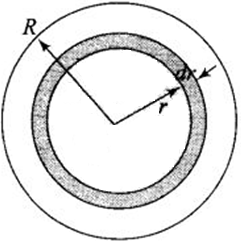
The expression of charge density distribution in the sphere suggests that the electric field is radial. Let us consider a sphere S of radius R and two hypothetic spheres of radius r < R and r > R. Let us first consider for point r < R, electric field intensity will be given by, $\oint\overrightarrow{\text{E}}.\text{d}\overrightarrow{\text{S}}=\frac{1}{\in_0}\int\rho\text{dV}$
Here $\text{dV}=4\pi\text{r}^2\text{dr}$$\Rightarrow\ \oint\overrightarrow{\text{E}}.\text{d}\overrightarrow{\text{S}}=\frac{1}{\in_0}4\pi\text{K}\int\text{r}^3\text{dr}\ \ (\because\ \rho(\text{r})=\text{Kr})$
$\Rightarrow\ (\text{E})4\pi\text{r}^2=\frac{4\pi\text{K}}{\in_0}\frac{\text{r}^4}{4}$
We get, $\text{E}=\frac{1}{4\in_0}\text{Kr}^2$ As charge density is positive, it means the direction of E is radially outwards. Now consider points r > R, electric field intensity will be given by$\oint\overrightarrow{\text{E}}.\text{d}\overrightarrow{\text{S}}=\frac{1}{\in_0}\int\rho\text{dV}$
$\Rightarrow\ \text{E}(4\pi\text{r}^2)=\frac{4\pi\text{K}}{\in_0}\oint\text{r}^3\text{dr}=\frac{4\pi\text{K}}{\in_0}\frac{\text{R}^4}{4}$
Which given, $\text{E}=\frac{\text{K}}{4\in_0}\frac{\text{r}^4}{\text{r}^2}$ Here also the charge density is again positive. So, the direction of E is radially outward.

Need a full question paper?

Generate a complete, print-ready paper with questions like this in minutes — across 16+ boards, with answer keys.

Start Generating Free

Similar questions

A free atom of iron emits $\text{K}_\alpha$ X-rays of energy 6.4keV. Calculate the recoil kinetic energy of the atom. Mass of an iron atom $= 9.3 \times 10^-^{26}kg.$
Using Gauss’s theorem, show mathematically that for any point outside the shell, the field due to a uniformly charged thin spherical shell is the same as if the entire charge of the shell is concentrated at the centre. Why do you expect the electric field inside the shell to be zero according to this theorem?
The relative luminosity of wavelength 600nm is 0.6. Find the radiant flux of 600nm needed to produce the same brightness sensation as produced by 120W of radiant flux at 555nm.
  1. Define mutual inductance and write its S.I. unit.
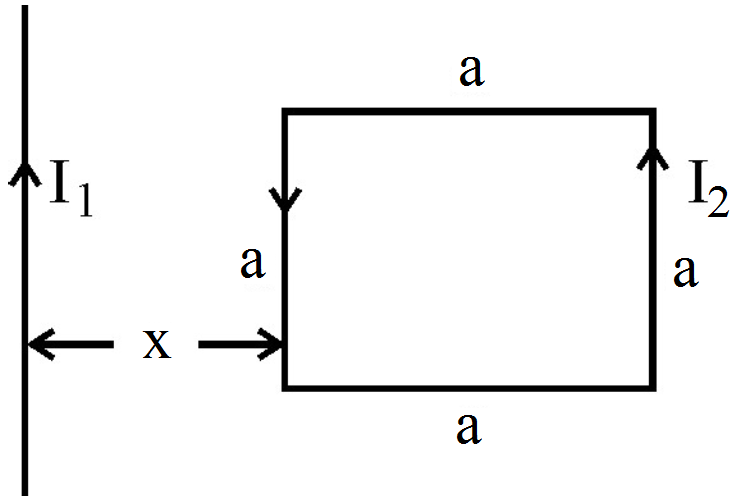
  2. A square loop of side ‘a’ carrying a current $I_2$ is kept at distance x from an infinitely long straight wire carrying a current $I_1$ as shown in the figure. Obtain the expression for the resultant force acting on the loop.
A charge Q is uniformly distributed over a rod of length l. Consider a hypothetical cube of edge l with the centre of the cube at one end of the rod. Find the minimum possible flux of the electric field through the entire surface of the cube.
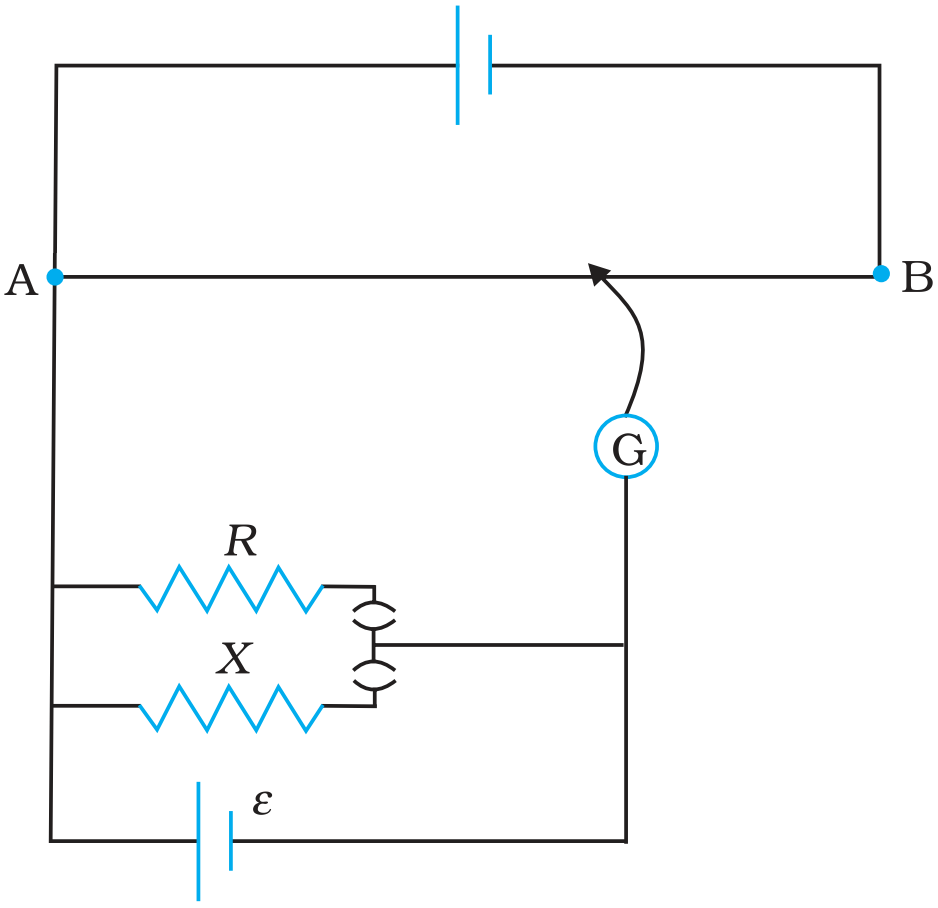
Figure shows a potentiometer circuit for comparison of two resistances. The balance point with a standard resistor $\text{R}=10.0\ \Omega$ is found to be 58.3 cm, while that with the unknown resistance X is 68.5 cm. Determine the value of X. What might you do if you failed to find a balance point with the given cell of emf $\varepsilon?$
Let x and a stand for distance. Is $\int\frac{\text{dx}}{\sqrt{\text{a}^2-\text{x}^2}}=\frac{1}{\text{a}}\sin^{-1}\frac{\text{a}}{\text{x}}$ dimensionally correct?
Draw the circuit diagram of a full wave rectifier using two p-n junction
diodes. Explain its working and show input and output voltage variations.
Assume that the mass of a nucleus is approximately given by $M = Am_p$ where A is the mass number. Estimate the density of matter in $kg/m^3$ inside a nucleus. What is the specific gravity of nuclear matter?
A ball is dropped from a balloon going up at a speed of 7m/s. If the balloon was at a height 60m at the time of dropping the ball, how long will the ball take in reaching the ground?