Question
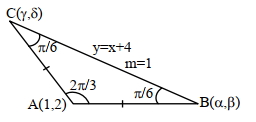
Consider a triangle $\mathrm{ABC}$ having the vertices $\mathrm{A}(1,2), \mathrm{B}(\alpha, \beta)$ and $\mathrm{C}(\gamma, \delta)$ and angles $\angle \mathrm{ABC}=\frac{\pi}{6}$ and $\angle \mathrm{BAC}=\frac{2 \pi}{3}$. If the points $\mathrm{B}$ and $\mathrm{C}$ lie on the line $\mathrm{y}=\mathrm{x}+4$, then $\alpha^2+\gamma^2$ is equal to....................
Answer

d
Equation of line passes through point $\mathrm{A}(1,2)$ which makes angle $\frac{\pi}{6}$ from $y=x+4$ is

$ \mathrm{y}-2=\frac{1 \pm \tan \frac{\pi}{6}}{1 \mp \tan \frac{\pi}{6}}(\mathrm{x}-1) $

$ \mathrm{y}-2=\frac{\sqrt{3} \pm 1}{\sqrt{3} \mp 1}(\mathrm{x}-1)$

$\oplus$                                                           

$y-2=(2+\sqrt{3})(x-1) $

solve with $ y=x+4 $

$x+2=(2+\sqrt{3}) x-2-\sqrt{3} $

$x=\frac{4+\sqrt{3}}{1+\sqrt{3}}$

$\Theta$

$y-2=(2-\sqrt{3})(x-1)$

solve with $\mathrm{y}=\mathrm{x}+4$

$x+2=(2-\sqrt{3}) x-2+\sqrt{3} $

$x=\frac{4-\sqrt{3}}{1-\sqrt{3}}$

$ \alpha^2+\gamma^2=\left(\frac{4+\sqrt{3}}{1+\sqrt{3}}\right)^2+\left(\frac{4-\sqrt{3}}{1-\sqrt{3}}\right)^2 $

$ \alpha^2+\gamma^2=14$

Need a full question paper?

Generate a complete, print-ready paper with questions like this in minutes — across 16+ boards, with answer keys.

Start Generating Free

Similar questions

Let $\mathrm{ABC}$ be a triangle of area $15 \sqrt{2}$ and the vectors $\overrightarrow{\mathrm{AB}}=\hat{i}+2 \hat{j}-7 \hat{k}, \quad \overrightarrow{B C}=a \hat{i}+b \hat{j}+c \hat{k}$ and $\overrightarrow{\mathrm{AC}}=6 \hat{\mathrm{i}}+\mathrm{d} \hat{\mathrm{j}}-2 \hat{\mathrm{k}}, \mathrm{d}>0$. Then the square of the length of the largest side of the triangle $\mathrm{ABC}$ is....................
Let the number $(22)^{2022}+(2022)^{22}$ leave the remainder $\alpha$ when divided by $3$ and $\beta$ when divided by $7$. Then $\left(\alpha^2+\beta^2\right)$ is equal to
The last two digits of the number $3^{400}$ are :
$\left| {\,\begin{array}{*{20}{c}}{{{\log }_3}512}&{{{\log }_4}3}\\{{{\log }_3}8}&{{{\log }_4}9}\end{array}\,} \right| \times \left| {\,\begin{array}{*{20}{c}}{{{\log }_2}3}&{{{\log }_8}3}\\{{{\log }_3}4}&{{{\log }_3}4}\end{array}\,} \right|=$
The number of elements in the set $\{ z = a + ib \in C : a , b \in Z$ and $1<| z -3+2 i |<4\}$ is.......
Let $S$ be the set of all ordered pairs $(x, y)$ of positive integers, with $HCF (x, y)=16$ and $\operatorname{LCM}(x, y)=48000$. The number of elements in $S$ is
$2{x^2} - (p + 1)x + (p - 1) = 0$. If $\alpha - \beta = \alpha \beta $, then what is the value of $p$
If $ABCD$ is a cyclic quadrilateral, then the value of $\cos A - \cos B + \cos C - \cos D = $
If $\log _{3} 2, \log _{3}\left(2^{x}-5\right), \log _{3}\left(2^{x}-\frac{7}{2}\right)$ are in an arithmetic progression, then the value of $x$ is equal to $.....$
$1\, + \,\frac{{{1^3}\, + \,{2^3}}}{{1 + 2}} + \frac{{{1^3}\, + \,{2^3} + {3^3}}}{{1 + 2 + 3}} + ...... + \frac{{{1^3}\, + \,{2^3} + {3^3} + ..... + {{15}^3}}}{{1 + 2 + 3 + ..... + 15}} - \frac{1}{2}\left( {1 + 2 + 3 + ....+15} \right)$ is equal to