Question

Consider a two slit interference arrangements such that the distance of the screen from the slits is half the distance between the slits.
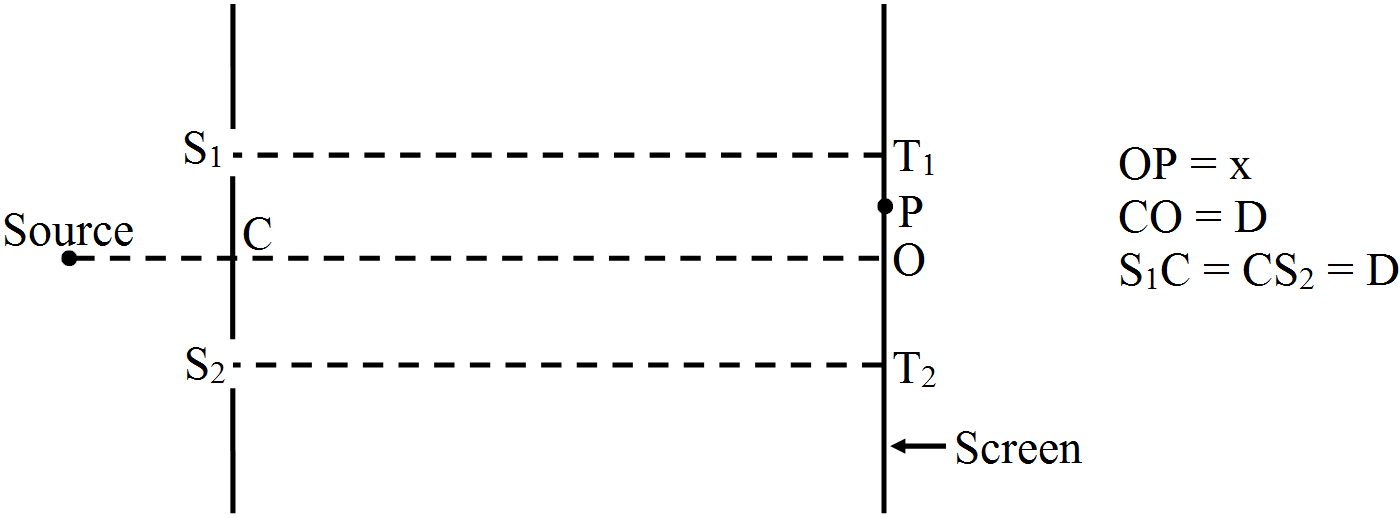
Obtain the value of D in terms of $\lambda$ such that the first minima on the screen fall at a distance D from the centre O.
Answer

$\text{T}_2\text{P}=\text{D}+\text{x},\text{T}_1\text{P}=\text{D}-\text{x}$ $\text{S}_1\text{P}=\sqrt{(\text{S}_1\text{T}_1)^2+(\text{P}\text{T}_1)^2}=[\text{D}^2+(\text{D}-\text{x}^2)]^\frac{1}{2}$ $\text{S}_2\text{P}=[\text{D}^2+\text{(D+x)}^2]^\frac{1}{2}$ Minima will occur when: $[\text{D}^2+(\text{D}+\text{x})^2]^\frac{1}{2}-[\text{D}^2+(\text{D}-\text{x})^2]^\frac{1}{2}=\frac{\lambda}{2}$ $\text{if}\text{ x}=\text{D},(\text{D}^2+4\text{D}^2)^\frac{1}{2}-\text{D}=\frac{\lambda}{2}$ $\Rightarrow \text{D}(\sqrt5-1)=\frac{\lambda}{2}\Rightarrow\text{D}=\frac{\lambda}{2(\sqrt5-1)}$

Need a full question paper?

Generate a complete, print-ready paper with questions like this in minutes — across 16+ boards, with answer keys.

Start Generating Free

Similar questions

An illuminated object and a screen are placed 90 cm apart. Determine the focal length and nature of the lens required to produce a clear image on the screen, twice the size of the object.
The conductivity of a pure semiconductor is roughly proportional to $\text{T}^\frac{3}{2}\text{e}^{\frac{-\Delta\text{E}}{2\text{kT}}}$ where $\Delta\text{E}$ is the band gap. The band gap for germanium is 0.74eV at 4K and 0.67eV at 300K. By what factor does the conductivity of pure germanium increase as the temperature is raised from 4K to 300K?
A train approaching a platform at a speed of 54km/h sounds a whistle. An observer on the platform finds its frequency to be 1620Hz. The train passes the platform keeping the whistle on and without slowing down. What frequency will the observer hear after the train has crossed the platfrom? The speed of sound in air = 332m/s.
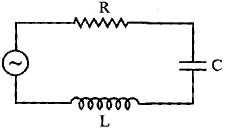
The figure shows a series LCR circuit with L = 5.0 H, C = 80 $\mu$F, R = 40 W connected to a variable frequency 240V source. Calculate
  1. The angular frequency of the source which drives the circuit at resonance.
  2. The current at the resonating frequency.
  3. The rms potential drop across the capacitor at resonance.
A person sitting on the top of a tall building is dropping balls at regular intervals of one second. Find the positions of the $3^{\text {rd }}, 4^{\text {th }}$ and $5^{\text {th }}$ ball when the $6^{\text {th }}$ ball is being dropped.
The magnifying power of a simple microscope is given by $1+\frac{\text{D}}{\text{f}},$ where D is the least distance for clear vision. For farsighted persons, D is greater than the usual. Does it mean that the magnifying power of a simple microscope is greater for a farsighted person as compared to a normal person? Does it mean that a farsighted person can see an insect more clearly under a microscope than a normal person?
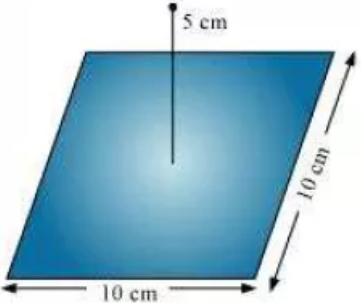
A point charge +10 μC is a distance 5cm directly above the centre of a square of side 10cm, as shown in Fig. 1.34. What is the magnitude of the electric flux through the square?
(Hint: Think of the square as one face of a cube with edge 10cm.)
A battery of emf 10 V and internal resistance $3\ \Omega$ is connected to a resistor. If the current in the circuit is 0.5 A, what is the resistance of the resistor? What is the terminal voltage of the battery when the circuit is closed?
  1. State the law of radioactive decay. Write the SI unit of ‘activity’.
  2. There are $4\sqrt{2}\times10^6$ radioactive nuclei in a given radioactive sample. If the half life of the sample is 20 s, how many nuclei will decay in 10 s?
A free atom of iron emits $\text{K}_\alpha$ X-rays of energy 6.4keV. Calculate the recoil kinetic energy of the atom. Mass of an iron atom $= 9.3 \times 10^-^{26}kg.$