The figure shows a series LCR circuit with L = 5.0 H, C = 80 $\mu$F, R = 40 W connected to a variable frequency 240V source. Calculate
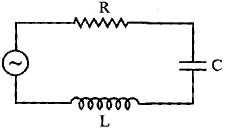
- The angular frequency of the source which drives the circuit at resonance.
- The current at the resonating frequency.
- The rms potential drop across the capacitor at resonance.
CBSE DELHI - SET 1 2012
Download our app for free and get started
- $\omega = \frac{1}{\sqrt{\text{LC}}}$
- Current at resonance
- $V_{rms}$ across capacitor
$ = 6\times\frac{1}{50\times80\times10^{-6}}\text{V}$
$ = \frac{6\times10^{6}}{4\times10^{3}}\text{V} = \frac{6000}{4}\text{V} = 1500\text{V}.$

Download our appand get started for free
Experience the future of education. Simply download our apps or reach out to us for more information. Let's shape the future of learning together!No signup needed.*
Similar Questions
- 1Two capacitors of capacitance $10\mu\text{F}$ and $20 \mu\text{F}$ are connected in series with a 6 V battery. After the capacitors are fully charged, a slab of dielectric constant (K) is inserted between the plates of the two capacitors. How will the following be affected after the slab is introduced:View Solution
- The electric field energy stored in the capacitors.
- The charges on the two capacitors.
- The potential difference between the plates of the capacitors.
- 2View Solution
- A screen is placed at a distance of 100 cm from an object. The image of the object is formed on the screen by a convex lens for two different locations of the lens separated by 20 cm. Calculate the focal length of the lens used.
- A converging lens is kept coaxially in contact with a diverging lens - both the lenses being of equal focal length. What is the focal length of the combination?
- 3View SolutionWhat is Global Positioning System? Explain its working principle in brief.
- 4View SolutionHow is a galvanometer converted into a voltmeter and an ammeter? Draw the relevant diagrams and find the resistance of the arrangement in each case. Take resistance of galvanometer as G.
- 5View Solution
- In Young's double slit experiment, two slits are 1 mm apart, and the screen is placed 1 m away from the slits. Calculate the fringe width when light of wavelength 500 nm is used.
- What should be the width of each slit in order to obtain 10 maxima of the double slits pattern within the central maximum of the single slit pattern?
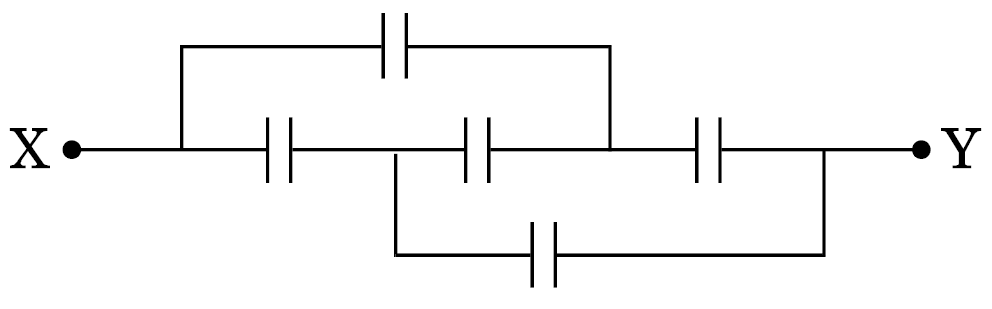
- 6Find the equivalent capacitance of the network shown in the figure, when each capacitor is of $1\mu\text{F}$. When the ends X and Y are connected to a 6 V battery, find out (i) The charge and (ii) The energy stored in the network.View Solution
- 7In a series LCR circuit, $\text{R = 1k}\Omega,\text{C}=2\mu\text{F}$ and voltage across R is 100V. The resonant frequency of the circuit $\omega$ is 200 rad $s^{-1}$. Calculate the value of voltage across L at resonance.View Solution
- 8View SolutionUsing truth tables of AND gate and NOT gate show that NAND gate is an AND gate followed by a NOT gate. Hence write the truth table of NAND gate.
Why are NAND gates called ‘Universal Gates’? - 9View SolutionAnswer the following:
- In what way is diffraction from each slit related to the interference pattern in a double slit experiment?
- When a tiny circular obstacle is placed in the path of light from a distant source, a bright spot is seen at the centre of the shadow of the obstacle. Explain, why.
- How does the resolving power of a microscope depend on (i) the wavelength of the light used and (ii) the medium used between the object and the objective lens?
- 10View SolutionSuppose the frequency of the source in the previous example can be varied. (a) What is the frequency of the source at which resonance occurs? (b) Calculate the impedance, the current, and the power dissipated at the resonant condition.