MCQ
Consider a uniform electric field in the $\hat{\text{Z}}$ direction. The potential is a constant:
- AIn all space.
- BFor any x for a given z.
- CFor any y for a given z.
- DOn the x-y plane for a given z.
We know, the electric field intensity E and electric potential V are
$\text{E}=-\frac{\text{dV}}{\text{dr}}$
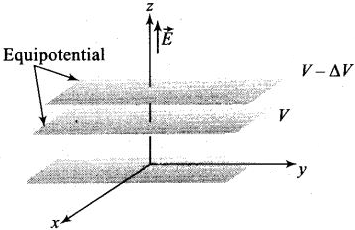
Electric potential decreases inf the direction of electric field. The direction of electric field is always perpendicular to one equipotential surface maintained at high electrostatic potential to other equipotential surface maintained at low electrostatic potential.
The electric field in z-direction suggest that equipotential surfaces are in x-y plane. Therefore the potential is a constant for any x for a given z, for any y for a given z and on the x-y plane for a given z.
Generate a complete, print-ready paper with questions like this in minutes — across 16+ boards, with answer keys.
A convex lens makes a real image 4 cm long on a screen. When the lens is shifted to a new position without disturbing the object, we again get a real image on the screen which is 16 cm tall. The length of the object must be
|
(a) 1/4 cm |
(b) 8 cm |
(c) 12 cm |
(d) 20 cm |
If a = 0.98 and current through emitter ie = 20 mA, the value of b is
|
(a) 4.9 |
(b) 49 |
(c) 96 |
(d) 9.6 |
Four equal capacitors, each of capacity C, are arranged as shown. The effective capacitance between A and B is

|
(a) |
(b) |
(c) |
(d) C |


