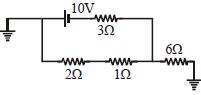
Consider a wire having current $10\,A$ having area of crossection $1\,cm^2$. If number of electrons per unit volume is $9 \times 10^{28}\, m^{-3}$. Find the drift velocity of electrons
Easy
Download our app for free and get started
The relation between current and drift velocity
I.e1 $= V _{\text {d.ena }}$
where $I$ = current
$V _{ d }=$ current velocity
$e =$ electron
$n =$ no. of electrons per unit volume
$a=$ area of cross section
Now, $V_d=\frac{I}{\text { nea }}$
$=\frac{10}{1 \times 10^{-4} \times 9 \times 10^7 \times 28}=1.94 \times 10^{-3} m / s$

Download our appand get started for free
Experience the future of education. Simply download our apps or reach out to us for more information. Let's shape the future of learning together!No signup needed.*
Similar Questions
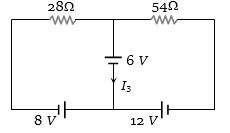
- 1Consider the circuit shown in the figure. The current ${I_3}$ is equal toView Solution
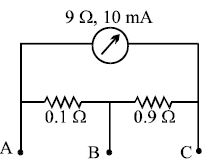
- 2A milliammeter of range $10\, mA$ and resistance $9\, \Omega$ is joined in a circuit as shown. The meter gives full-scale deflection for current $I$ when $A$ and $B$ are used as its terminals, i.e., current enters at $A$ and leaves at $B$ ($C$ is left isolated). The value of $I$ isView Solution
- 3An electric bulb rated as $200\, {W}$ at $100 \,{V}$ is used in a circuit having $200\, {V}$ supply. The resistance $'R'$ that must be put in series with the bulb so that the bulb delivers the same power is $.....\,\Omega$View Solution
- 4If a wire is stretched to make it $0.1 \%$ longer, its resistance willView Solution
- 5A wire of length ' $r$ ' and resistance $100 \Omega$ is divided into $10$ equal parts. The first $5$ parts are connected in series while the next $5$ parts are connected in parallel. The two combinations are again connected in series. The resistance of this final combination is:View Solution
- 6In a meter bridge experiment null point is obtained at $20\, cm$ from one end of the wire when resistance $X$ is balanced against another resistance $Y$. If $X < Y$, then where will be the new position of the null point from the same end, if one decides to balance a resistance of $4X$ against $Y$ ........... $cm$View Solution
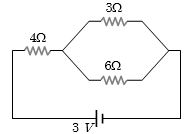
- 7The potential drop across the $3$ $\Omega$ resistor is ............... $V$View Solution
- 8Two bulbs of $(40 \;W, 200\; V)$ and $(100\; W, 200 \;V)$. Then correct relation for their resistanceView Solution
- 9Two wires have resistance of $2$ $\Omega$ and $4$ $\Omega$ connected to same voltage, ratio of heat dissipated at resistance isView Solution
- 10Find current in $6\,\Omega $ resistanceView Solution