Question
  1. Consider an arbitrary electrostatic field configuration. A small test charge is placed at a null point (i.e., where E = 0) of the configuration. Show that the equilibrium of the test charge is necessarily unstable.
  2. Verify this result for the simple configuration of two charges of the same magnitude and sign placed a certain distance apart.
Answer

  1. Let the equilibrium of the test charge be stable. If a test charge is in equilibrium and displaced from its position in any direction, then it experiences a restorinq force towards a null point, where the electric field is zero. All the field lines near the null point are directed inwards towards the null point. There is a net inward flux of electric field through a closed surface around the null point. According to Gauss's law, the flux of electric field through a surface, which is not enclosing any charge, is zero. Hence, the equilibrium of the test charge can be stable.
  2. Two charges of same magnitude and same sign are placed at a certain distance. The mid-point of the joining line of the charges is the null point. When a test charged is displaced along the line, it experiences a restoring force. If it is displaced normal to the joining line, then the net force takes it away from the null point. Hence, the charge is unstable because stability of equilibrium requires restoring force in all directions.

Need a full question paper?

Generate a complete, print-ready paper with questions like this in minutes — across 16+ boards, with answer keys.

Start Generating Free

Similar questions

One end of a cylindrical glass rod $(\mu=1.5)$ of radius 1.0cm is rounded in the shape of a hemisphere. The rod is immersed in water $\Big(\mu=\frac{4}{3}\Big)$ and an object is placed in the water along the axis of the rod at a distance of 8.0cm from the rounded edge. Locate the image of the object.
Explain isotopes, isobars, isotones and isomers by giving examples.
A particle of mass m moves on a straight line with its velocity varying with the distance travelled according to the equation $\text{v}=\text{a}\sqrt{\text{x}},$ where a is a constant. Find the total work done by all the forces during a displacement from x = 0 to x = d.
An object is placed at (i) $10 cm$, (ii) $5 cm$ in front of a concave mirror of radius of curvature $15 cm$. Find the position, nature, and magnification of the image in each case.
The condition of air in a cloeed room is described as follows. Temperature = 25°C, relative humidity = 60%, pressure = 104kPa. lf all the water vapour is removed from the room without changing the temperature, what will be the new pressure? The saturation vapour pressure at 25°C = 3.2kPa.
A straight wire of length l can slide on two parallel plastic rails kept in a horizontal plane with a separation d. The coefficient of friction between the wire and the rails is $\mu.$ If the wire carries a current i, what minimum magnetic field should exist in the space in order to slide the wire on the rails?
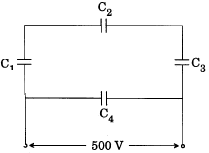
A network of four capacitors each of 12 μF capacitance is connected to a 500 V supply as shown in the figure. Determine (a) equivalent capacitance of the network and (b) charge on each capacitor. 

A convex lens produces a double size real image when an object is placed at a distance of 18cm from it. Where should the object be placed to produce a triple size real image?
What is the nature of electrostatic force between two point electric charges q1 and q2 if:
  1. q1 + q2 > 0?
  2. q1 + q2 < 0?
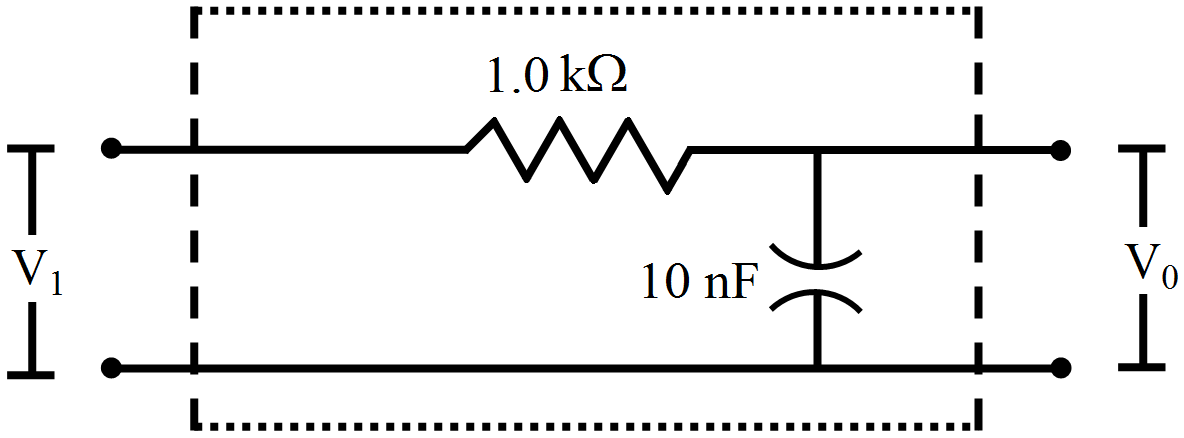
Figure shows a typical circuit for a low-pass filter. An AC input Vi = 10mV is applied at the left end and the output V0 is received at the right end. Find the output voltage for ν = 10kHz, 1.0MHz and 10.0MHz. Note that as the frequency is increased the output decreases and, hence, the name low-pass filter.