- A$12 \times {10^{ - 20}}Joule$
- ✓$6.0 \times {10^{ - 20}}Joule$
- C$6.0 \times {10^{ - 18}}Joule$
- D$6\ Joule$
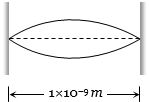
$\lambda = 2l = 2 \times {10^{ - 9}}m$
$ \Rightarrow \lambda = \frac{h}{{\sqrt {2mE} }}$
$ \Rightarrow E = \frac{{{h^2}}}{{2m{\lambda ^2}}} = 6 \times {10^{ - 20}}J$
Generate a complete, print-ready paper with questions like this in minutes — across 16+ boards, with answer keys.
Figure: $Image$
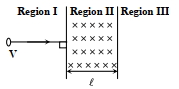
$(A)$ The particle enters Region $III$ only if its velocity $V>\frac{q / B}{m}$
$(B)$ The particle enters Region $III$ only if its velocity $\mathrm{V}<\frac{\mathrm{q} / \mathrm{B}}{\mathrm{m}}$
$(C)$ Path length of the particle in Region $II$ is maximum when velocity $V=\frac{q / B}{m}$
$(D)$ Time spent in Region $II$ is same for any velocity $V$ as long as the particle returns to Region $I$

$Reason\,(R):$ Gauss's law is independent of size of the Gaussian surface.