MCQ
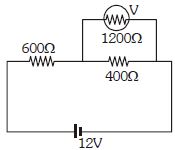
Find the error in reading of voltmeter ................ $\%$
  • A
    $16.67$
  • B
    $8$
  • C
    $4$
  • D
    $5$

Answer

Need a full question paper?

Generate a complete, print-ready paper with questions like this in minutes — across 16+ boards, with answer keys.
Start Generating Free

Similar questions

An infinite line charge produce a field of $7.182 \times {10^8}\,N/C$ at a distance of $2\, cm$. The linear charge density is
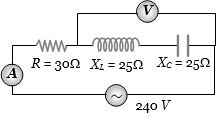
In the circuit shown in figure neglecting source resistance the voltmeter and ammeter reading will respectively, will be
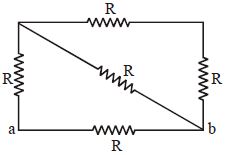
Find out the equivalent resistance between the points $a$ and $b$
The radius of curvature for a convex lens is $40 cm$, for each surface. Its refractive index is $1.5.$ The focal length will be......$cm$
A nucleus of $_{84}^{210}PO$ originally at rest emits a particle with speed v. What will be the recoil speed of the daughter nucleus
The diagram shows a small bead of mass $m$ carrying charge $q$. The bead can freely move on the smooth fixed ring placed on a smooth horizontal plane. In the same plane a charge $+Q$ has also been fixed as shown. The potential atthe point $P$ due to $+Q$ is $V$. The velocity with which the bead should projected from the point $P$ so that it can complete a circle should be greater than
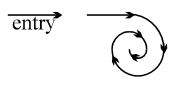
Acharged particle enters a uniform magnetic field perpendicular to its initial direction travelling in air. The path of the particle is seen to follow the path in figure. Which of statements $1-3$ is/are correct?

$[1]$ The magnetic field strength may have been increased while the particle was travelling in air

$[2]$ The particle lost energy by ionising the air

$[3]$ The particle lost charge by ionising the air
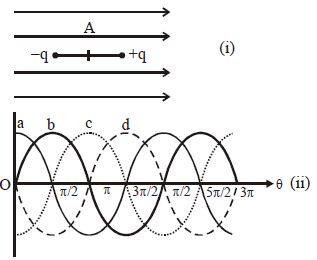
The electric dipole is situated in an electric field as shown in figure. The dipole and electric field vare both in the plane of paper. The dipole is rotated about an axis perpendicular to the paper at point $A$ in anticlockwise direction. If the angle of rotation is measured with respect to the direction of the electric field then the torque for different values of the angle of rotation $\theta $ will be as represented in Fig. $(ii)$
The gravitational force between a $H-$atom and another particle of mass $m$ will be given by Newton’s law: $\text{F}=\text{G}\frac{\text{M.m}}{\text{r}^2}$, where $r$ is in $km$ and,
The graph between the energy log $E$ of an electron and its de$-$Broglie wavelength log $\lambda$ will be