Question
Consider an excited hydrogen atom in state n moving with a velocity u(ν << c). It emits a photon in the direction of its motion and changes its state to a lower state m. Apply momentum and energy conservation principles to calculate the frequency ν of the emitted radiation. Compare this with the frequency ν0 emitted if the atom were at rest.
Answer

Velocity of hydrogen atom in state ‘n’ = u
Also the velocity of photon = u
But u << C
Here the photon is emitted as a wave.
So its velocity is same as that of hydrogen atom i.e. u.
$\therefore$ Accounding to Doppler’s effect,
Frequency $\text{v}=\text{v}_0\bigg(\frac{1+\frac{\text{u}}{\text{c}}}{1-\frac{\text{u}}{\text{c}}}\bigg)$
as u <<< C
$1-\frac{\text{u}}{\text{c}}=\text{q}$
$\therefore\ \text{v}=\text{v}_0\bigg(\frac{1+\frac{\text{u}}{\text{c}}}{1}\bigg)=\text{v}_0\Big(1+\frac{\text{u}}{\text{c}}\Big)$
$\text{v}=\text{v}_0\Big(1+\frac{\text{u}}{\text{c}}\Big)$

Need a full question paper?

Generate a complete, print-ready paper with questions like this in minutes — across 16+ boards, with answer keys.

Start Generating Free

Similar questions

A bar magnet of length 1cm and cross-sectional area 1.0cm2 produces a magnetic field of 1.5 × 10. T at a point in end-on position at a distance 15cm away from the centre.
  1. Find the magnetic moment M of the magnet.
  2. Find the magnetization I of the magnet.
  3. Find the magnetic field B at the centre of the magnet.
A servo voltage stabiliser restricts the voltage output to 220V ± 1%. If an electric bulb rated at 220V, 100W is connected to it, what will be the minimum and maximum power consumed by it?
k transparent slabs are arranged one over another. The refractive indices of the slabs are $\mu_1,\mu_2,\mu_3, \ ...\mu_{\text{k}}$ and the thicknesses are t1, t2, t3, ... tk . An object is seen through this combination with nearly perpendicular light. Find the equivalent refractive index of the system which will allow the image to be formed at the same place.
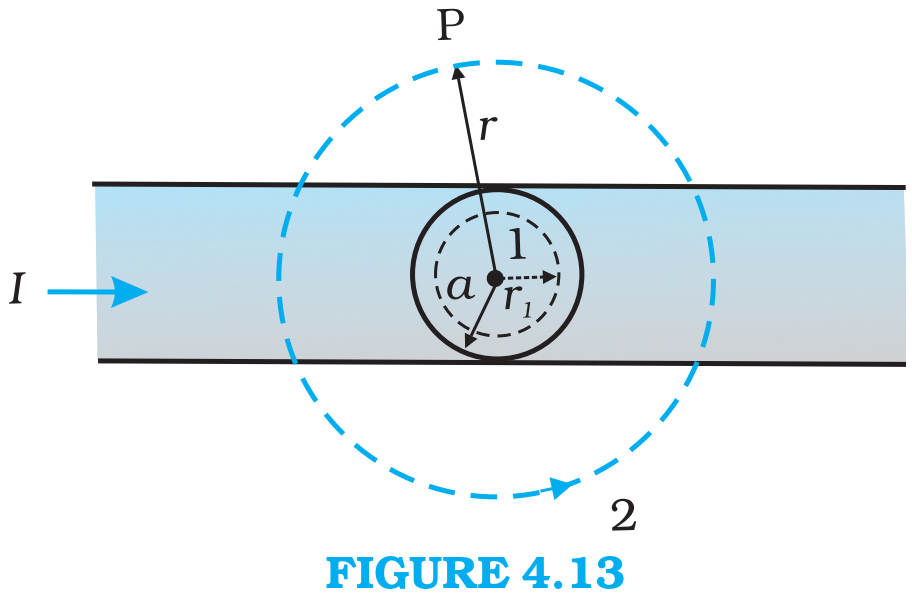
Figure 4.13 shows a long straight wire of a circular cross-section (radius a) carrying steady current $I$. The current $I$ is uniformly distributed across this cross-section. Calculate the magnetic field in the region $r<a$ and $r>a$.
Image
A capacitor of capacitance $10\mu\text{F}$ is connected to a battery of emf 2V. It is found that it takes 50ms for the charge of the capacitor to become $12.6\mu\text{C}.$ Find the resistance of the circuit.
A small source of sound oscillates in simple harmonic motion with an amplitude of 1.7cm. A detector is placed along the line of motion of the source. The source emits a sound of frequency 800Hz which travels at a speed of 340m/s. If the width of the frequency band detected by the detector is 8Hz, find the time period of the source.
An LC circuit contains a 20mH inductor and a 50μF capacitor with an initial charge of 10mC. The resistance of the circuit is negligible.
Let the instant the circuit is closed be t = 0.
  1. What is the total energy stored initially? Is it conserved during LC oscillations?
  2. What is the natural frequency of the circuit?
  3. At what time is the energy stored
  1. completely electrical (i.e., stored in the capacitor)?
  2. completely magnetic (i.e., stored in the inductor)?
  1. At what times is the total energy shared equally between the inductor and the capacitor?
  2. If a resistor is inserted in the circuit, how much energy is eventually dissipated as heat?
A capacitor of capacitance $12.0\mu\text{F}$ is connected to a battery of emf 6.00V and internal resistance $1.00\Omega$ through resistanceless leads. $12.0\mu\text{s}$ after the connections are made, what will be (a) the current in the circuit (b) the power delivered by the battery (c) the power dissipated in heat and (d) the rate at which the energy stored in the capacitor is increasing.
A monoenergetic electron beam with electron speed of 5.20 × 106 ms–1 is subject to a magnetic field of 1.30 × 10–4 T normal to the beam velocity. What is the radius of the circle traced by the beam, given e/m for electron equals 1.76 × 1011C kg–1.
Two wires of equal length, one of aluminium and the other of copper have the same resistance. Which of the two wires is lighter? Hence explain why aluminium wires are preferred for overhead power cables.
$(\rho_{\text{A}1}=2.63\times10^{-8}\Omega\ \text{m,}\ \text{Relative density of Al}=2.7,\ \text{of Cu}=8.9)$