Question
Consider an excited hydrogen atom in state n moving with a velocity u(ν << c). It emits a photon in the direction of its motion and changes its state to a lower state m. Apply momentum and energy conservation principles to calculate the frequency ν of the emitted radiation. Compare this with the frequency ν0 emitted if the atom were at rest.
Answer

Velocity of hydrogen atom in state ‘n’ = u
Also the velocity of photon = u
But u << C
Here the photon is emitted as a wave.
So its velocity is same as that of hydrogen atom i.e. u.
$\therefore$ Accounding to Doppler’s effect,
Frequency $\text{v}=\text{v}_0\bigg(\frac{1+\frac{\text{u}}{\text{c}}}{1-\frac{\text{u}}{\text{c}}}\bigg)$
as u <<< C
$1-\frac{\text{u}}{\text{c}}=\text{q}$
$\therefore\ \text{v}=\text{v}_0\bigg(\frac{1+\frac{\text{u}}{\text{c}}}{1}\bigg)=\text{v}_0\Big(1+\frac{\text{u}}{\text{c}}\Big)$
$\text{v}=\text{v}_0\Big(1+\frac{\text{u}}{\text{c}}\Big)$

Need a full question paper?

Generate a complete, print-ready paper with questions like this in minutes — across 16+ boards, with answer keys.

Start Generating Free

Similar questions

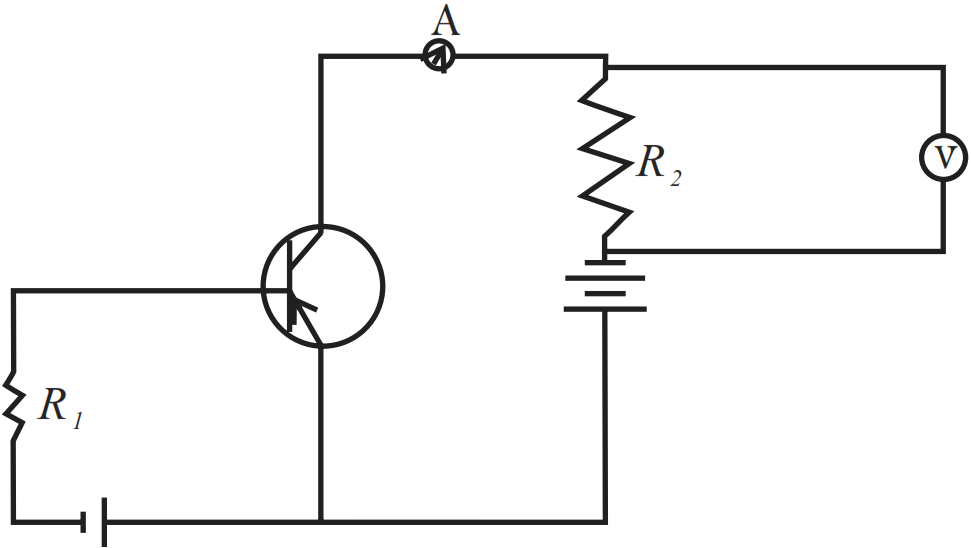
If the resistance R1 is increased (Fig.), how will the readings of the ammeter and voltmeter change?

A biconvex thick lens is constructed with glass $(\mu=1.50)$ Each of the surfaces has a radius of 10cm and the thickness at the middle is 5cm. Locate the image of an object placed far away from the lens.
The mixture a pure liquid and a solution in a long vertical column (i.e, horizontal dimensions < < vertical dimensions) produces diffusion of solute particles and hence a refractive index gradient along the vertical dimension. A ray of light entering the column at right angles to the vertical is deviated from its original path. Find the deviation in travelling a horizontal distance d < < h, the height of the column.
A circular coil of 200 turns has a radius of 10cm and carries a current of 2.0A.
  1. Find the magnitude of the magnetic field. B at the centre of the coil.
  2. At what distance from the centre along the axis of the coil will the field B drop to half its value at the centre? $\big(\sqrt[3]{4}=1.5874\ ...\big)$
Air is pumped into the tubes of a cycle rickshaw at a pressure of 2 atm. The volume of each tube at this pressure is 0.002m3. One of the tubes gets punctured and the volume of the tube reduces to 0.0005m3. How many moles of air have leaked out? Assume that the temperature remains constant at 300K and that the air behaves as an ideal gas.
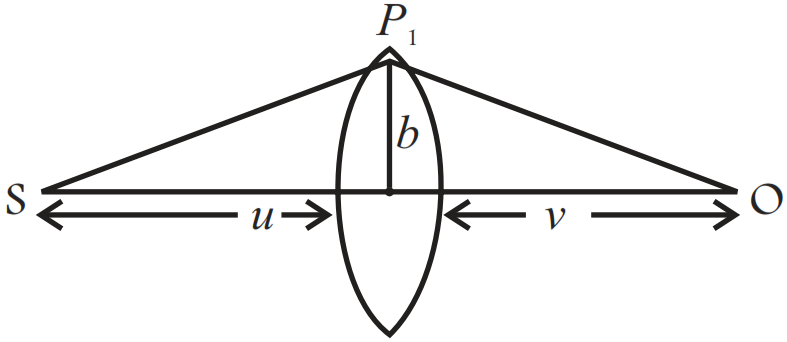
Consider a thin lens placed between a source (S) and an observer (O) (Fig). Let the thickness of the lens vary as $\text{w}\text{(b)}=\text{w}_0-\frac{\text{b}^2}{\alpha}$, where b is the verticle distance from the pole. w0 is a constant. Using Fermat’s principle i.e. the time of transit for a ray between the source and observer is an extremum, find the condition that all paraxial rays starting from the source will converge at a point O on the axis. Find the focal length.

(a) For circuits used for transporting electric power, a low power factor implies large power loss in transmission. Explain.
(b) Power factor can often be improved by the use of a capacitor of appropriate capacitance in the circuit. Explain.
A bullet of mass m moving at a speed v hits a ball of mass M kept at rest. A small part having mass m' breaks from the ball and sticks to the bullet. The remaining ball is found to move at a speed v1 in the direction of the bullet. Find the velocity of the bullet after the collision.
Is the formula you employ in (a) valid for calculating radius of the path of a 20 MeV electron beam? If not, in what way is it modified?
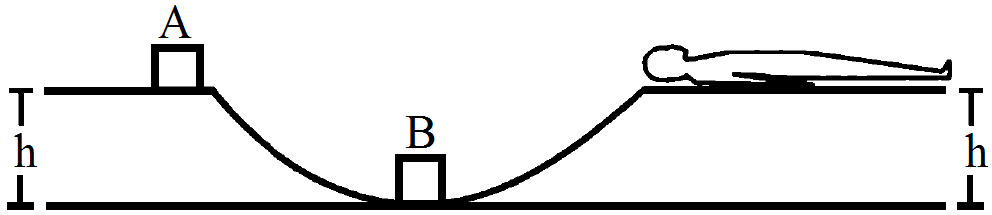
The track shown in figure is frictionless. The block B of mass 2m is lying at rest and the block A of mass m is pushed along the track with some speed. The collision between A and B is perfectly elastic. With what velocity should the block A be started to get the sleeping man awakened?