MCQ
Consider an npn transitor with its base-emitter junction forward biased and collector base junction reverse biased. Which of the following statements are true?
  • A
    Electrons crossover from emitter to collector.
  • B
    Holes move from base to collector.
  • C
    Electrons move from emitter to base.
  • D
    Electrons from emitter move out of base without going to the collector.

Answer

  1. Electrons crossover from emitter to collector.
  1. Electrons move from emitter to base.

Solution:

Key concept: Transistor:

A junction transistor is formed by sandwiching a thin layer of P-type semiconductor between two N-type semiconductors or by sandwiching a thin layer of N-type semiconductor between two p-type semiconductors.
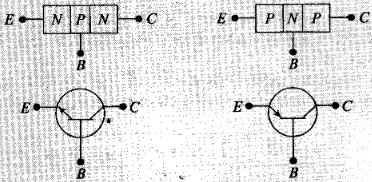
E - Emitter (emits majority charge carriers)

C - Collects majority charge carries

B - base (provide proper interaction between E and C)
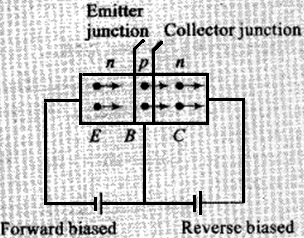
In normal operation base-emitter is forward biased, i.e., the positive pole of emitter base battery is connected to base and its negative pole is connected to the emitter. And collector base junction is reverse biased, i.e., the positive pole of the collector base battery is connected to collector and negative pole to base. Thus, electron moves from emitter to base and crossover from emitter to collector.

Need a full question paper?

Generate a complete, print-ready paper with questions like this in minutes — across 16+ boards, with answer keys.

Start Generating Free

Similar questions

An electric bulb is made to work at 12 V dc. When this bulb is joined with an ac source, it gives normal brightness. Peak voltage of ac source is:
A charged particle enters a magnetic field H with its initial velocity making an angle of 45° with H. Then the path of the particle will be:

Three observers A, B and C measure the speed of light coming from a source to be  and . The observer A moves towards the source, the observer C moves away from the source with the same speed. The observer B stays stationary. the surrounding space is vacuum every where. Then

(a)  

(b)  

(c)  

(d)  

The self inductance L of a solenoid of length l and area of crosssection A, with a fixed number of turns N increases as:
A bar magnet of magnetic moment M is cut into two parts of equal length. The magnetic moment of either part is :
The equivalent capacitance of the combination shown in figure is:

  1. C
  2. 2C
  3. $\frac{\text{C}}{2}$
  4. None of these.
Free 238U nuclei kept in a train emit alpha particles. When the train is stationary and a uranium nucleus decays, a passenger measures that the separation between the alpha particle and the recoiling nucleus becomes x in time t after the decay. If a decay takes place when the train is moving at a uniform speed v, the distance between the alpha particle and the recoiling nucleus at a time t after the decay, as measured by the passenger will be:
  1. x + vt
  2. x - vt
  3. x
  4. depends on the direction of the train.

de-Broglie wavelength of a body of mass 1 kg moving with velocity of 2000 m/s is

(a) 3.32 × 10⁻²⁷ Å

(b) 1.5 × 10⁷ Å

(c) 0.55 × 10⁻²² Å

(d) None of these

A rod of length 20 cm is rotating with angular speed of 100 rps in a magnetic field of strength 0.5 T about it’s one end. What is the potential difference between two ends of the rod

(a) 2.28 V

(b) 4.28 V

(c) 6.28 V  

(d) 2.5 V

When a hydrogen bomb explodes, which of the following is used?