MCQ
Consider an npn transitor with its base-emitter junction forward biased and collector base junction reverse biased. Which of the following statements are true?
  • A
    Electrons crossover from emitter to collector.
  • B
    Holes move from base to collector.
  • C
    Electrons move from emitter to base.
  • A and C both.

Answer

Correct option: D.
A and C both.
Solution:
Key concept: Transistor:
A junction transistor is formed by sandwiching a thin layer of P-type semiconductor between two N-type semiconductors or by sandwiching a thin layer of N-type semiconductor between two p-type semiconductors.
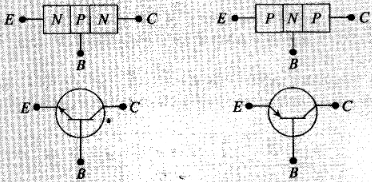
E - Emitter (emits majority charge carriers)
C - Collects majority charge carries
B - base (provide proper interaction between E and C)
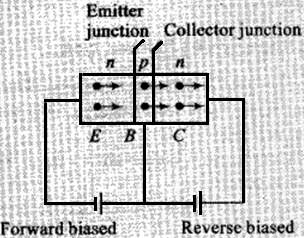
In normal operation base-emitter is forward biased, i.e., the positive pole of emitter base battery is connected to base and its negative pole is connected to the emitter. And collector base junction is reverse biased, i.e., the positive pole of the collector base battery is connected to collector and negative pole to base. Thus, electron moves from emitter to base and crossover from emitter to collector.
Need a full question paper?

Generate a complete, print-ready paper with questions like this in minutes — across 16+ boards, with answer keys.

Start Generating Free

Similar questions

$1 \ emu =.......... C$
Find the power of the circuit ............ $W$
The energy resides in a current carrying inductor in the form of:
A radio transmitter radiates $1 kW$ power at a wavelength $198.6 $ metres. How many photons does it emit per second
When $\text{npn}$ transistor is used as an amplifier:
Seven capacitors each of capacity 2μF are to be so connected to have a total capacity $\frac{10}{11}\mu F$. Which will be the necessary figure as shown 
Given below are two statements: One is labelled as Assertion $A$ and the other is labelled as Reason $R$.

Assertion $A:$ Two metallic spheres are charged to the same potential. One of them is hollow and another is solid, and both have the same radii. Solid sphere will have lower charge than the hollow one.

Reason $R:$ Capacitance of metallic spheres depend on the radii of spheres.

In the light of the above statements, choose the correct answer from the options given below.

A modulating signal $2 \sin \left(6.28 \times 10^{6}\right) t$ is added to the carrier signal $4 \sin \left(12.56 \times 10^{9}\right)$ t for amplitude modulation. The combined signal is passed through a non-linear square law device. The output is then passed through a band pass filter. The bandwidth of the output signal of band pass filter will be $MHz$.
Unpolarized light falls first on polarizer (P) and then on analyzer (A). If the intensity of the transmitted light from the analyser is $\frac{1}{8}\text{th}$ of the incident unpolarized light. What will be the angle between optic axes of P and A?
Consider a current carrying wire $($current $I)$ in the shape of a circle.