Question
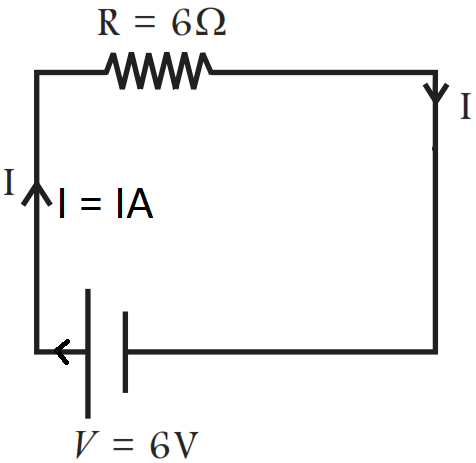
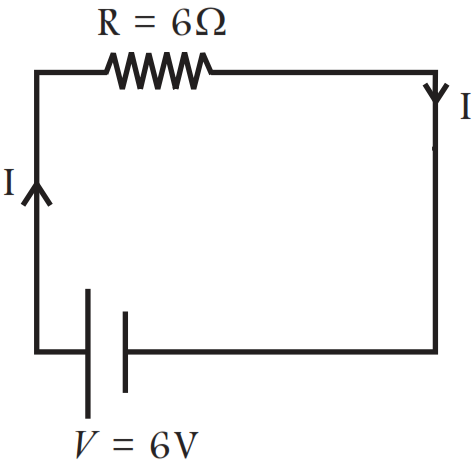
Consider circuit in Fig. How much energy is absorbed by electrons from the initial state of no current (ignore thermal motion) to the state of drift velocity?
Answer

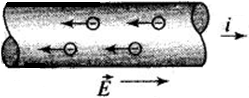
Key concept: Relation between current and drift velocity is given by I = ne Avd,
where vd is the drift speed of electrons and n is the number density of electrons.

According to the Ohm's law current in the circuit

$\text{I}=\frac{\text{V}}{\text{R}}$
$\text{I}=\frac{6\text{V}}{6\Omega}=1\text{A}$
But, $\text{I}=\text{neAv}_\text{d}$
or $\text{v}_\text{d}=\frac{\text{I}}{\text{neA}}$
On substituting the value,
For n = number of electrons/volume = 1029/m3
length of circuit = 10cm, cross-section = A = (1mm)2
$\text{v}_\text{d}=\frac{1}{10^{29}\times16\times10^{-19}\times10^{-6}}$
$=\frac{1}{1.6}\times10^{-4}\text{m/s}$
Therefore, the energy absorbed in the form of KE is given by
Total KE = KE of 1 electron × on. of electrons
$\text{KE}=\frac{1}{2}\text{m}_\text{e}\text{v}_\text{d}^2\times\text{nAl}$
$=\frac{1}{2}\times9.1\times10^{31}\times\frac{1}{2.56}\times10^{-8}\times{10}^{29}\times{10}^{-6}\times10^{-1}$
$=2\times10^{-17}\text{J}$

Need a full question paper?

Generate a complete, print-ready paper with questions like this in minutes — across 16+ boards, with answer keys.

Start Generating Free

Similar questions

k transparent slabs are arranged one over another. The refractive indices of the slabs are $\mu_1,\mu_2,\mu_3, \ ...\mu_{\text{k}}$ and the thicknesses are t1, t2, t3, ... tk . An object is seen through this combination with nearly perpendicular light. Find the equivalent refractive index of the system which will allow the image to be formed at the same place.
A mica strip and a polysterene strip are fitted on the two slits of a double slit apparatus. The thickness of the strips is 0.50mm and the separation between the slits is 0.12cm. The refractive index of mica and polysterene are 1.58 and 1.55 respectively for the light of wavelength 590nm which is used in the experiment. The interference is observed on a screen a distance one meter away.
  1. What would be the fringe-width?
  2. At what distance from the centre will the first maximum be located?
Two blocks of masses 400g and 200g are connected through a light string going over a pulley which is free to rotate about its axis. The pulley has a moment of inertia 1.6 x 10⁻⁴kg-m2 and a radius 2.0cm. Find:
  1. The kinetic energy of the system as the 400g block falls through 50cm.
  2. The speed of the blocks at this instant.
Suppose that the radius of cross-section of the wire used in the previous problem is r. Find the increase in the radius of the loop if the magnetic field is switched off. Young's modulus of the material of the wire is Y.
A hydrogen atom moving at speed υ collides with another hydrogen atom kept at rest. Find the minimum value of υ for which one of the atoms may get ionized. The mass of a hydrogen atom = 1.67 × 10⁻²⁷kg.
Consider a non-conducting plate of radius r and mass m that has a charge q distributed uniformly over it. The plate is rotated about its axis with an angular speed $\omega.$ Show that the magnetic moment $\mu$ and the angular momentum of the plate are related as $\mu=\frac{\text{q}}{2\text{m}}\text{l}.$
A conducting square loop having edges of length 2.0cm is rotated through 180° about a diagonal in 0.20s. A magnetic field B exists in the region which is perpendicular to the loop in its initial position. If the average induced emf during the rotation is 20mV, find the magnitude of the magnetic field.
A $100\mu\text{F}$ capacitor is joined to a 24V battery through a $1.0\text{M}\Omega$ resistor. Plot qualitative graphs (a) between current and time for the first 10 minutes and (b) between charge and time for the same period.
A point object 'O' is kept in a medium of refractive index n1 in front of a convex spherical surface of radius of curvature R which separates the second medium of refractive index n2 from the first one, as shown in the figure.
  1. Draw the ray diagram showing the image formation and deduce the relationship between the object distance and the image distance in terms of n1, n2 and R.
  2. When the image formed above acts as a virtual object for concave spherical, surface separating the medium n2 from n1 (n2> n1), draw this ray diagram and write the similar (similar to (a) relation. Hence obtain the expression for the lens maker's formula.
Two waves, each having a frequency of 100Hz and a wavelength of 2.0cm, are travelling in the same direction on a string. What is the phase difference between the waves,
  1. If the second wave was produced 0.015s later than the first one at the same place.
  2. If the two waves were produced at the same instant but the first one was produced a distance 4.0cm behind the second one?
  3. If each of the waves has an amplitude of 2.0mm, what would be the amplitudes of the resultant waves in part (a) and (b)?