MCQ
Consider four conducting materials copper, tungsten, mercury and aluminium with resistivity $\rho_{ C }, \rho_{ T }, \rho_{ M }$ and $\rho_{ A }$ espectively Then:
  • A
    $\rho_{ A }>\rho_{ T }>\rho_{ C }$
  • B
    $\rho_{ C }>\rho_{ A }>\rho_{ T }$
  • C
    $\rho_{A}>\rho_{M}>\rho_{C}$
  • $\rho_{ M }>\rho_{ A }>\rho_{ C }$

Answer

Correct option: D.
$\rho_{ M }>\rho_{ A }>\rho_{ C }$
d
$\rho_{ M }>\rho_{ A }>\rho_{ C }$

Need a full question paper?

Generate a complete, print-ready paper with questions like this in minutes — across 16+ boards, with answer keys.

Start Generating Free

Similar questions

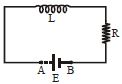
An inductor $(L = 100\, mH),$ a resistor $(R = 100 \, \Omega )$ and a battery $(E = 100 \,V)$ are initially connected in series as shown in the figure. After a long time the battery is disconnected after short circuiting the points $A$ and $B.$ The current in the circuit $1 \,ms$ after the short circuit is-
In Young's double slit arrangement, water is filled in the space between screen and slits. Then :
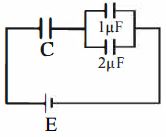
In the given circuit, charge $Q_2$ on the $2\ μF$ capacitor changes as $C$ is varied from $1\ μF$ to $3\ μF$. $Q_2$ as a function of '$C$' is given properly by: (figures are drawn schematically and are not to scale)
The de Broglie wavelength of an electron having kinetic energy $E$ is $\lambda$. If the kinetic energy of electron becomes $\frac{E}{4}$, then its de-Broglie wavelength will be :
Venus appears brighter than other stars because
The resistance of a galvanometer is 90 ohms. If only 10 percent of the main current may flow through the galvanometer, in which way and of what value, a resistor is to be used
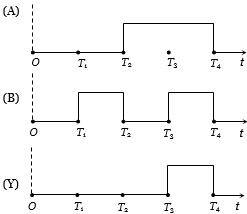
The given figure shows the wave forms for two inputs $A$ and $B$  and that for the output Y of a logic circuit. The logic circuit is
Einstein's photoelectric equation states that ${E_k} = h\nu - \phi $. In this equation ${E_k}$ refers to
Which radiation in sunlight, causes heating effect
Orange light of wavelength $6000 \times 10^{-10}\, m$ in illuminates a single slit of width $0.6 \times 10^{-4}\, m$ The maximum possible number of diffraction minima produced on both sides of the central maximum is$........$