MCQ
Consider given endothermic reaction at equilibrium, $PCl_5(g) \rightleftharpoons  PCl_3(g) + Cl_2(g) $

A graph is plotted between concentration and time as shown. Effect$-1$  &   Effect$-2$ are due to respectively
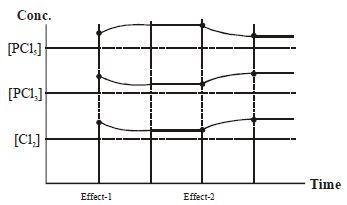
  • $P$ increase, $T$ increase
  • B
    $P$ increase, $T$ decrease
  • C
    Inert gas added at constant pressure, $T$ increase
  • D
    $P$ decrease, $T$ decrease

Answer

Correct option: A.
$P$ increase, $T$ increase
a

Need a full question paper?

Generate a complete, print-ready paper with questions like this in minutes — across 16+ boards, with answer keys.

Start Generating Free

Similar questions

The uncertainty principle was enunciated by
For the isothermal expansion of an ideal gas
Polarity in a molecule and hence the dipole moment depends primarily on electronegativity of the constituent atoms and shape of a molecule. Which of the following has the highest dipole moment?
Which of the following compounds is not aromatic?
The equilibrium concentrations of the species in the reaction $A + B \rightleftharpoons C + D$ are $2,3,10$ and $6\,mol\,L-1$, respectively at $300\,K . \Delta G ^{\circ}$ for the reaction is ( $\left.R =2\,cal / mol\, K \right)$
The number of optical isomers for the given compound

$\begin{array}{*{20}{c}}
  {C{H_3} - CH - CH - C{H_2} - COOH} \\ 
  {|\,\,\,\,\,\,\,\,\,\,\,\,\,|\,\,\,\,\,\,\,\,\,\,\,\,\,\,\,\,\,\,\,\,\,\,\,\,\,\,} \\ 
  {\,\,OH\,\,\,\,\,\,\,\,Cl\,\,\,\,\,\,\,\,\,\,\,\,\,\,\,\,\,\,\,\,\,\,\,\,\,\,\,\,\,} 
\end{array}$

What are A and B in following reaction? $ \ \ \ \ \ \ \ \ \ \ \ \ \ \text{H}\\ \ \ \ \ \ \ \ \ \ \ \ \ \ |\\\text{H}_2\text{C}-\text{C}-\text{H}+\text{KOH}\xrightarrow{\text{Alcohol}}\text{A}\xrightarrow{\text{NaNH}_2}\text{B}\\ \ \ \ \ \ \ | \ \ \ \ \ \ |\\ \ \ \ \ \ \text{Br} \ \ \ \text{Br}$
If in the reaction ${N_2}{O_4} = 2N{O_2},\,\alpha $ is that part of ${N_2}{O_4}$ which dissociates, then the number of moles at equilibrium will be
If $\alpha $ is the degree of ionization, $C$ the concentration of a weak electrolyte and ${K_a}$the acid ionization constant, then the correct relationship between $\alpha ,\,\,C$ and ${K_a}$is
For the given hypothetical reactions, the equilibrium constants are as follows:

$\mathrm{X} \rightleftharpoons \mathrm{Y} ; \mathrm{K}_1=1.0$

$\mathrm{Y} \rightleftharpoons \mathrm{Z} ; \mathrm{K}_2=2.0$

$\mathrm{Z} \rightleftharpoons \mathrm{W} ; \mathrm{K}_3=4.0$

The equilibrium constant for the reaction $\mathrm{X} \rightleftharpoons \mathrm{W}$ is