MCQ
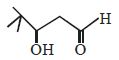
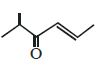
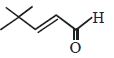
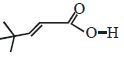
Consider reaction sequence and identify $'C' ?$

$A + B\xrightarrow{{dil\,NaOH/\Delta }}C$

  • A

  • B


  • D

Answer

Correct option: C.

c

Need a full question paper?

Generate a complete, print-ready paper with questions like this in minutes — across 16+ boards, with answer keys.

Start Generating Free

Similar questions

Amongst sodium halides $(NaF, NaCl, NaBr$ and $Nal), NaF$ has the highest melting  point because of
What will be $\Delta S$ for reaction: $2A + 3B \to 4C + 5D$

$\Delta S_A^o = 100\frac{J}{{mol \times k}}$   $\Delta S_C^o = 200\frac{J}{{mol \times k}}$

$\Delta S_B^o = 120\frac{J}{{mol \times k}}$   $\Delta S_D^o = 150\frac{J}{{mol \times k}}$
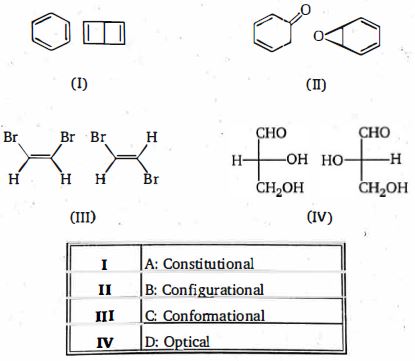
The relationship among the following pairs of isomers is
Which are the correct IUPAC names of the following compound?
$\ \ \ \ \ \ \ \ \ \ \ \ \ \ \ \ \ \ \ \ \ \ \ \ \ \ \ \ \ \ \ \ \ \ \ \text{HC(CH}_3)_2\\\ \ \ \ \ \ \ \ \ \ \ \ \ \ \ \ \ \ \ \ \ \ \ \ \ \ \ \ \ \ \ \ \ \ \ \ \ \ \ |\\\text{H}_3\text{C}-\text{CH}_2-\text{CH}_2-\text{CH}-\text{CH}-\text{CH}_2-\text{CH}_2-\text{CH}_2-\text{CH}_2-\text{CH}_3\\\ \ \ \ \ \ \ \ \ \ \ \ \ \ \ \ \ \ \ \ \ \ \ \ \ \ \ \ \ \ \ \ \ \ \ \ \ \ \ \ \ \ \ \ \ \ \ \ \ \ |\\\ \ \ \ \ \ \ \ \ \ \ \ \ \ \ \ \ \ \ \ \ \ \ \ \ \ \ \ \ \ \ \ \ \ \ \ \text{H}_3\text{C}-\text{CH}-\text{CH}_2\text{CH}_3$
In the manufacture of ammonia by Haber's process, ${N_{2(g)}} + 3{H_2}$ $\rightleftharpoons$ $2N{H_{3(g)}} + 92.3\,kJ$,which of the following conditions is unfavourable
The solubility of $Ca{F_2}$ is a moles/litre. Then its solubility product is …..
Five valence electrons of $P^{15}$ are labelled as $\mathop {\boxed{AB}}\limits_{3s} \,\mathop {\boxed{X|Y|Z}}\limits_{3p} $ If the spin quantum numbers of $B$ and $Z$ is $ + \frac{1}{2}$ , the group of electron with three of the quantum number $(n, l, m)$ same are
Which of the configuration is correct :-
${H_{2(g)}} + {I_{2(g)}}$ $\rightleftharpoons$ $2H{I_{(g)}}\,\,\,\Delta H = + q$ $cal,$ then formation of $HI:$
An atom has $x$ energy level, then total number of lines in its spectrum are