MCQ
Consider sunlight incident on a slit of width ${10^4}\,\mathop A\limits^o $. The image seen through the slit shall
  • A
    be a fine sharp slit, white colour at the centre
  • B
    a bright slit white at the centre diffusing to zero intensities at the edges
  • a bright slit white at centre diffusing to regions of different colours
  • D
    only be a diffused slit white in colour
Answer

Correct option: C.
a bright slit white at centre diffusing to regions of different colours
c
since the width of slit is comparable to that of wavelength diffraction occurs with maxima at centre. Therefore, at the centre all colours appear i.e, mixing of colours from white patch at centre

Need a full question paper?

Generate a complete, print-ready paper with questions like this in minutes — across 16+ boards, with answer keys.

Start Generating Free

Similar questions

$Q$-value of the decay ${ }_{11}^{22} Na \rightarrow{ }_{10}^{22} Ne + e ^{+}+v$ is
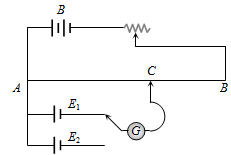
The circuit shown here is used to compare the e.m.f. of two cells $E_1$ and $E_2\left(E_1>E_2\right)$. The null point is at C when the galvanometer is connected to $E_1$. When the galvanometer is connected to $E_2$, the null point will be
Two resistors having equal resistances are joined in series and a current is passed through the combination. Neglect any variation in resistance as the temperature changes. In a given time interval
Which of the following support the quantum nature of the $EM$ radiations

$(A)$  Photoelectric effect     $(B)$  Compton effect
$(C)$ Doppler's effect            $(D)$  Field effect

The binding energy per nucleon of $0^{16}$ is 7.97 MeV and that of $O ^{17}$ is 7.75 MeV . The energy (in MeV ) required to remove a neutron from $O ^{17}$ is 
Consider sunlight incident on a slit of width $10^4A$. The image seen through the slit shall.
A series $LCR$ circuit consists of $R =80\,\Omega X _{ L }=100\, \Omega$ and $X _{ C }=40\, \Omega$ The input voltage is $2500 \cos (100 \pi t )\,V$. The amplitude of current, in the circuit, is $................A.$
The heating coils rating at 220 volt and producing 50 cal/sec heat are available with the resistances 55Ω,110 Ω, 220 Ω and 440 Ω. The heater of maximum power will be of
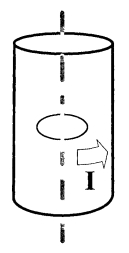
A long circular tube of length $10 \ m$ and radius $0.3 \ m$ carries a current $I$ along its curved surface as shown. A wire-loop of resistance $0.005$ ohm and of radius $0.1 \ m$ is placed inside the tube with its axis coinciding with the axis of the tube. The current varies as $I=I_0 \cos (300 t)$ where $I_0$ is constant. If the magnetic moment of the loop is $N \mu_0 I_0 \sin (300 t)$, then ' $N$ ' is
The transition of electron from $n = 4, 5, 6, .......$ to $n = 3$ corresponds to: