Question
Consider the and answer the following questions.
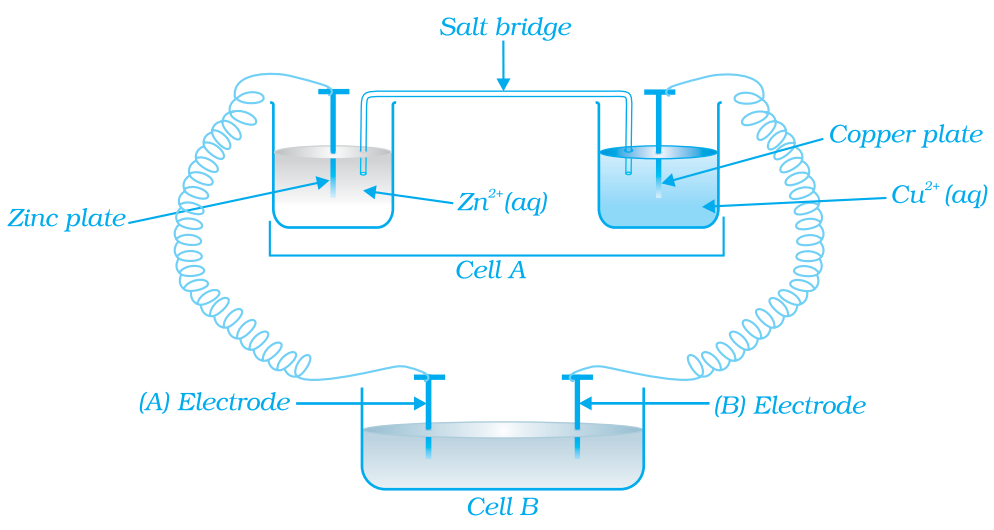
  1. Cell $'A\ ’$ has $E_{Cell}= 2V$ and Cell $'B\ ’$ has $E_{Cell} = 1.1V$ which of the two cells $'A\ ’$ or $'B\ ’$ will act as an electrolytic cell. Which electrode reactions will occur in this cell?
  2. If cell $'A\ ’$ has $E_{Cell}= 0.5V$ and cell $'B\ ’$ has $E_{Cell}= 1.1V$ then what will be the reactions at anode and cathode?

Answer

  1. Cell ‘B’ will act as electrolytic cell as it has lower emf
$\therefore$ The electrode reactions will be:
$\text{zn}^{2+}+2\text{e}^{-}\xrightarrow{\ \ \ \ \ \ \ \ \ \ \ }\text{zn}\ \ \text{ at cathode}$
$\text{Cu}\xrightarrow{\ \ \ \ \ \ \ \ \ \ \ }\text{Cu}^{2+}+2\text{e}^-\ \ \text{ at anode}$
  1. Now cell $'B\ ’$ acts as galvanic cell as it has higher emf and will push electrons into cell $‘A’.$
The electrode reaction will be:
$\text{at cathode}\ \ \text{ zn}\xrightarrow{\ \ \ \ \ \ \ \ \ \ \ }\text{zn}^{2+}+2\text{e}^{-}$
$\text{ at anode}\ \ \ \text{Cu}^{2+}+2\text{e}^-\xrightarrow{\ \ \ \ \ \ \ \ \ \ \ }\text{Cu}$

Need a full question paper?

Generate a complete, print-ready paper with questions like this in minutes — across 16+ boards, with answer keys.

Start Generating Free

Similar questions

  1. What may be the possible oxidation states of the transition metals with the following d electronic configurations in the ground state of their atoms:
  1. $3d^34s^2, 3d^54s^2$ and $3d^6 4s^3$. Indicate relative stability of oxidation states in each case.
  2. Write steps involved in the preparation of $(i) Na_2CrO_4$ from chromite ore and $(ii) K_2MnO_4$ from pyrolusite ore.
An aromatic compound $'A\ ’$ on treatment with $\ce{CHCl_3/ KOH}$ gives two compounds $'B\ ’$ and $'C\ ’.$ Both $B$ and $C$ give the same product $'D\ ’$ when distilled with zinc dust. Oxidation of $D$ gives $E$ having molecular formula $\ce{C_7H_6O_2}.$ The sodium salt of $E$ on heating with sodalime gives $F$ which may also be obtained by distilling $A$ with zinc dust. Identify $A$ to $F.$
Attempt any five of the following:
$(a)$ Deficiency of which vitamin causes night-blindness.
$(b)$ Give two examples of reducing sugars.
$(c)$ Define the following terms:
$i.$ Glycosidic linkage
$ii.$ Native protein
$(d)$ Write function of carbohydrates in plants.
$(e)$ Differentiate between:
$i.$ Peptide linkage and Glycosidic linkage
$ii.$ Nucleoside and Nucleotide
$(f)$ What type of linkage holds together the monomers of $\text{DNA}$?
$(g)$ Write the product obtained when $D-$glucose reacts with $H_2N-OH.$
  1. The acid strength of alcohols decreases in the order
  1. Phenol is more easily nitrated than benzene.
How would you convert aniline into :
(i) Chlorobenzene
(ii) Benzoic acid
(iii) Fluorobenzene?
What is vapour pressure? When a non- volatile solute is dissolved in any liquid, the vapour pressure of the liquid decreases. Give reason.
Decinormal solution of NaCl developed an osmotic pressure of 4.6 atm at 300 K. Calculate the degree of dissociation.
What is adsorption isotherm? Describe the Freundlich adsorption isotherm.
When kept in water, raisin swells in size. Name and explain the phenomenon involved with the help of a diagram. Give three applications of the phenomenon.
The air is a mixture of a number of gases. The major components are oxygen and nitrogen with approximate proportion of $20\%$ is to $79\%$ by volume at $298\ K.$ The water is in equilibrium with air at a pressure of $10\ atm.$ At $298\ K$ if the Henry’s law constants for oxygen and nitrogen at $298\ K$ are $3.30 \times 10^7\ mm$ and $6.51 \times 10^7\ mm$ respectively, calculate the composition of these gases in water.