Question
✓
Answer
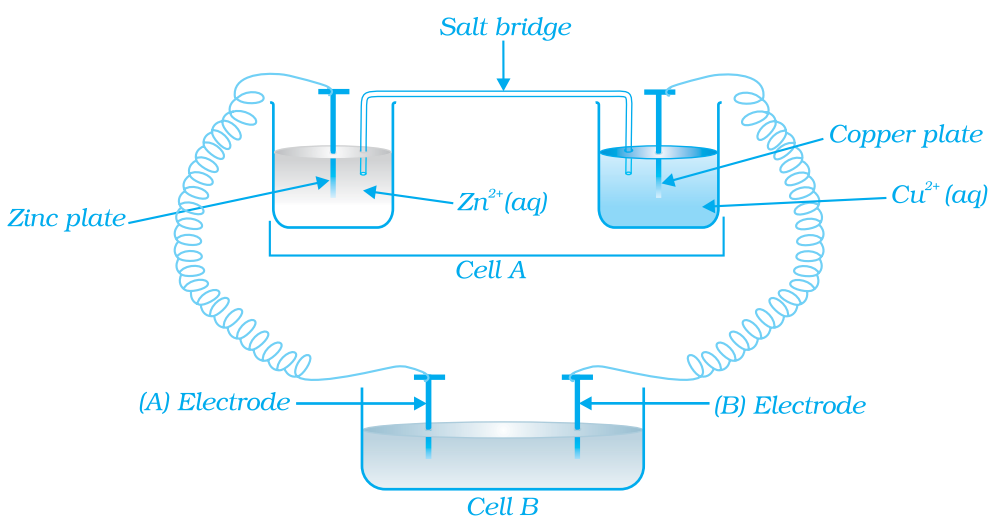
- Cell ‘B’ will act as electrolytic cell as it has lower emf
$\therefore$ The electrode reactions will be:
$\text{zn}^{2+}+2\text{e}^{-}\xrightarrow{\ \ \ \ \ \ \ \ \ \ \ }\text{zn}\ \ \text{ at cathode}$
$\text{Cu}\xrightarrow{\ \ \ \ \ \ \ \ \ \ \ }\text{Cu}^{2+}+2\text{e}^-\ \ \text{ at anode}$
- Now cell ‘B’ acts as galvanic cell as it has higher emf and will push electrons into cell ‘A’.
The electrode reaction will be:
$\text{at cathode}\ \ \text{ zn}\xrightarrow{\ \ \ \ \ \ \ \ \ \ \ }\text{zn}^{2+}+2\text{e}^{-}$
$\text{ at anode}\ \ \ \text{Cu}^{2+}+2\text{e}^-\xrightarrow{\ \ \ \ \ \ \ \ \ \ \ }\text{Cu}$
Need a full question paper?
Generate a complete, print-ready paper with questions like this in minutes — across 16+ boards, with answer keys.
Explore more
Similar questions
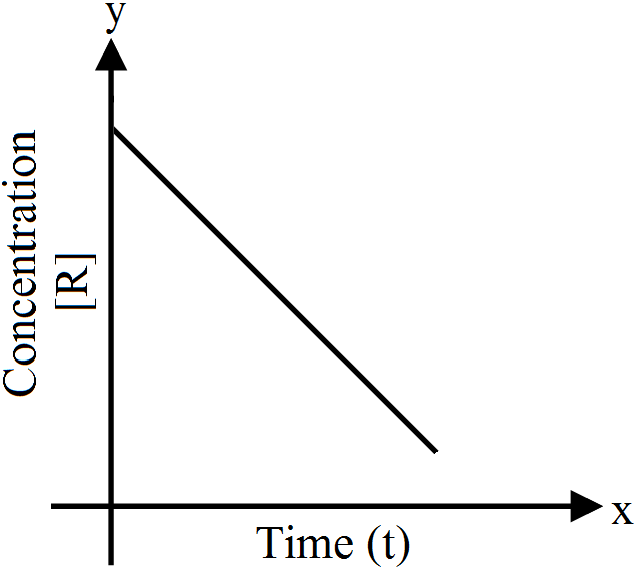
Consider the reaction $\text{R}\xrightarrow{\ \ \text{k}\ \ } \text{P}.$ The change in concentration of R with time is shown in the following plot:
→- Predict the order of the reaction.
- Derive the expression for the time required for the completion of the reaction.
- What does the slope of the above line indicate?
Explain the various methods of preparation of $CHCl _3$ and its chemical properties.
→Explain the structure and classification of animes.
How are different aromatic compounds synthesized by benzene diazonium chloride? Explain with examples.
Magnetic properties of coordination compounds. Explain in detail.
Match the terms given in Column I with the units given in Column II.
| | Column I | | Column II |
| i. | ∧m | a. | S cm-1 |
| ii. | ECell | b. | m- |
| iii. | K | c. | S cm2 mol-1 |
| iv. | G* | d. | V |
How will you distinguish $1^{\circ}, 2^{\circ}$ and $3^{\circ}$ alcohols by Victor Mayer Test? Explain.
→- Define the following terms:
- Molarity.
- Molal elevation constant(Kb).
- A solution containing 15 g urea (molar mass = 60 g mol–1) per litre of solution in water has the same osmotic pressure (isotonic) as a solution of glucose (molar mass = 180 g mol–1) in water. Calculate the mass of glucose present in one litre of its solution.
What is crystal field theory? On the basis of this, explain the crystal field splitting in octahedral coordinaton compounds.
Answer the following question:
How will you convert phenol to benzoic acid?
How will you convert phenol to benzoic acid?