Question
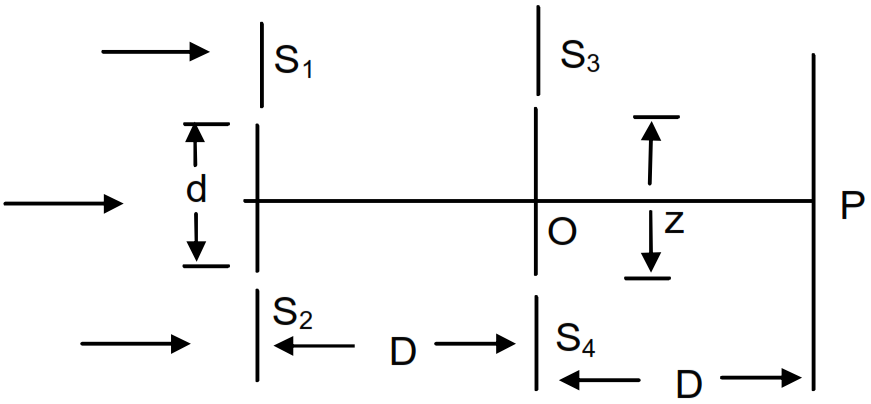
Consider the arrangement shown in figure. By some mechanism, the separation between the slits $S_3$ and $S_4$ can be changed. The intensity is measured at the point $P$ which is at the common perpendicular bisector
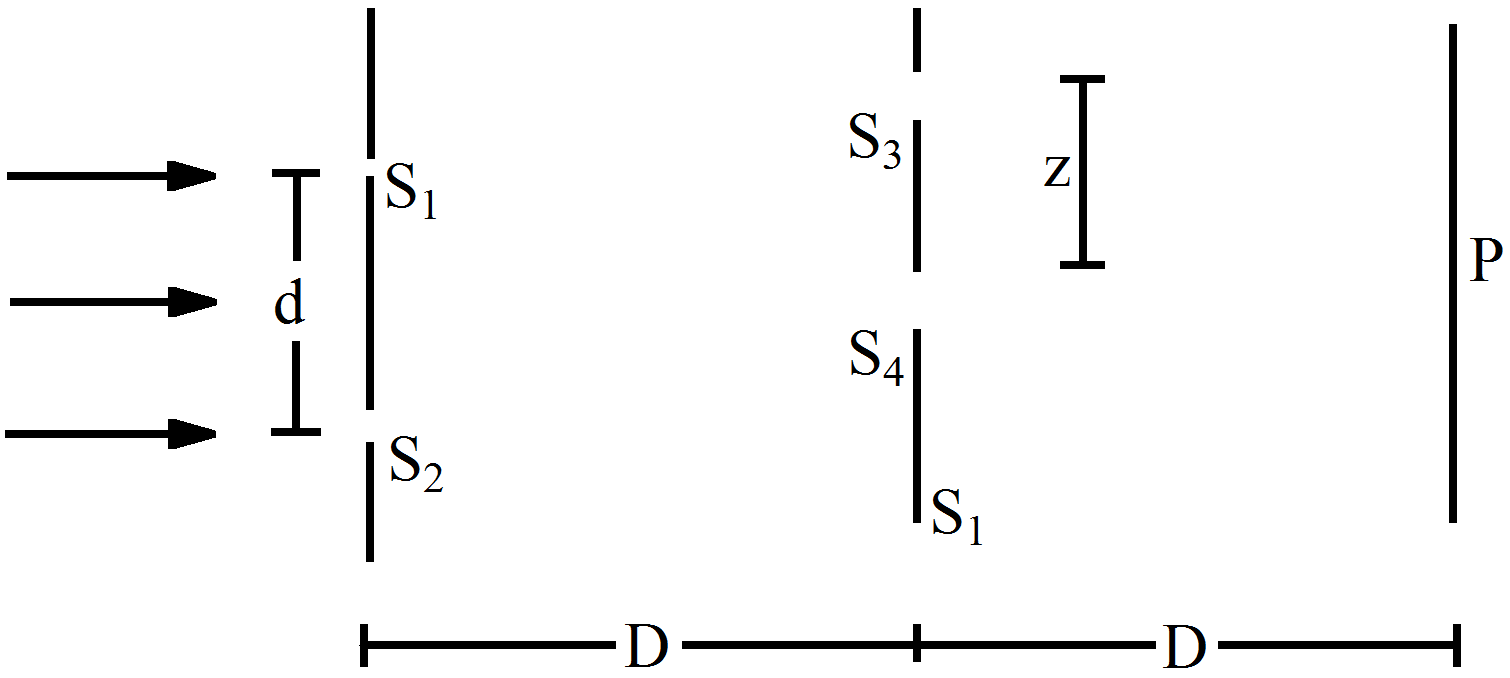
of $S_1S_2$ and $S_3S_4$. When $\text{z}=\frac{\text{D}\lambda}{2\text{d}},$ intensity measured at $P$ is I. Find this intensity when $z$ is equal to:
  1. $\frac{\text{D}\lambda}{\text{d}}$
  2. $\frac{3\text{D}\lambda}{2\text{d}}$
  3. $\frac{2\text{D}\lambda}{\text{d}}$
Answer


  1. When, $\text{z}=\frac{\text{D}\lambda}{\text{d}}$
So, $\text{OS}_3=\text{OS}_4=\frac{\text{D}\lambda}{2\text{d}}$
$\Rightarrow$ Dark fringe at $S_3$ and $S_4.$
$\Rightarrow$ At $S_3$, intensity at $S_3 = 0$
$\Rightarrow I_1 = 0$
At $S_4,$ intensity at $S_4 = 0$
$\Rightarrow I_2 = 0$
At P, path difference $= 0$
$ \Rightarrow$ Phase difference $= 0.$
$\Rightarrow\text{I}=\text{I}_1+\text{I}_2+\sqrt{\text{I}_1\text{I}_2}\cos0^\circ=0+0+0=0$
$\Rightarrow$ Intensity at $P = 0.$
  1. Given that, when $\text{z}=\frac{\text{D}\lambda}{2\text{d}}$, intensity at $P = I$
Here, $\text{OS}_3=\text{OS}_4=\text{y}=\frac{\text{D}\lambda}{4\text{d}}$
$\therefore\phi=\frac{2\pi\text{x}}{\lambda}=\frac{2\pi}{\lambda}\times\frac{\text{yd}}{\text{D}}=\frac{2\pi}{\lambda}\times\frac{\text{D}\lambda}{4\text{d}}\times\frac{\text{d}}{\text{D}}=\frac{\pi}{2}.$
$\Big[$Since, $x =$ path difference $=\frac{\text{yd}}{\text{D}}\Big]$
Let, intensity at $S_3$ and $S_4 = I'$
$\therefore$ At $P$, phase difference $= 0$
So, $\text{I}'+\text{I}'+2\text{I}'\cos0^\circ=\text{I}$
$\Rightarrow4\text{I}'=\text{I}\Rightarrow\text{I}'=\frac{1}{4}$
When, $\text{z}=\frac{3\text{D}\lambda}{2\text{d}},\Rightarrow\text{y}=\frac{3\text{D}\lambda}{4\text{d}}$
$\therefore\phi=\frac{2\pi\text{x}}{\lambda}=\frac{2\pi}{\lambda}\times\frac{\text{yd}}{\text{D}}=\frac{2\pi}{\lambda}\times\frac{3\text{D}\lambda}{4\text{d}}\times\frac{\text{d}}{\text{D}}=\frac{3\pi}{2}$
Let,$I$'' be the intensity at $S_3$ and $S_4$ when, $\phi=\frac{3\pi}{2}$
Now comparing,
$\frac{\text{I}"}{\text{I}}=\frac{\text{a}^2+\text{a}^2+2\text{a}^2\cos\Big(\frac{3\pi}{2}\Big)}{\text{a}^2+\text{a}^2+2\text{a}^2\cos\frac{\pi}{2}}=\frac{2\text{a}^2}{2\text{a}^2}=1$ $\Rightarrow\text{I}"=\text{I}'=\frac{\text{I}}{4}$
$\therefore$ Intensity at $\text{P}=\frac{\text{I}}{4}+\frac{\text{I}}{4}+2\times\Big(\frac{\text{I}}{4}\Big)\cos0^\circ=\frac{\text{I}}{2}+\frac{\text{I}}{2}=1$
  1. When $\text{z}=\frac{2\text{D}\lambda}{\text{d}}$
$\Rightarrow\text{y}=\text{OS}_3=\text{OS}_4=\frac{\text{D}\lambda}{\text{d} }$
$\therefore\phi=\frac{2\pi\text{X}}{\lambda}=\frac{2\pi}{\lambda}\times\frac{\text{yd}}{\text{D}}=\frac{2\pi}{\lambda}\times\frac{\text{D}\lambda}{\text{d}}\times\frac{\text{d}}{\text{D}}=2\pi.$
Let, $I"' =$ intensity at $S_3$ and $S_4$ when, $\phi=2\pi.$
$\frac{\text{I}'''}{\text{I}'}=\frac{\text{a}^2+\text{a}^2+2\text{a}^2\cos2\pi}{\text{a}^2+\text{a}^2+2\text{a}^2\cos\frac{\pi}{2}}=\frac{4\text{a}^2}{2\text{a}^2}=2$
$\Rightarrow\text{I}'''=2\text{I}'=2\Big(\frac{\text{I}}{4}\Big)=\frac{\text{I}}{2}$
At $P, I_{resultant} =\frac{\text{I}}{2}+\frac{\text{I}}{2}+2\Big(\frac{\text{I}}{2}\Big)\cos0^\circ=\text{I}+\text{I}=2\text{I}$
So, the resultant intensity at $P$ will be $2I.$

Need a full question paper?

Generate a complete, print-ready paper with questions like this in minutes — across 16+ boards, with answer keys.

Start Generating Free

Similar questions

A wire of resistance $15.0\Omega$ is bent to form a regular hexagon ABCDEFA. Find the equivalent resistance of the loop between the points (a) A and B (b) A and C and (c) A and D.
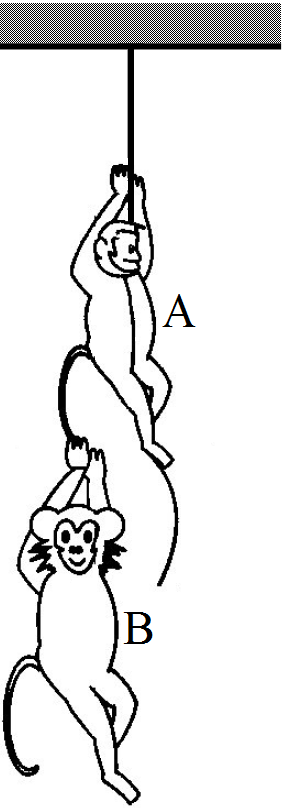
The monkey $B$ shown in figure is holding on to the tail of the monkey A which is climbing up a rope. The masses of the monkeys $A$ and $B$ are $5\ kg$ and $2\ kg$ respectively. If $A$ can tolerate a tension of $30N$ in its tail, what force should it apply on the rope in order to carry the monkey $B$ with it? Take $ g = 10m/s^2$​​​​​​​
Two parallel coaxial circular coils of equal radius ‘R’ and equal number of turns ‘N’, carry equal currents ‘I’ in the same direction and are separated by a distance ‘2R’. Find the magnitude and direction of the net magnetic field produced at the mid-point of the line joining their centres.
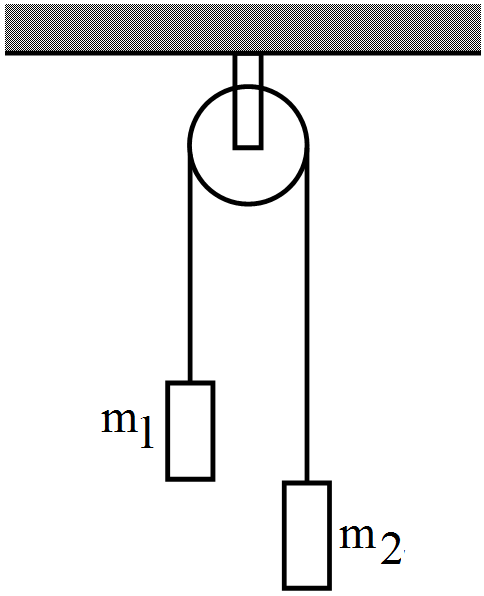
In a simple Atwood machine, two unequal masses $m_1$ and $m_2$ are connected by a string going over a clamped light smooth pulley. In a typical arrangement $m_1 = 300g$ and $m_2 = 600g$. The system is released from rest.
  1. Find the distance travelled by the first block in the first two seconds.
  2. Find the tension in the string.
  3. Find the force exerted by the clamp on the pulley.
An electron is emitted with negligible speed from the negative plate of a parallel$-$plate capacitor charged to a potential difference $V$. The separation between the plates is $d$ and $a$ magnetic field Bexists in the space, as shown in the figure. Show that the electron will fail to strike the upper plates if $\text{d} > \Big(\frac{2\text{m}_\text{e}\text{v}}{\text{eB}^2}\Big)^{\frac{1}{2}}.$
Derive the lens formula,  $\frac{1}{\text{f}} = \frac{1}{\text{v}} - \frac{1}{\text{u}}$ for a concave lens, using the necessary ray diagram.
Two lenses of powers 10 D and – 5 D are placed in contact.
  1. Calculate the power of the new lens.
  2. Where should an object be held from the lens, so as to obtain a virtual image of magnification 2?
A proton projected in a magnetic field of $0.020T$ travels along a helical path of radius $5.0\ cm$ and pitch $20\ cm.$ Find the components of the velocity of the proton along and perpendicular to the magnetic field. Take the mass of the proton $= 1.6 \times 10^{-27}kg$
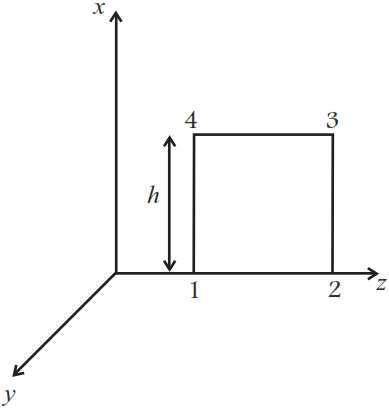
A plane EM wave travelling in vacuum along z direction is given by $\text{E}=\text{E}_0\sin(\text{kz}-\omega\text{t})\hat{\text{i}}\text{ and }\text{B}=\text{B}_0\sin(\text{kz}-\omega\text{t})\hat{\text{j}}$.
  1. Evaluate $\oint\text{E.dl}$ over the rectangular loop 1234 shown in Fig.
  2. Evaluate $\int\text{B.ds}$ over the surface bounded by loop 1234.
  3. Use equation $\oint\text{E.dl}=\frac{-\text{d}\phi_\text{B}}{\text{dt}}$ to prove $\frac{\text{E}_0}{\text{B}_0}=\text{c}$.
  4. By using similar process and the equation $\oint\text{B.dl}=\mu_0\text{I}+\epsilon_0\frac{\text{d}\phi_\text{E}}{\text{dt}}$, prove that $\text{c}=\frac{1}{\sqrt{\mu_0\epsilon_0}}$.
​​​​​​​
A coil of inductance $0.50H$ and resistance $100\Omega $ is connected to a $240V, 50Hz \ \ ac $supply.
  1. What is the maximum current in the coil?
  2. What is the time lag between the voltage maximum and the current maximum?
Four equal charges $2.0 \times 10^{-6}C$ each are fixed at the four corners of a square of side $5\ cm$. Find the Coulomb force experienced by one of the charges due to the rest three.