MCQ
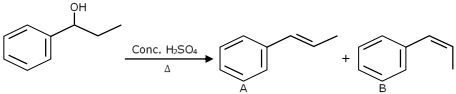
Consider the below reaction, and choose the correct statement:
  • A
    The reaction is not possible in acidic medium
  • B
    Both compounds $A$ and $B$ are formed equally
  • C
    Compound $B$ will be the major product
  • Compound $A$ will be the major product

Answer

Correct option: D.
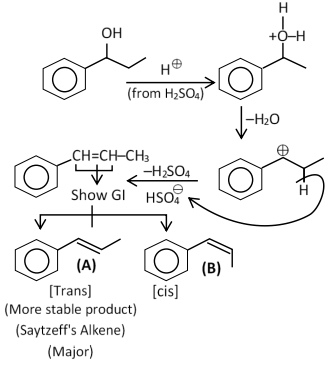
Compound $A$ will be the major product
d

Need a full question paper?

Generate a complete, print-ready paper with questions like this in minutes — across 16+ boards, with answer keys.

Start Generating Free

Similar questions

Which of the following imparts violet colouration to the Bunsen burner non-luminous flame?
The nucleus of the atom consists of
Which of the following is sink for $\text{CO}\ ?$
The valency of phosphorus in ${H_3}P{O_4}$ is
$\begin{matrix}
   \,\,\,C{{H}_{3}}  \\
   \,\,\,|\,\,\,  \\
   C{{H}_{3}}-CH\xrightarrow{KMn{{O}_{4}}}  \\
   \,\,\,|\,\,\,  \\
   \,\,\,C{{H}_{3}}  \\
\end{matrix}(A)\xrightarrow[\Delta ]{{{H}^{+}}}(B)\xrightarrow[ROOR]{HBr}(C)$

Product $(C)$ in the above reactions is

Arrange the following elements in increasing order of first ionization enthalpy:

$\mathrm{Li}, \mathrm{Be}, \mathrm{B}, \mathrm{C}, \mathrm{N}$

Choose the correct answer from the options given below:

Carbon and oxygen combine to form two oxides, carbon monoxide and carbon dioxide in which the ratio of the weights of carbon and oxygen is respectively $12 : 16$ and $12 : 32$. These figures illustrate the
An ideal gas expands isothermally from $10^{-3} \;\mathrm{m}^{3}$ to $10^{-2} \;\mathrm{m}^{3}$ at $300 \;\mathrm{K}$ against a constant pressure of $10^{5}\; \mathrm{Nm}^{-2} .$ The work done on the gas is
$1.24\, gm \,P $ is present in $2.2\, gm$
In which of the following processes entropy increases?

$A$. A liquid evaporates to vapour.

$B$. Temperature of a crystalline solid lowered from $130 \mathrm{~K}$ to $0 \mathrm{~K}$.

$C$. $2 \mathrm{NaHCO}_{3(\mathrm{~s})} \rightarrow \mathrm{Na}_2 \mathrm{CO}_{3(\mathrm{~s})}+\mathrm{CO}_{2(\mathrm{~g})}+\mathrm{H}_2 \mathrm{O}_{(\mathrm{g})}$

$D$. $\mathrm{Cl}_{2(g)} \rightarrow 2 \mathrm{Cl}_{(g)}$

Choose the correct answer from the options given below: