Question

Consider the circuit arrangement shown in Fig (a) for studying input and output characteristics of npn transistor in CE configuration.
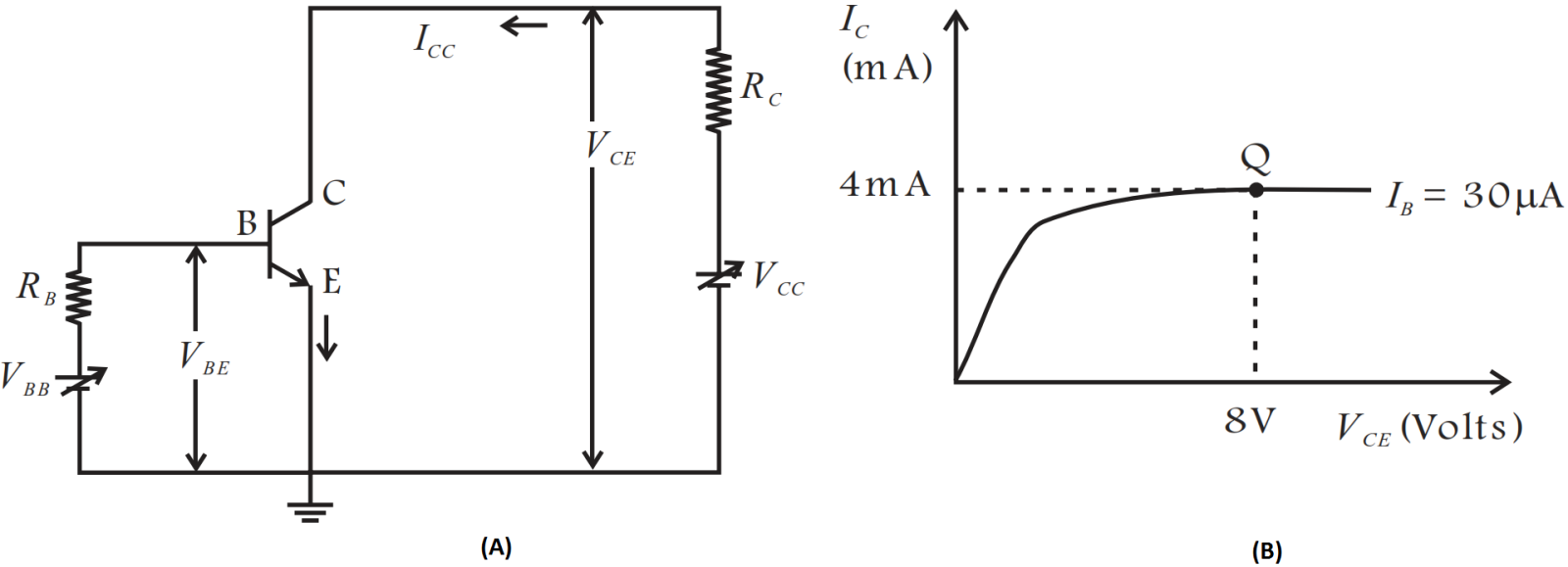
Select the values of $R_B$ and $R_C$ for a transistor whose $V_{BE} = 0.7V,$ so that the transistor is operating at point Q as shown in the characteristics shown in Fig. (b).
Given that the input impedance of the transistor is very small and $V_{CC} = V_{BB} = 16V,$ also find the voltage gain and power gain of circuit making appropriate assumptions.
Answer

According to the problem, at point Q, from graph
$V_{BE} = 0.7V, V_{CC} = V_{BB} = 16V$ and $V_{CE} = 8V. IC = 4mA = 4 \times 10^{-3}A$
$\text{I}_\text{B}=30\mu\text{A}=30\times10^{-6}\text{A}$
Since, $V_{CC} = I_CR_C + V_{CE} $
$\text{R}_\text{C}=\frac{\text{V}_\text{CC}-\text{V}_\text{CE}}{\text{I}_\text{C}}=\frac{16-8}{4\times10^{-3}}=\frac{8\times1000}{4}=2\text{k}\Omega$
Similarly, $V_{BB} - I_BR_B + V_{BE}$
$\text{R}_\text{B}=\frac{\text{V}_\text{BB}-\text{V}_\text{BE}}{\text{I}_\text{B}}=\frac{16-0.7}{30\times10^{-6}}$
$=510\times10^3\Omega=510\text{k}\Omega$ Current gain,
$\beta=\frac{\text{I}_\text{C}}{\text{I}_\text{B}}=\frac{4\times10^{-3}}{30\times10^{-6}}=133.3$
Voltage gain $=\beta\frac{\text{R}_\text{C}}{\text{R}_\text{B}}=\frac{133\times2\times10^3}{510\times10^3}=0.52$
$\text{Power gain}=\beta\times\text{Voltage gain}=133\times0.52=69$

Need a full question paper?

Generate a complete, print-ready paper with questions like this in minutes — across 16+ boards, with answer keys.

Start Generating Free

Similar questions

A diverging lens of focal length 20cm and a converging lens of focal length 30cm are placed 15cm apart with their principal axes coinciding. Where should an object be placed on the principal axis so that its image is formed at infinity?
In a CE transistor amplifier there is a current and voltage gain associated with the circuit. In other words there is a power gain. Considering power a measure of energy, does the circuit voilate conservation of energy?
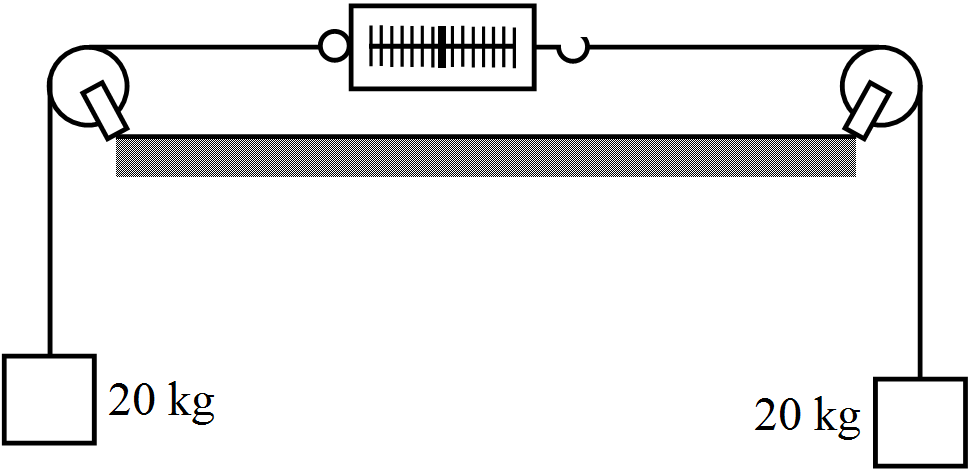
Figure shows a light spring balance connected to two blocks of mass 20kg each. The graduations in the balance measure the tension in the spring.
  1. What is the reading of the balance?
  2. Will the reading change if the balance is heavy, say 2.0kg?
  3. What will happen if the spring is light but the blocks have unequal masses?
The left end of a copper rod (length = 20cm area of cross section = 0.20cm) is maintained at $20^\circ C$ and the right end is maintained at $80^\circ C$. Neglecting any loss of heat through radiation, find,
  1. The temperature at a point 11cm from the left end
  2. The heat current through the rod. Thermal conductivity of copper $=385\text{Wm}^{-1}{^{\circ}}\text{C}^{-1}.$
A long solenoid 'S' has 'n' turns per meter, with diameter 'a'. At the centre of this coil we place a smaller coil of 'N' turns and diameter 'b' (where b < a). If the current in the solenoid increases linearly, with time, what is the induced emf appearing in the smaller coil. Plot graph showing nature of variation in emf, if current varies as a function of $mt^2 +C.$
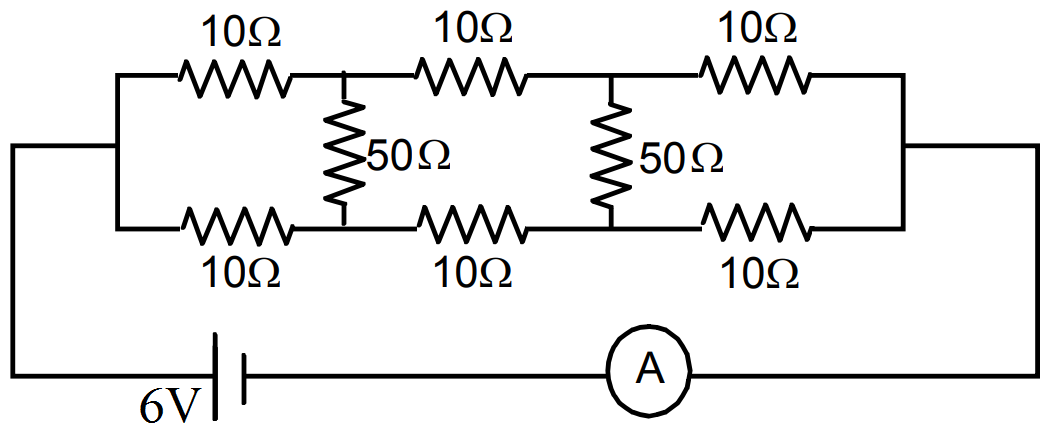
Find the current measured by the ammeter in the circuit shown in the figure.
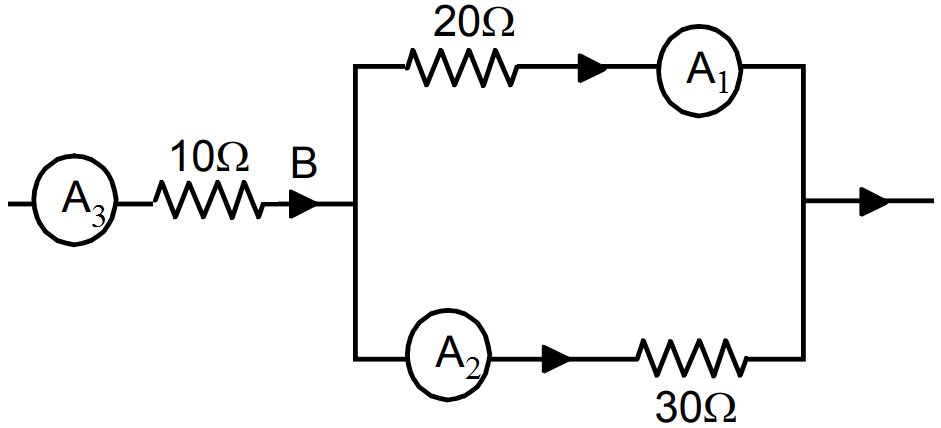
If the reading of the ammeter, $A_1$ in the figure. is 2.4A, what will be the readings of ammeters $A_2$ and $A_3?$ Neglect the resistances of the ammeters.
$i$. Prove that an ideal capacitor in an ac circuit does not dissipate power.
$ii$. An inductor of $200 mH,$ a capacitor of $400 \mu f$, and a resistor of $10 \Omega$ are connected in series to ac source of $50 V$ of variable frequency. Calculate the
$a$. the angular frequency at which maximum power dissipation occurs in the circuit and the corresponding value of the effective current and
$b$. value of $Q-$ factor in the circuit.
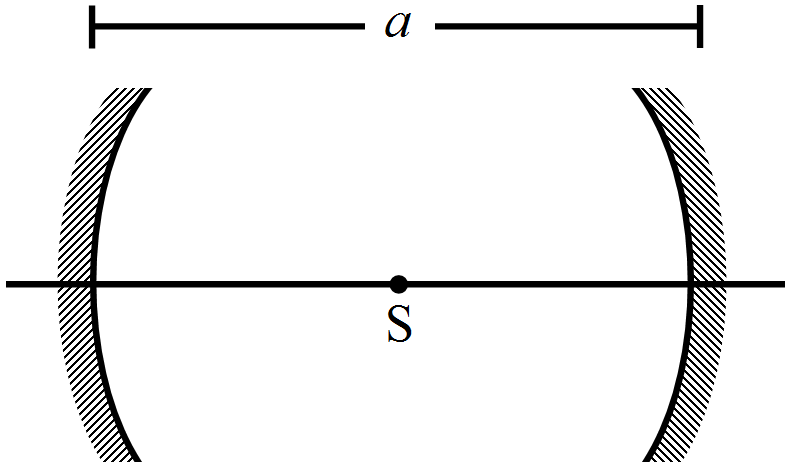
A point source S is placed midway between two converging mirrors having equal focal length f. Find the values of d for which only one image is formed.
A permanent magnet in the shape of a thin cylinder of length 10 cm has M = 106A/m. Calculate the magnetisation current $I_M.$