Question
In a CE transistor amplifier there is a current and voltage gain associated with the circuit. In other words there is a power gain. Considering power a measure of energy, does the circuit voilate conservation of energy?

Answer

Key concept: Different gain in CE transistor amplifier:
  1. Ac current gain: $\beta_\text{ac}=\Big(\frac{\Delta\text{i}_\text{c}}{\Delta\text{i}_\text{b}}\Big)\text{V}_\text{CE}=\text{constant}$
  2. dc current gain: $\beta_\text{dc}=\frac{\text{i}_\text{c}}{\text{i}_\text{b}}$
  3. Voltage gain: $\text{A}_\text{v}=\frac{\Delta\text{V}_0}{\Delta\text{V}_\text{i}}=\beta_\text{ac}\times\text{Resistance gain}$
  4. Power gain: $=\frac{\Delta\text{P}_0}{\Delta\text{P}_\text{i}}=\beta_\text{ac}^2\times\text{Resistance gain}$
The power gain is very high in CE transistor amplifier. In this circuit, the extra power required for amplified output is obtained from DC source. Thus, the circuit used does not violate the law of conservation.

Need a full question paper?

Generate a complete, print-ready paper with questions like this in minutes — across 16+ boards, with answer keys.
Start Generating Free

Similar questions

A gas is initially at a pressure of 100kPa and its volume is $2.0m^3.$ Its pressure is kept constant and the volume is changed from $2.0m^3$ to $2.5m^3$. Its volume is now kept constant and the pressure is increased from 100kPa to 200kPa. The gas is brought back to its initial state, the pressure varying linearly with its volume.
  1. Whether the heat is supplied to or extracted from the gas in the complete cycle?
  2. How much heat was supplied or extracted?
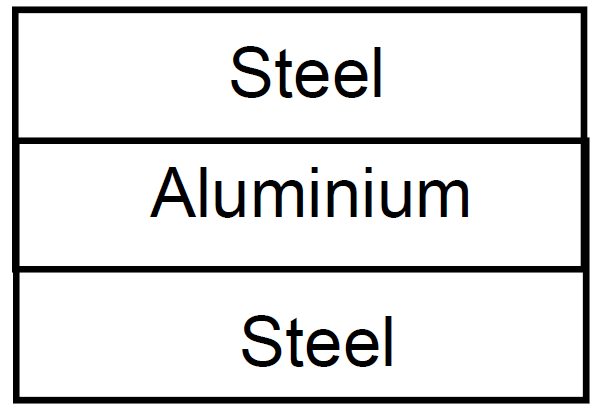
Two steel rods and an aluminium rod of equal length $l_0$ and equal cross section are joined rigidly at their ends as shown in the figure below. All the rods are in a state of zero tension at $0^\circ C$. Find the length of the system when the temperature is raised to $\theta$. Coefficient of linear expanaion of aluminium and steel are $\alpha_\text{a}$ and $\alpha_\text{s}$respectively. Young's modulus of aluminium is $Y_a$ and of steel is $Y_s.$​​​​​​​
The heavier block in an Atwood machine has a mass twice that of the lighter one. The tension in the string is 16.0N when the system is set into motion. Find the decrease in the gravitational potential energy during the first second after the system is released from rest.
Two identical pith balls, each carrying a charge q, are suspended from a common point by two strings of equal length l. Find the mass of each ball if the angle between the strings is $2\theta$ in equilibrium.
A circular loop of string rotates about its axis on a frictionless horizontal plane at a uniform rate so that the tangential speed of any particle of the string is v. If a small transverse disturbance is produced at. a point of the loop, with what speed (relative to the string) will this disturbance travel on the string?
Suppose the space between the two inner shells of the previous problem is filled with a dielectric of dielectric coastant K. Find the capacitance of the system between A and B.
  1. Estimate the speed with which electrons emitted from a heated emitter of an evacuated tube impinge on the collector maintained at a potential difference of 500 V with respect to the emitter. Ignore the small initial speeds of the electrons. The specific charge of the electron, i.e., its e/m is given to be $1.76 \times 10^{11}\ C\ kg^{–1}.$
  2. Use the same formula you employ in (a) to obtain electron speed for an collector potential of 10 MV. Do you see what is wrong? In what way is the formula to be modified?
A small piece of cesium metal ($\phi$ = 1 ·9 eV) is kept at a distance of 20cm from a large metal plate having a charge density of $1.0 \times 10^{-9}C/m^2$ on the surface facing the cesium piece. A monochromatic light of wavelength 400nm is incident on the cesium piece. Find the minimum and the maximum kinetic energy of the photoelectrons reaching the large metal plate. Neglect any change in electric field due to the small piece of cesium present.
Figure shows a plane mirror M placed at a distance of 10cm from a concave lens L. A point object is placed at a distance of 60cm from the lens. The image formed due to refraction by the lens and reflection by the mirror is 30cm behind the mirror. What is the focal length of this lens?
Explain ac voltage applied on a series LCR circuit and give its analytical solution.