Consider the circuit given below where A, B and C are three identical light bulbs of constant resistance.
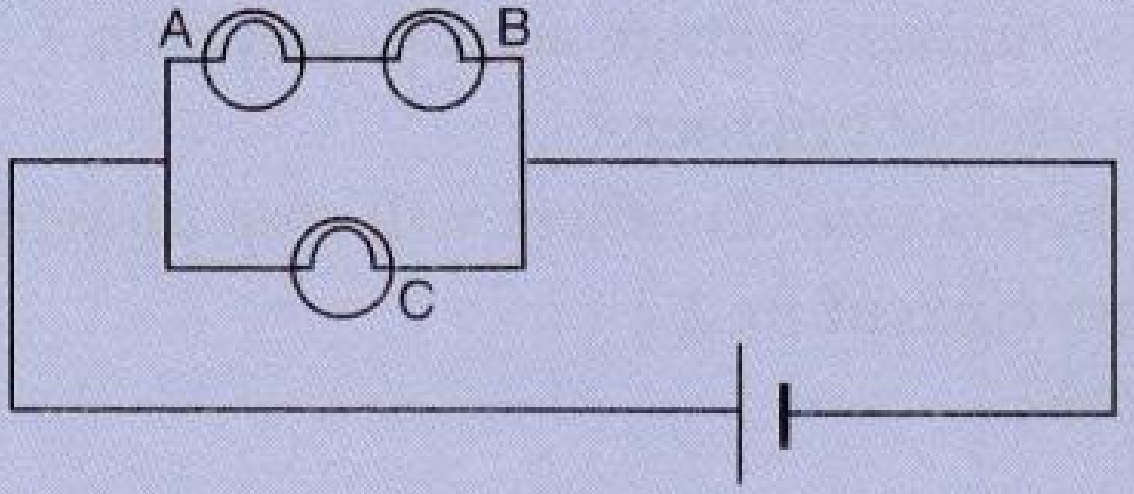
List the bulbs in order of increasing brightness.
If C burns out, what will be the brightness of A now compared with before?
If B burns out instead, what will be the brightness of A and C compared with before?
Download our app for free and get started
C will be the brightest. Voltage will be distributed equally between A and B, so they will have equal brightness but lesser than that of C.
A gets the same voltage as before, so its brightness remains the same.
If B burns put, A will also stop glowing because it is connected in series with B. However, brightness of C remains the same.
Download our app
and get started for free
Experience the future of education. Simply download our apps or reach out to us for more information. Let's shape the future of learning together!No signup needed.*
The electrical resistivities of four materials $A, B, C$ and $D$ are given below:
$\text{A}\ -110\times10^{-8}\Omega\text{ m}$
$\text{B}-\ 1.0\times10^{10}\Omega\text{ m}$
$\text{C}-\ 10.0\times10^{-8}\Omega\text{ m}$
$\text{D}-\ 2.3\times10^{3}\Omega\text{ m}$
Which material is:
Ten bulbs are connected in a series circuit to a power supply line. Ten identical bulbs are connected in a Parallel circuit to an identical power supply line.
Which circuit would have the highest voltage across each bulb?
In which circuit would the bulbs be brighter?
In which circuit, if one bulb blows out, all others will stop glowing
A resistor of 8 ohms is connected in parallel with another resistor X. The resultant resistance of the combination is 4.8 ohms. What is the value of the resistor X?