Question
State the conclusions that can be drawn from Oersted’s experiment.

Answer

Conclusions that can be drawn from Oersted’s experiment:
1. An electric current produces a magnetic field around it. The moving charge in the conducting wire is a source of magnetic field.

2. The direction of the magnetic field produced by the current is the direction in which the north pole of the magnetic needle is deflected. Hence, from the experimental observations we can conclude that at any point near the current-carrying conductor, the magnetic field is perpendicular to (i) the length of the conductor and (ii) the line joining the conductor and the given point.

Need a full question paper?

Generate a complete, print-ready paper with questions like this in minutes — across 16+ boards, with answer keys.
Start Generating Free

Similar questions

Draw a neat labelled diagrams: One solar panel produces a potential difference of 18 V and current of 3A. Describe how you can obtain a potential difference of 72 Volts and current of 9 A with a solar array using solar panels. You can use sign of a battery for a solar panel.
Find the amount of heat needed to raise the temperature of a silver container of mass 100 g by 10 °C. (c = 0.056 cal/g °C)
Write the factors affecting environment.
What are the two ways in which cow-dung can be used as a fuel? Which of them is better and why?
Solve the problem.
If the mass of a planet is eight times the mass of the Earth and its radius is twice the radius of the Earth, what will be the escape velocity for that planet?
Complete the paragraph with the help of words given in the bracket:
(nutritive, ethanol, salt, actinomycetes, fermentation, carbon dioxide, lactic acid, Saccharomyces cerevisiae)
Different types of breads are produced from flour of cereals. Dough is formed by mixing of baker's yeast - __________ , water, __________ and other necessary materials with flour. Due to __________ of carbohydrates by yeast, sugar is __________ and __________ . Dough converted into rises up due to $CO _2$ and the bread becomes spongy. Bread and other products produced with the help of yeast become __________ .
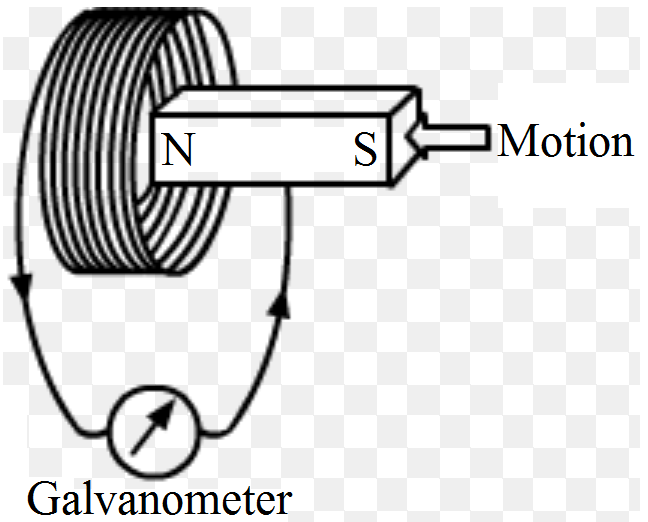
When the magnet shown in the diagram below is moving towards the coil, the galvanometer gives a reading to the right.
  1. What is the name of the effect being produced by the moving magnet?
  2. State what happens to the reading shown on the galvanometer when the magnet is moving away from the coil.
  3. The original experiment is repeated. This time the magnet is moved towards the coil at a great speed. State two changes you would notice in the reading on the galvanometer.
A concave mirror has a focal length of $4\ cm$ and an object $2\ cm$ tall is placed 9cm away from it. Find the nature, position and size of the image formed.
Balance the following equation stepwise.
$H_2S_2O_{7(l)} + H2O_{(l)}\rightarrow H_2SO_{4(l)}$
${ }_1 H ,{ }_7 N,{ }_{20} Ca ,{ }_{16} S,{ }_4 Be ,{ }_{18} Ar$. Which of these elements belong to the second group?