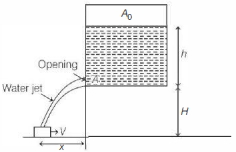
Consider the configuration of a stationary water tank of cross-section area $A_{0}$ and a small bucket as shown in figure below; the speed $v$ is .......... $m/s$ of the bucket, so that the water leaking out of a hole of cross-section area $A$ (as shown) from the water tank does not fall outside the bucket? (Take, $h=5 \,m , H=5 \,m , g=10 \,m / s ^{2}, A=5 \,cm ^{2}$ and $\left.A_{0}=500 \,cm ^{2}\right)$.
KVPY 2019, Advanced


Download our appand get started for free
Experience the future of education. Simply download our apps or reach out to us for more information. Let's shape the future of learning together!No signup needed.*
Similar Questions
- 1View SolutionConstruction of submarines is based on
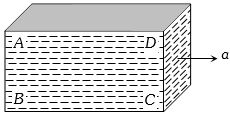
- 2A closed rectangular tank is completely filled with water and is accelerated horizontally with an acceleration a towards right. Pressure is $(i)$ maximum at, and $ (ii) $ minimum atView Solution
- 3View SolutionA small steel ball is dropped into a long cylinder containing glycerine. Which one of the following is the correct representation of the velocity time graph for the transit of the ball?
- 4A small ball of mass $M$ and density $\rho$ is dropped in a viscous liquid of density $\rho_0$. After some time, the ball falls with a constant velocity. What is the viscous force on the ball ?View Solution
- 5View SolutionThe property of a liquid by which it opposes the flow of itself is called ..........
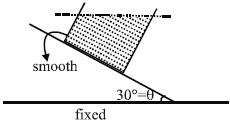
- 6A container of liquid release from the rest, on a smooth inclined plane as shown in the figure. Length of at the inclined plane is sufficient, and assume liquid finally equilibrium. Finally liquid surface makes an angle with horizontal ...... $^o$View Solution
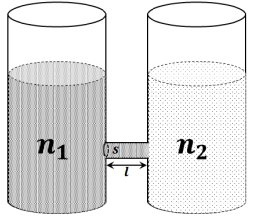
- 7As shown schematically in the figure, two vessels contain water solutions (at temperature $T$ ) of potassium permanganate $\left( KMnO _4\right)$ of different concentrations $n_1$ and $n_2\left(n_1>n_2\right)$ molecules per unit volume with $\Delta n=\left(n_1-n_2\right) \ll n_1$. When they are connected by a tube of small length $\ell$ and cross-sectional area $S , KMnO _4$ starts to diffuse from the left to the right vessel through the tube. Consider the collection of molecules to behave as dilute ideal gases and the difference in their partial pressure in the two vessels causing the diffusion. The speed $v$ of the molecules is limited by the viscous force $-\beta v$ on each molecule, where $\beta$ is a constant. Neglecting all terms of the order $(\Delta n)^2$, which of the following is/are correct? ( $k_B$ is the Boltzmann constant)-View Solution
$(A)$ the force causing the molecules to move across the tube is $\Delta n k_B T S$
$(B)$ force balance implies $n_1 \beta v \ell=\Delta n k_B T$
$(C)$ total number of molecules going across the tube per sec is $\left(\frac{\Delta n}{\ell}\right)\left(\frac{k_B T}{\beta}\right) S$
$(D)$ rate of molecules getting transferred through the tube does not change with time
- 8Pressure at the bottom of a tank of water is $3P$, where $P$ is atmospheric pressure. If water is drawn out till the level of water is lowered by one fifth, then the pressure at the bottom of the tank isView Solution
- 9Air is streaming past a horizontal air plane wing such that its speed in $ 120 m/s$ over the upper surface and $ 90 m/s$ at the lower surface. If the density of air is $1.3 kg$ per $metre^3 $ and the wing is $10 m $ long and has an average width of $2 m$, then the difference of the pressure on the two sides of the wing of ....... $Pascal$View Solution
- 10A body of density $\rho'$ is dropped from rest at a height $h$ into a lake of density $\rho$ , where $\rho > \rho '$ . Neglecting all dissipative forces, calculate the maximum depth to which the body sinks before returning to float on the surface.View Solution