Pressure at the bottom of a tank of water is $3P$, where $P$ is atmospheric pressure. If water is drawn out till the level of water is lowered by one fifth, then the pressure at the bottom of the tank is
Medium
Download our app for free and get started
$3 P=P+h \rho_{w} g \Rightarrow h \rho_{w} g=2 P$
when water is drawn out, the pressure at bottom.
$P^{\prime}=P+\left(h-\frac{h}{5}\right) \rho_{w} g=P+\frac{4}{5} h \rho_{w} g$
$P^{\prime}=P+\frac{4}{5}(2 P)=\frac{13}{5} P$

Download our appand get started for free
Experience the future of education. Simply download our apps or reach out to us for more information. Let's shape the future of learning together!No signup needed.*
Similar Questions
- 1If two liquids of same masses but densities ${\rho _1}$ and ${\rho _2}$ respectively are mixed, then density of mixture is given byView Solution
- 2A rectangular block is $5 cm × 5 cm × 10cm$ in size. The block is floating in water with $ 5 cm $ side vertical. If it floats with $10 cm $ side vertical, what change will occur in the level of water?View Solution
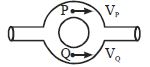
- 3In the figure shown, a liquid is flowing through a tube at the rate of $0.1\, m^3/sec$. The tube is branched into two semicircular tubes of cross-sectional area $A/3$ and $2A/3$. The velocity of liquid at $Q$ is ......... $ m/sec$ (The cross-section of the main tube $= A =10^{-2}\, m^2$ and $v_p = 20\, m/sec$)View Solution
- 4Three identical vessels are filled to the same height with three different liquids $A, B$ and $C$ $({\rho _A} > {\rho _B} > {\rho _C})$. The pressure at the base will beView Solution
- 5View SolutionA good lubricant should have
- 6We have three beakers $A, B$ and $ C $ containing glycerine, water and kerosene respectively. They are stirred vigorously and placed on a table. The liquid which comes to rest at the earliest isView Solution
- 7A piston of cross-section area $100\, cm^2$ is used in a hydraulic press to exert a force of $107\, dynes$ on the water. The cross-sectional area of the other piston which supports an object having a mass $2000 \,kg$. isView Solution
- 8A streamlined body falls through air from a height $h$ on the surface of a liquid. If $d$ and $D(D > d) $ represents the densities of the material of the body and liquid respectively, then the time after which the body will be instantaneously at rest, isView Solution
- 9A sphere is dropped under gravity through a fluid of viscosity $\eta$ . If the average acceleration is half of the initial acceleration, the time to attain the terminal velocity is ($\rho$ = density of sphere ; $r$ = radius)View Solution
- 10$A U-$ tube having horizontal arm of length $20$ $cm$, has uniform cross-sectional area $=1\ cm^2$. It is filled with water of volume $60$ $cc$. What volume of a liquid of density $4$ $g/cc$ should be poured from one side into the $U -$ tube so that no water is left in the horizontal arm of the tube ........ $cc$ ?View Solution