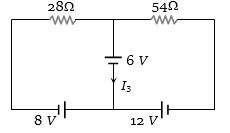
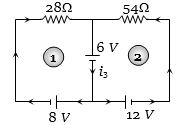
Consider the circuit shown in the figure. The current ${I_3}$ is equal to
Diffcult


Download our appand get started for free
Experience the future of education. Simply download our apps or reach out to us for more information. Let's shape the future of learning together!No signup needed.*
Similar Questions
- 1Which of the following graph represents the variation of resistivity ( $\rho$ ) with temperature $(T)$ for copper $?$View Solution
- 2Assertion : The current density $\vec J$ at any point in ohmic resistor is in direction of electric field $\vec E$ at that point.View Solution
Reason : A point charge when released from rest in a region having only electrostatic field always moves along electric lines of force.
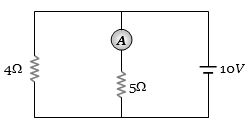
- 3if the internal resistance of the battery is $1\, ohm$, then what is the reading of ammeterView Solution
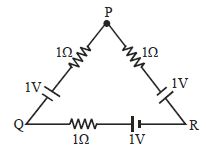
- 4In given circuit find potential difference between $P$ and $Q$ .................. $V$View Solution
- 5Two wires that are made up of two different materials whose specific resistance are in the ratio $2 : 3$, length $3 : 4$ and area $4 : 5$. The ratio of their resistances isView Solution
- 6In the given figure the steady state current $I$ is ................. $\mathrm{A}$View Solution
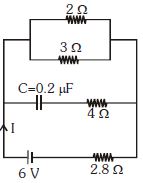
- 7Different combination of $3$ resistors of equal resistance $R$ are shown in the figures.View Solution
The increasing order for power dissipation is: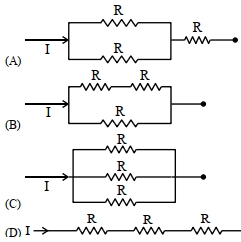
- 8Equivalent resistance between the adjacent corners of a regular $n$-sided polygon of uniform wire of resistance $R$ would be:View Solution
- 9A copper wire has a square cross-section, $2.0\, mm$ on a side. It carries a current of $8\, A$ and the density of free electrons is $8 \times {10^{28}}\,{m^{ - 3}}$. The drift speed of electrons is equal toView Solution
- 10The drift velocity of free electrons in a conductor is ‘$v$’ when a current ‘$i$’ is flowing in it. If both the radius and current are doubled, then drift velocity will beView Solution