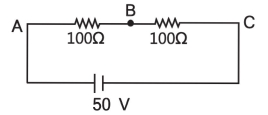
Consider the diagram shown below. A voltmeter of resistance $150\,\Omega$ is connected across $A$ and $B$. The potential drop across $B$ and $C$ measured by voltmeter is $...........\,V$
AIIMS 2015, Diffcult


Download our appand get started for free
Experience the future of education. Simply download our apps or reach out to us for more information. Let's shape the future of learning together!No signup needed.*
Similar Questions
- 1A charged particle of specific charge $\alpha$ is released from origin at time $t = 0$ with velocity $\vec V = {V_o}\hat i + {V_o}\hat j$ in magnetic field $\vec B = {B_o}\hat i$ . The coordinates of the particle at time $t = \frac{\pi }{{{B_o}\alpha }}$ are (specific charge $\alpha = \,q/m$)View Solution
- 2charged particle with charge $q$ enters a region of constant, uniform and mutually orthogonal fields $\vec E$ and $\vec B$ with a velocity $\vec v$ perpendicular to both $\vec E$ and $\vec B$ , and comes out without any change in magnitude or direction of $\vec v$ . ThenView Solution
- 3Two concentric coplanar circular loops of radii ${r_1}$ and ${r_2}$ carry currents of respectively ${i_1}$ and ${i_2}$ in opposite directions (one clockwise and the other anticlockwise.) The magnetic induction at the centre of the loops is half that due to ${i_1}$ alone at the centre. If ${r_2} = 2{r_1}.$ the value of ${I_2}/{I_1}$ is....View Solution
- 4Consider the motion of a positive point charge in a region where there are simultaneous uniform electric and magnetic fields $\vec{E}=E_0 \hat{j}$ and $\vec{B}=B_0 \hat{j}$. At time $t=0$, this charge has velocity $\nabla$ in the $x$-y plane, making an angle $\theta$ with $x$-axis. Which of the following option$(s)$ is(are) correct for time $t>0$ ?View Solution
$(A)$ If $\theta=0^{\circ}$, the charge moves in a circular path in the $x-z$ plane.
$(B)$ If $\theta=0^{\circ}$, the charge undergoes helical motion with constant pitch along the $y$-axis.
$(C)$ If $\theta=10^{\circ}$, the charge undergoes helical motion with its pitch increasing with time, along the $y$-axis.
$(D)$ If $\theta=90^{\circ}$, the charge undergoes linear but accelerated motion along the $y$-axis.
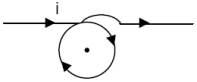
- 5In the figure, find out the magnetic field at $B$ (Given $I =2.5 \;A,r =5\, cm )$View Solution
- 6View SolutionTwo free parallel wires carrying currents in opposite direction
- 7View SolutionAssertion : If the current in a solenoid is reversed in direction while keeping the same magnitude, the magnetic field energy stored in the solenoid decreases.
Reason : Magnetic field energy density is proportional to square of current.
- 8A uniform magnetic field $B$ of $0.3\, T$ is along the positive $Z-$ direction . A rectangular loop $(abcd)$ of sides $10\, cm\times5\, cm$ carries a current $I$ of $12\, A$. Out of the following different orientations which one corresponds to stable equilibrium ?View Solution
- 9Biot-Savart, law indicates that the moving electrons (velocity $v$) produce a magnetic field $B$ such thatView Solution
- 10Acharged particle enters a uniform magnetic field perpendicular to its initial direction travelling in air. The path of the particle is seen to follow the path in figure. Which of statements $1-3$ is/are correct?View Solution
$[1]$ The magnetic field strength may have been increased while the particle was travelling in air
$[2]$ The particle lost energy by ionising the air
$[3]$ The particle lost charge by ionising the air