charged particle with charge $q$ enters a region of constant, uniform and mutually orthogonal fields $\vec E$ and $\vec B$ with a velocity $\vec v$ perpendicular to both $\vec E$ and $\vec B$ , and comes out without any change in magnitude or direction of $\vec v$ . Then
AIEEE 2007, Medium


Download our appand get started for free
Experience the future of education. Simply download our apps or reach out to us for more information. Let's shape the future of learning together!No signup needed.*
Similar Questions
- 1Two parallel wires in free space are $10\, cm$ apart and each carries a current of $10\, A$ in the same direction. The force one wire exerts on the other per metre of length isView Solution
- 2View SolutionA moving coil sensitive galvanometer gives at once much more deflection. To control its speed of deflection
- 3Two galvanometers $A$ and $B$ require $3\,mA$ and $5\,mA$ respectively to produce the same deflection of $10$ divisions. ThenView Solution
- 4View SolutionA moving coil sensitive galvanometer gives at once much more deflection. To control its speed of deflection
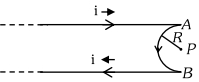
- 5A very long conducting wire is bent in a semicircular shape from $A$ to $B$ as shown in figure. The magnetic field at point $P$ for steady current configuration is given by:View Solution
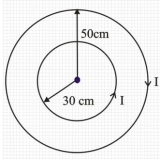
- 6Two concentric circular loops of radii $r _{1}=30\,cm$ and $r_{2}=50\,cm$ are placed in $X - Y$ plane as shown in the figure. $A$ current $I=7\,A$ is flowing through them in the direction as shown in figure. The net magnetic moment of this system of two circular loops is approximately.View Solution
- 7In bio savart law direction of magnetic field is shown by $d\vec B = \frac{{{\mu _0}}}{{4\pi }}\frac{{I\overrightarrow {dl} \times \vec r}}{{{r^3}}}$View Solution
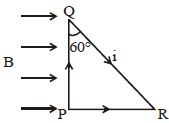
- 8For the circuit shown in figure, the direction and magnitude of the force on $PQR$ is :-View Solution
- 9Two parallel wires of length $9\, m$ each are separated by a distance $0.15\, m$. If they carry equal currents in the same direction and exerts a total force of $30 \times 10^{-7} \,N$ on each other, then the value of current must be........$amp$View Solution
- 10A particle of mass $m$ and charge $q$ moves with a constant velocity $v$ along the positive $x$ direction. It enters a region containing a uniform magnetic field $B$ directed along the negative $z$ direction, extending from $x = a$ to $x = b$. The minimum value of $v$ required so that the particle can just enter the region $x > b$ isView Solution