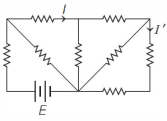
Consider the following circuit shown below. All the resistors are identical. The ratio of $I / I^{\prime}$ is
KVPY 2013, Advanced
Download our app for free and get started
(a)
first we distribute current in circuit given as
Current distribution must follows Kirchhoff's junction rule.
Now, from closed loops marked $1, 2, 3$ and $4$ , we have following set of equations by application of Kirchhoff's loop rule,
$I_1=I_2+I_3 \quad \dots(i)$
$I_3=I_2+I_4 \quad \dots(ii)$
$I_4=I_2-I_4+I_5$
$\Rightarrow 2 I_4=I_2+I_5 \quad \dots(iii)$
$I_5=2\left(I_2-I_4-I_5\right)$
$\Rightarrow I_5=2 I_2-2 I_4-2 I_5 \quad \dots(iv)$
$3 I_5=2 I_2-2 I_4 \quad \dots(v)$
From Eqs. $(iii)$ and $(v)$, we have
$3 I_5=2 I_2-\left(I_2+I_5\right)$
$\Rightarrow 4 I_5=I_2 \quad \dots(vi)$
From Eqs. $(iii)$ and $(vi)$, we have
$2 I_4=4 I_5+I_5 \Rightarrow I_4=\frac{5}{2} I_5 \quad \dots(vii)$
From Eqs. $(ii), (vi)$ and $(vii)$, we have
$I_3=4 I_5+\frac{5}{2} I_5=\frac{13}{2} I_5 \quad \dots(viii)$
Now, marked currents $I$ and $I^{\prime}$ in the given circuit are
$I^{\prime}=\left(I_2-I_4-I_5\right)=\left(4 I_5-\frac{5}{2} I_5-I_5\right)$
$=\left(\frac{8-5-2}{2}\right) I_5=\frac{I_5}{2} \quad \dots(ix)$
And $I=I_2=4 I_5$
Hence, ratio of $I / I^{\prime}=\left(4 I_5\right) /\left(I_5 / 2\right)=8$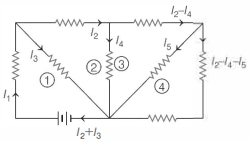

Download our appand get started for free
Experience the future of education. Simply download our apps or reach out to us for more information. Let's shape the future of learning together!No signup needed.*
Similar Questions
- 1If $400\; \Omega$ of resistance is made by adding four $100\; \Omega$ resistance of tolerance $5 \%$ then the tolerance of the combination is .....$\%$View Solution
- 2In a potentiometer, the null point is received at $7^{th}$ wire. If now we have to change the null point at $9^{th}$ wire, what should we do ?View Solution
- 3An infinite sequence of resistance is shown in the figure. The resultant resistance between $A$ and $B$ will be, when ${R_1} = 1\,ohm$ and ${R_2} = 2\,ohm$ ............. $\Omega$View Solution
- 4$A$ wire of length $L$ and $3$ identical cells of negligible internal resistances are connected in series. Due to the current, the temperature of the wire is raised by $\Delta T$ in time $t. N$ number of similar cells is now connected in series with a wire of the same material and cross section but of length $2L$. The temperature of the wire is raised by the same amount $\Delta T$ in the same time $t$. The value of $N$ is :View Solution
- 5Potential difference across the $40\,\Omega $ resistance will be ............ $V$View Solution
- 6View SolutionReferring to the figure below, the effective resistance of the network is
- 7You are given several identical resistances each of value $R = 10\,\Omega $ and each capable of carrying maximum current of $1\, ampere$. It is required to make a suitable combination of these resistances to produce a resistance of $5\,\Omega $ which can carry a current of $4\, amperes$. The minimum number of resistances of the type $R$ that will be required for this jobView Solution
- 8There are $n$ similar conductors each of resistance $R$. The resultant resistance comes out to be $x$ when connected in parallel. If they are connected in series, the resistance comes out to beView Solution
- 9View SolutionIn the below circuit the current in each resistance is
- 10View SolutionIn the given circuit