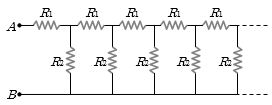
An infinite sequence of resistance is shown in the figure. The resultant resistance between $A$ and $B$ will be, when ${R_1} = 1\,ohm$ and ${R_2} = 2\,ohm$ ............. $\Omega$
Medium
Download our app for free and get started
Let the resultant resistance be $R$. If we add one more branch, then the resultant resistance would be the same because this is an infinite sequence.
$\therefore \frac{{R{R_2}}}{{R + {R_2}}} + {R_1} = R \Rightarrow 2R + R + 2 = {R^2} + 2R$
$ \Rightarrow {R^2} - R - 2 = 0 \Rightarrow R = - 1$ or $R = 2\,ohm$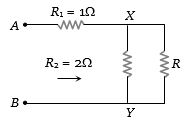

Download our appand get started for free
Experience the future of education. Simply download our apps or reach out to us for more information. Let's shape the future of learning together!No signup needed.*
Similar Questions
- 1Two wires of same material have length $L$ and $2L $ and cross-sectional areas $4A$ and $A$ respectively. The ratio of their specific resistance would beView Solution
- 2Two wires $A$ and $B$ of the same material, having radii in the ratio $1: 2$ carry currents in the ratio $4: 1$. The ratio of drift speed of electrons in $A$ and $B$ isView Solution
- 3The temperature coefficient of resistance of tungsten is $4.5 \times 10^{-3}{ }^{\circ} C ^{-1}$ and that of germanium is $-5 \times 10^{-2}{ }^{\circ} C ^{-1}$. A tungsten wire of resistance $100 \,\Omega$ is connected in series with a germanium wire of resistance $R$. The value of $R$ for which the resistance of combination does not change with temperature is .......... $\Omega$View Solution
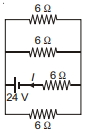
- 4Current $I$ in the network shown in figure is .......... $A$View Solution
- 5As shown in the figure, a network of resistors is connected to a battery of $2\,V$ with an internal resistance of $3\,\Omega$. The currents through the resistors $R_4$ and $R_5$ are $I_4$ and $I_5$ respectively. The values of $I_4$ and $I_5$ are :View Solution
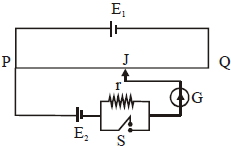
- 6A potentiometer wire $PQ$ of $1\,m$ length is connected to a standard cell $E _{1}$. Another cell $E _{2}$ of emf $1.02\, V$ is connected with a resistance $'r'$ and switch $S$ (as shown in figure). With switch $S$ open, the null position is obtained at a distance of $49\, cm$ from $Q$. The potential gradient in the potentiometer wire is.......$V/cm$View Solution
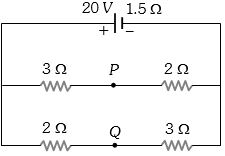
- 7If in the circuit shown below, the internal resistance of the battery is $1.5$ $\Omega$ and $V_P$ and $V_Q$ are the potentials at $P$ and $Q$ respectively, what is the potential difference between the points $P$ and $Q$View Solution
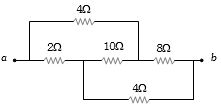
- 8Find the equivalent resistance between the points $a$ and $b$ .......... $\Omega$View Solution
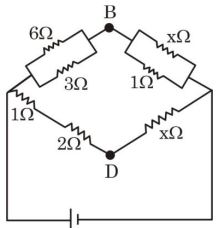
- 9If the potential difference between $B$ and $D$ is zero, the value of $x$ is $\frac{1}{n} \Omega$. The value of $n$ is .......View Solution
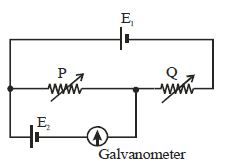
- 10Two cells of $e.m.f.$ $s\, E_1$ and $E_2$ and of negligible internal resistances are connected with two variable resistors as shown in Fig. When the galvanometer shows no deflection, the values of the resistances are $P$ and $Q$. What is the value of the ratio $E_2/E_1$ ?View Solution