Question
Consider the following diagram, where the forces in the cable are given. Based on the above information, answer the following questions.
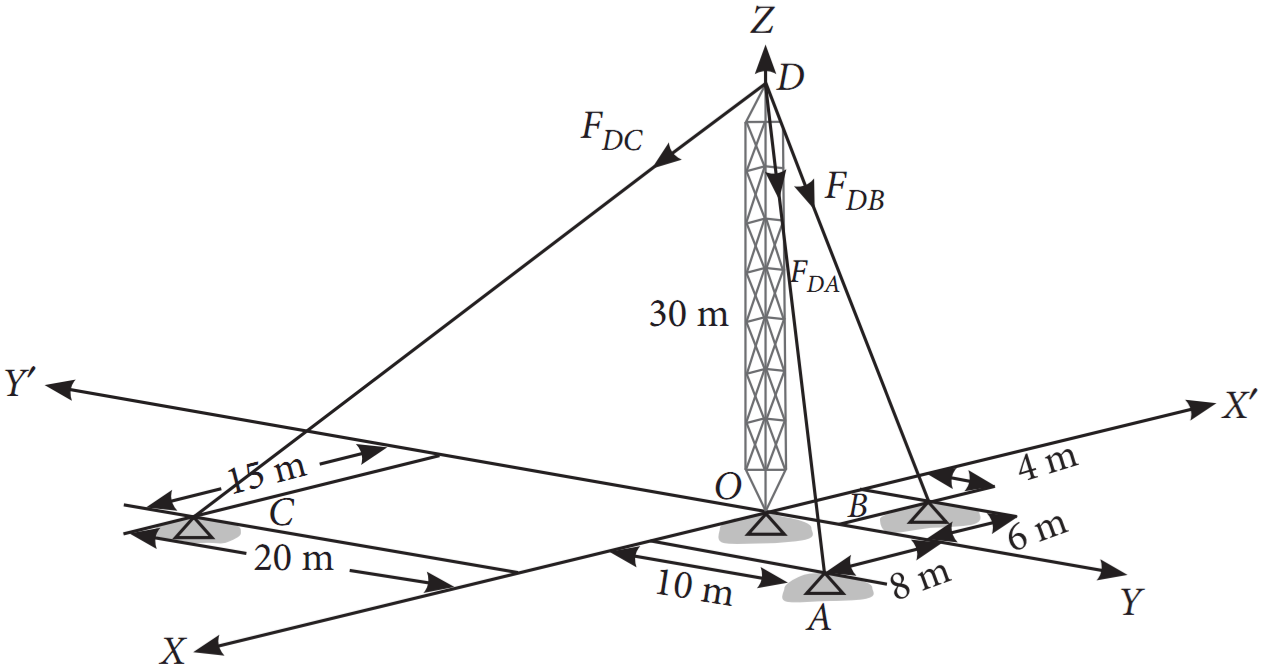
  1. The equation of line along the cable AD is:
  1. $\frac{\text{x}}{5}=\frac{\text{y}}{4}=\frac{\text{z}-30}{15}$
  2. $\frac{\text{x}}{4}=\frac{\text{y}}{5}=\frac{\text{z}-30}{15}$
  3. $\frac{\text{x}}{5}=\frac{\text{y}}{4}=\frac{30-\text{z}}{15}$
  4. $\frac{\text{x}}{4}=\frac{\text{y}}{5}=\frac{30-\text{z}}{15}$
  1. The length of cable DC is:
  1. $4\sqrt{61}\text{m}$
  2. $5\sqrt{61}\text{m}$
  3. $6\sqrt{61}\text{m}$
  4. $7\sqrt{61}\text{m}$
  1. The vector DB is:
  1. $-6\hat{\text{i}}+4\hat{\text{j}}-30\hat{\text{k}}$
  2. $6\hat{\text{i}}-4\hat{\text{j}}+30\hat{\text{k}}$
  3. $6\hat{\text{i}}+4\hat{\text{j}}+30\hat{\text{k}}$
  4. None of these
  1. The sum of vectors along the cables is:
  1. $17\hat{\text{i}}+6\hat{\text{j}}+90\hat{\text{k}}$
  2. $17\hat{\text{i}}-6\hat{\text{j}}-90\hat{\text{k}}$
  3. $17\hat{\text{i}}+6\hat{\text{j}}-90\hat{\text{k}}$
  4. None of these
  1. The sum of distances of points A, B and C from the origin, i.e., OA + OB + OC is:
  1. $\sqrt{164}+\sqrt{52}+\sqrt{625}$
  2. $\sqrt{52}+\sqrt{625}+\sqrt{48}$
  3. $\sqrt{164}+\sqrt{625}+\sqrt{49}$
  4. None of these

Answer

  1. (d) $\frac{\text{x}}{4}=\frac{\text{y}}{5}=\frac{30-\text{z}}{15}$
Solution:

Clearly, the coordinates of A are (8, 10, 0) and D are (0, 0, 30)

$\therefore$ Equation of AD is given by

$\frac{\text{x}-0}{8-0}=\frac{\text{y}-0}{10-0}=\frac{30-\text{z}}{-30}$

$\Rightarrow\frac{\text{x}}{4}=\frac{\text{y}}{5}=\frac{30-\text{z}}{15}$
  1. (b) $5\sqrt{61}\text{m}$
Solution:

The coordinates of point Care (15, -20, 0) and D are (0, 0, 30)

$\therefore$ Length of the cable DC

$=\sqrt{(0-15)^2+(0-20)^2+(30-0)^2}$

$=\sqrt{225+400+900}$

$=\sqrt{1525}=\sqrt{61}\text{m}.$
  1. (a) $-6\hat{\text{i}}+4\hat{\text{j}}-30\hat{\text{k}}$
Solution:

Since, the coordinates of point B are (-6, 4, 0) and D are (0, 0, 30), therefore vector DB is

$(-6-0)\hat{\text{i}}+(4-0)\hat{\text{j}}+(0-30)\hat{\text{k}},$

i.e., $-6\hat{\text{i}}+4\hat{\text{j}}-30\hat{\text{k}}$
  1. (b) $17\hat{\text{i}}-6\hat{\text{j}}-90\hat{\text{k}}$
​​​​​​​Solution:

Required sum

$(8\hat{\text{i}}+10\hat{\text{j}}-30\hat{\text{k}})+(-6\hat{\text{i}}+4\hat{\text{j}}-30\hat{\text{k}})+(15\hat{\text{i}}-20\hat{\text{j}}-30\hat{\text{k}})$

$17\hat{\text{i}}-6\hat{\text{j}}-90\hat{\text{k}}$
  1. (a) $\sqrt{164}+\sqrt{52}+\sqrt{625}$
​​​​​​​Solution:

Clearly, $\text{OA}=\sqrt{8^2+10^2}=\sqrt{164}$

$\text{OB}=\sqrt{6^2+4^2}=\sqrt{36+16}=\sqrt{52}$

And $\text{OC}=\sqrt{15^2+20^2}=\sqrt{225+400}=\sqrt{625}$

Need a full question paper?

Generate a complete, print-ready paper with questions like this in minutes — across 16+ boards, with answer keys.

Start Generating Free

Similar questions

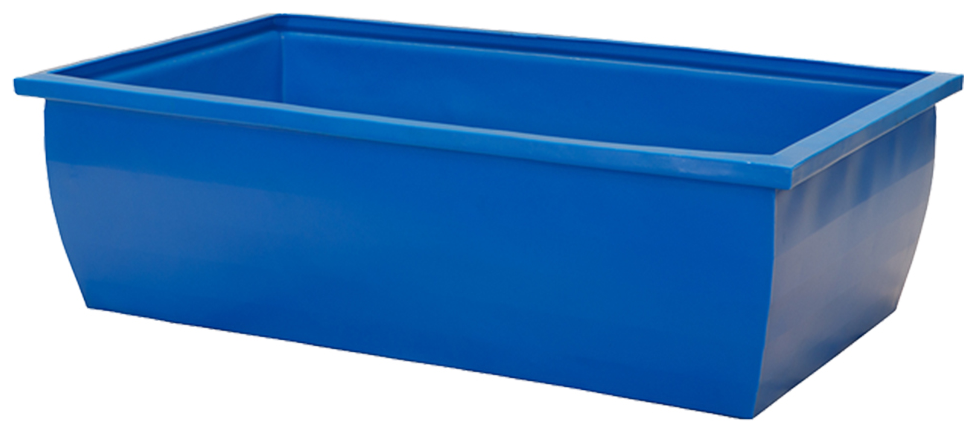
Nitin wants to construct a rectangular plastic tank for his house that can hold $80\ ft^3$ of water. The top of the tank is open. The width of tank will be $5$ ft but the length and heights are variables. Building the tank cost? $₹\ 20$ per sq. foot for the base and $₹\ 10$ per sq. foot for the side.

Based on the above information, answer the following questions.
  1. In order to make a least expensive water tank, Nitin need to minimize its.
  1. Volume
  2. Base
  3. Curved surface area
  4. Cost
  1. Total cost of tank as a function of h can be represented as.
  1. $c(h) = 100h - 320 - 1600/ h$
  2. $c(h) = 100h - 320h - 720h^2$
  3. $c(h) = 100 + 320h + 1600h^2$
  4. $\text{c}\big(\text{h}\big)=100\text{h}+320+\frac{1600}{\text{h}}$
  1. Range of $h$ is.
  1. $(3, 5)$
  2. $\big(0,\infty\big)$
  3. $(0, 8)$
  4. $(0, 3)$
  1. Value of hat which $c(h)$ is minimum, is.
  1. $4$
  2. $5$
  3. $6$
  4. $6, 7$
  1. The cost of least expensive tank is.
  1. $₹\ 1020$
  2. $₹\ 1100$
  3. $₹\ 1120$
  4. $₹\ 1220$
Three shopkeepers $A, B$ and $C$ go to a store to buy stationary. $A $ purchase $12$ dozen notebooks, $5$ dozen pens and $6$ dozen pencils. $B$ purchases $10$ dozen notebooks, $6$ dozen pens and $7$ dozen pencils. $C$ purchases $11$ dozen notebooks, $13$ dozen pens and $8$ dozen pencils. $A$ notebook costs ₹ $40$, a pen costs ₹ $12$ and a pencil costs ₹ $3.$

Based on the above information, answer the following questions.
  1. The number of items purchased by shopkeepers $A, B$ and $C$ represented in matrix form as:
  1. $\begin{matrix}\text{Notebooks}&\text{Pens}&\text{Pencils}\end{matrix}\\\begin{bmatrix}144&\ \ \ \ \ \ \ \ 60&\ \ \ \ \ 72\\120&\ \ \ \ \ \ \ \ \ 720&\ \ \ \ \ 84\\132&\ \ \ \ \ \ \ \ \ 156&\ \ \ \ \ 96\end{bmatrix}\begin{matrix}\text{A}\\\text{B}\\\text{C}\end{matrix}$
  2. $\begin{matrix}\text{Notebooks}&\text{Pens}&\text{Pencils}\end{matrix}\\\begin{bmatrix}144&\ \ \ \ \ \ \ \ 72&\ \ \ \ \ 60\\120&\ \ \ \ \ \ \ \ \ 84&\ \ \ \ \ 72\\132&\ \ \ \ \ \ \ \ \ 156&\ \ \ \ \ 96\end{bmatrix}\begin{matrix}\text{A}\\\text{B}\\\text{C}\end{matrix}$
  3. $\begin{matrix}\text{Notebooks}&\text{Pens}&\text{Pencils}\end{matrix}\\\begin{bmatrix}144&\ \ \ \ \ \ \ \ 72&\ \ \ \ \ 72\\120&\ \ \ \ \ \ \ \ \ 156&\ \ \ \ \ 84\\132&\ \ \ \ \ \ \ \ \ 84&\ \ \ \ \ 96\end{bmatrix}\begin{matrix}\text{A}\\\text{B}\\\text{C}\end{matrix}$
  4. $\begin{matrix}\text{Notebooks}&\text{Pens}&\text{Pencils}\end{matrix}\\\begin{bmatrix}144&\ \ \ \ \ \ \ \ 60&\ \ \ \ \ 60\\120&\ \ \ \ \ \ \ \ \ 84&\ \ \ \ \ 72\\132&\ \ \ \ \ \ \ \ \ 156&\ \ \ \ \ 96\end{bmatrix}\begin{matrix}\text{A}\\\text{B}\\\text{C}\end{matrix}$
  1. If $Y$ represents the matrix formed by the cost of each item, then $XY$ equals.
  1. $\begin{bmatrix}5741\\6780 \\8040\end{bmatrix}$
  2. $\begin{bmatrix}6696\\5916 \\7440\end{bmatrix}$
  3. $\begin{bmatrix}5916\\6696 \\7440\end{bmatrix}$
  4. $\begin{bmatrix}6740\\5740 \\8140\end{bmatrix}$
  1. Bill of A is equal to:
  1. ₹ $6740$
  2. ₹ $8140$
  3. ₹ $5740$
  4. ₹ $6696$
  1. If $A^2 = A,$ then $(A + 1)^3- 7A =$
  1. $A$
  2. $A - I$
  3. $I$
  4. $A + I$
  1. If $A$ and $B$ are $3 × 3$ matrices such that $A^2 - B^2 = (A - B) (A+ B),$ then
  1. Either $A$ or $B$ is zero matrix.
  2. Either $A$ or $B$ is unit matrix.
  3. $A = B$
  4. $AB = BA$
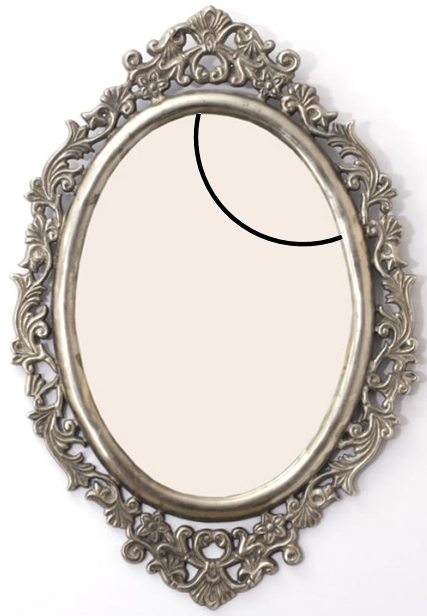
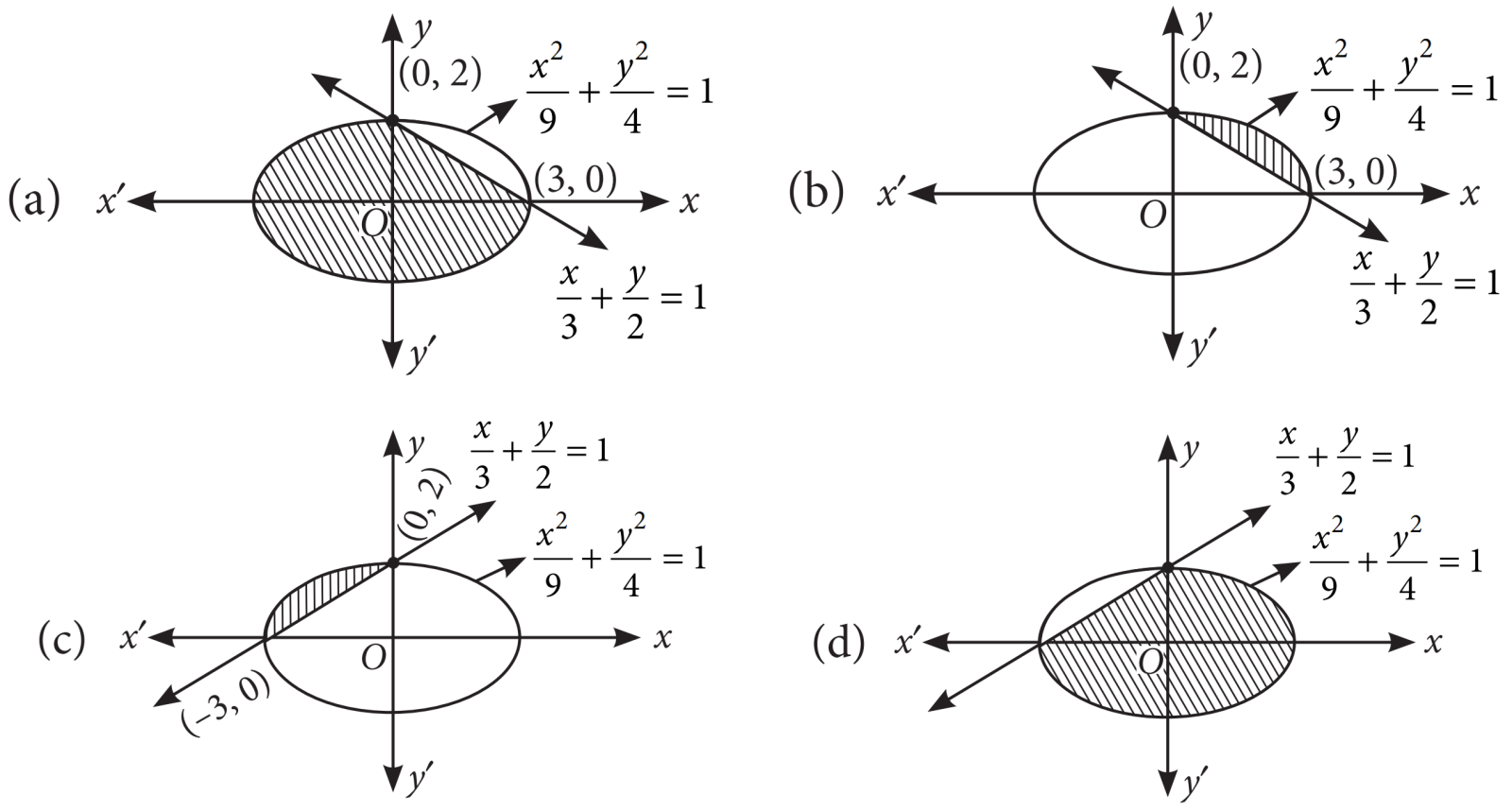
A mirror in the shape of an ellipse represented by $\frac{\text{x}^2}{9}+-\frac{\text{y}^2}{4}=1$ was hanging on the wall. Arun and his sister were playing with ball inside the house, even their mother refused to do so. All of sudden, ball hit the mirror and got a scratch in the shape of line represented by $\frac{\text{x}}{3}+\frac{\text{y}}{2}=1$

Based on the above information, answer the following questions.
  1. Point(s) of intersection of ellipse and scratch (straight line) is (are).
  1. (0, 2), (3, 0)
  2. (2, 0), (3, 0)
  3. (2, 3), (0, 0)
  4. (0, 3), (3, 0)
  1. Area of smaller region bounded by the ellipse and line is represented by.
  1. The value of $\frac{2}{3}\int\limits_{0}^{3}\sqrt{9-\text{x}^2}\text{dx}$ is.
    1. $\frac{\pi}{2}$
    2. $\pi$
    3. $\frac{3\pi}{2}$
    4. $\frac{\pi}{4}$
  1. The value of $2\int\limits_{0}^{3}\bigg(1-\frac{\text{x}}{3}\bigg)\text{dx}$ is.
    1. 0
    2. 1
    3. 2
    4. 3
  1. Area of the smaller region bounded by the mirror and scratch is.
  1. $3\Big(\frac{\pi}{2}+1\Big)\text{ sq.units}$
  2. $\Big(\frac{\pi}{2}+1\Big)\text{ sq.units}$
  3. $\Big(\frac{\pi}{2}-1\Big)\text{ sq.units}$
  4. $3\Big(\frac{\pi}{2}-1\Big)\text{ sq.units}$
Naina is creative she wants to prepare a sweet box for Diwali at home. She took a square piece of cardboard of side $18 \mathrm{~cm}$ which is to be made into an open box, by cutting a square from each corner and folding up the flaps to form the box. She wants to cover the top of the box with some decorative paper. Naina is interested in maximizing the volume of the box.

Image

(i) Find the volume of the open box formed by folding up the cutting each corner with $\mathrm{x} \mathrm{cm}$.

(ii) Naina is interested in maximizing the volume of the box. So, what should be the side of the square to be cut off so that the volume of the box is maximum?

(iii) Verify that volume of the box is maximum at $x=3 \mathrm{~cm}$ by second derivative test?

OR

Find the maximum volume of the box.

If a relation between x and y is such that y cannot be expressed in terms of x, then y is called an implicit function of x. When a given relation expresses y as an implicit function of x and we want to find $\frac{\text{dy}}{\text{dx}},$ then we differentiate every term of the given relation w.r.t. x, remembering that a tenn in y is first differentiated w.r.t. y and then multiplied by $\frac{\text{dy}}{\text{dx}}.$
Based on the ab:ve information, find the value of $\frac{\text{dy}}{\text{dx}}$ in each of the following questions.
  1. $x^3 + x^2y + xy^2 + y^3 = 81$
  1. $\frac{(3\text{x}^2+2\text{xy}+\text{y}^2)}{\text{x}^2+2\text{xy}+3\text{y}^2}$
  2. $\frac{-(3\text{x}^2+2\text{xy}+\text{y}^2)}{\text{x}^2+2\text{xy}+3\text{y}^2}$
  3. $\frac{(3\text{x}^2+2\text{xy}-\text{y}^2)}{\text{x}^2-2\text{xy}+3\text{y}^2}$
  4. $\frac{3\text{x}^2+\text{xy}+\text{y}^2}{\text{x}^2+\text{xy}+3\text{y}^2}$
  1. $x^y = e^{x-y}$
  1. $\frac{\text{x}-\text{y}}{(1+\log\text{x})}$
  2. $\frac{\text{x}+\text{y}}{(1+\log\text{x})}$
  3. $\frac{\text{x}-\text{y}}{\text{x}(1+\log\text{x})}$
  4. $\frac{\text{x}+\text{y}}{\text{x}(1+\log\text{x})}$
  1. $\text{e}^{\sin\text{y}}=\text{xy}$
  1. $\frac{-\text{y}}{\text{x}(\text{y}\cos\text{y}-1)}$
  2. $\frac{\text{y}}{\text{y}\cos\text{y}-1}$
  3. $\frac{\text{y}}{\text{y}\cos\text{y}+1}$
  4. $\frac{\text{y}}{\text{x}(\text{y}\cos\text{y}-1)}$
  1. $\sin^2\text{x}+\cos^2\text{y}=1$
  1. $\frac{\sin2\text{y}}{\sin2\text{x}}$
  2. $-\frac{\sin2\text{x}}{\sin2\text{y}}$
  3. $-\frac{\sin2\text{y}}{\sin2\text{x}}$
  4. $\frac{\sin2\text{x}}{\sin2\text{y}}$
  1. $\text{y}=(\sqrt{\text{x}})^{\sqrt{\text{x}}^\sqrt{\text{x}}...\infty}$
  1. $\frac{-\text{y}^2}{\text{x}(2-\text{y}\log\text{x})}$
  2. $\frac{\text{y}^2}{2+\text{y}\log\text{x}}$
  3. $\frac{\text{y}^2}{\text{x}(2+\text{y}\log\text{x})}$
  4. $\frac{\text{y}^2}{\text{x}(2-\text{y}\log\text{x})}$
To promote the making of toilets for women, an organisation tried to generate awareness through (i) house call (ii) emails and (iii) announcements. The cost for each mode per attempt is given below:
  1. ₹ 50
  2. ₹ 20
  3. ₹ 40
The number of attempts made in the villages X, Y and Z are given below:
  (i) (ii) (iii)
X 400 300 100
Y 300 250 75
Z 500 400 150
Also, the chance of making of toilets corresponding to one attempt of given modes is:
  1. 2%
  2. 4%
  3. 20%
Based on the above information, answer the following questions.
  1. The cost incurred by the organisation on village X is:
  1. ₹ 10000
  2. ₹ 15000
  3. ₹ 30000
  4. ₹ 20000
  1. The cost incurred by the organisation on village Y is:
  1. ₹ 25000
  2. ₹ 18000
  3. ₹ 23000
  4. ₹ 28000
  1. The cost incurred by the organisation on village Z is:
  1. ₹ 19000
  2. ₹ 39000
  3. ₹ 45000
  4. ₹ 50000
  1. The total number of toilets that can be expected after the promotion in village X, is:
  1. 20
  2. 30
  3. 40
  4. 50
  1. The total number of toilets that can be expected after the promotion in village Z, is
  1. 56
  2. 26
  3. 36
  4. 46
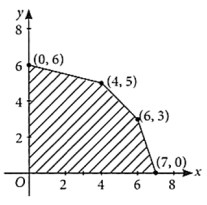
Corner points of the feasible region for an LPP are (0, 3), (5, 0), (6, 8), (0, 8). Let Z = 4x - 6y be the objective function.
Based on the above information, answer the following questions.
  1. The minimum value of Z occurs at:
  1. (6, 8)
  2. (5, 0)
  3. (0, 3)
  4. (0, 8)
  1. Maximum value of Z occurs at:
  1. (5, 0)
  2. (0, 8)
  3. (0, 3)
  4. (6, 8)
  1. Maximum of Z - Minimum of Z =
  1. 58
  2. 68
  3. 78
  4. 88
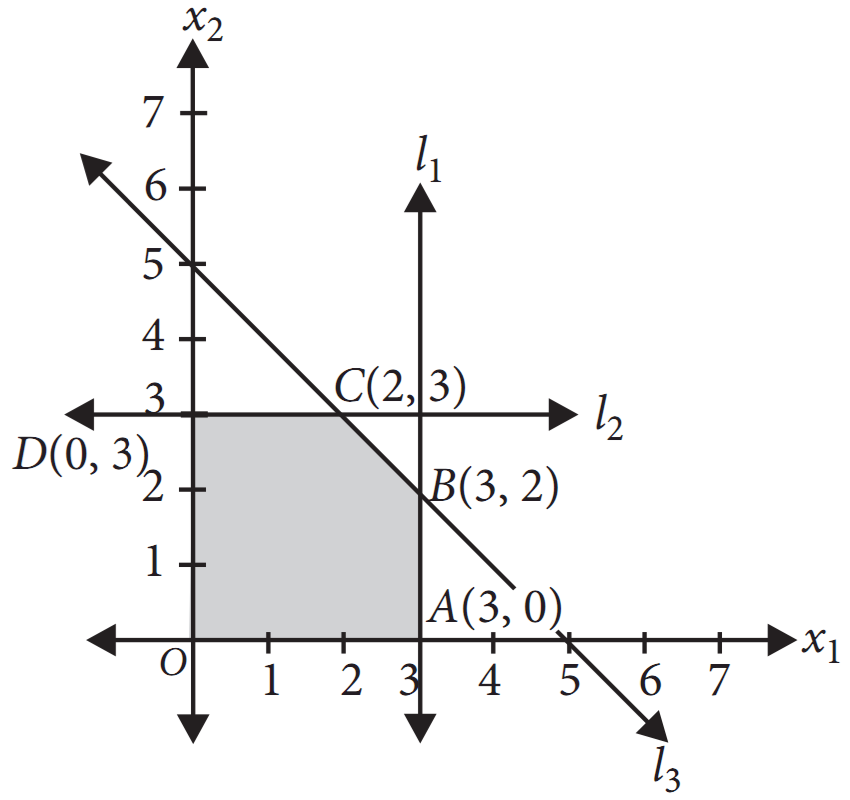
  1. The corner points of the feasible region determined by the system of linear inequalities are:
  1. (0, 0), (-3, 0), (3, 2). (2, 3)
  2. (3, 0), (3, 2), (2, 3), (0, -3)
  3. (0, 0), (3, 0), (3, 2), (2, 3), (0, 3)
  4. None of these
  1. The feasible solution of LPP belongs to:
  1. First and second quadrant.
  2. First and third quadrant.
  3. Only second quadrant.
  4. Only first quadrant.
A telephone company in a town has $500$ subscribers on its list and collects fixed charges of $Rs. 300/-$ per subscriber per year. The company proposes to increase the annual subscription and it is believed that for every increase of Re $1/-$ one subscriber will discontinue the service. Find what increase will bring maximum profit?
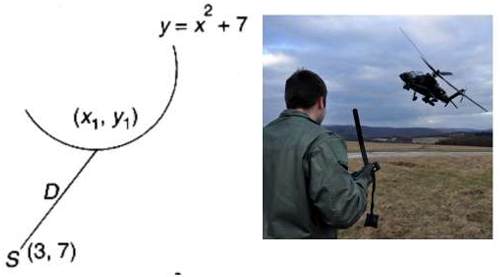
An Apache helicopter of the enemy is flying along the curve given by $y=x^2+7$. A soldier, placed at $(3,7)$ want to shoot down the helicopter when it is nearest to him.

Image

(i) If $\mathrm{P}\left(\mathrm{x}_1, \mathrm{y}_1\right)$ be the position of a helicopter on curve $\mathrm{y}=\mathrm{x}^2+7$, then find distance $\mathrm{D}$ from $\mathrm{P}$ to soldier place at $(3,7)$.

(ii) Find the critical point such that distance is minimum.

(iii) Verify by second derivative test that distance is minimum at $(1,8)$.

OR

Find the minimum distance between soldier and helicopter?