Question
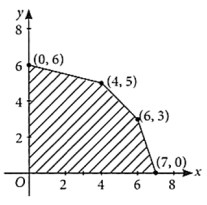
✓
Answer
When we solve an L.P.P. graphically, the optimal (or optimum) value of the objective function is attained at corner points of the feasible region.
ii. From the graph of 3x + 4y < 12 it is clear that it contains the origin but not the points on the line 3x + 4y = 12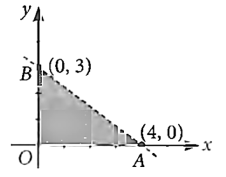
iii. Maximum of objective function occurs at corner points
OR
Value of $Z=p x+q y$ at $(15,15)=15 p+15 q$ and that at $(0,20)=20 q$. According to given condition, we have $15 p +15 q =20 q \Rightarrow 15 p =5 q \Rightarrow q =3 p$
ii. From the graph of 3x + 4y < 12 it is clear that it contains the origin but not the points on the line 3x + 4y = 12
iii. Maximum of objective function occurs at corner points
| Corner Points | Value of z = 2x + 5y |
| (0,0) | 0 |
| (7,0) | 14 |
| (6,3) | 27 |
| (4,5) | $33 \leftarrow$ Maximum |
| (0,6) | 30 |
Value of $Z=p x+q y$ at $(15,15)=15 p+15 q$ and that at $(0,20)=20 q$. According to given condition, we have $15 p +15 q =20 q \Rightarrow 15 p =5 q \Rightarrow q =3 p$
Need a full question paper?
Generate a complete, print-ready paper with questions like this in minutes — across 16+ boards, with answer keys.
Explore more
Similar questions
Shreya got a rectangular parallelepiped shaped box and spherical ball inside it as return gift. Sides of the box are x, 2x, and $\frac{\text{x}}{3},$ while radius of the ball is r.
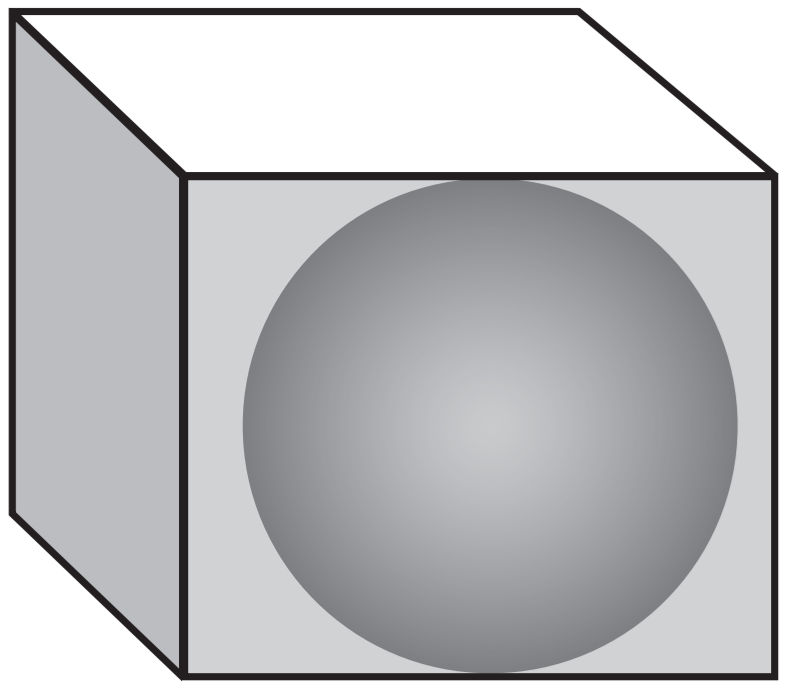
Based on the above information, answer the following questions.
→Based on the above information, answer the following questions.
- If S represents the sum of volume of parallelepiped and sphere, then Scan be written as.
- $\frac{4\text{x}^3}{3}+\frac{2}{2}\pi\text{r}^2$
- $\frac{2\text{x}^2}{3}+\frac{4}{3}\pi\text{r}^2$
- $\frac{2\text{x}^3}{3}+\frac{4}{3}\pi\text{r}^3$
- $\frac{2}{3}\text{x}+\frac{4}{3}\pi\text{r}$
- If sum of the surface areas of box and ball are given to be constant $k^2$ then x is equal to.
- $\sqrt{\frac{\text{k}^2-4\pi\text{r}^2}{6}}$
- $\sqrt{\frac{\text{k}^2-4\pi\text{r}}{6}}$
- $\sqrt{\frac{\text{k}^2-4\pi}{6}}$
- $\text{None of these}$
- The radius of the ball, when Sis minimum, is.
- $\sqrt{\frac{\text{k}^2}{54+\pi}}$
- $\sqrt{\frac{\text{k}^2}{54+4}}$
- $\sqrt{\frac{\text{k}^2}{64+3\pi}}$
- $\sqrt{\frac{\text{k}^2}{4\pi+3}}$
- Relation between length of the box and radius of the ball can be represented as.
- $\text{x} = \frac{2}{\text{r}}$
- $\text{x}=\frac{\text{r}}{2}$
- $\text{x}=\frac{2}{\text{r}}$
- $\text{x}=3\text{r}$
- Minimum value of S is.
- $\frac{\text{k}^2}{2(3\pi+54)^\frac{2}{3}}$
- $\frac{\text{k}}{2(3\pi+54)^\frac{3}{2}}$
- $\frac{\text{k}^3}{2(4\pi+54)^\frac{1}{2}}$
- $\text{None of these}$
A phannaceutical company wants to advertise a new product on T.V., where the product is specially designed for women. For that an advertising executive is hired to study television-viewing habits of married couples during prime time hours. Based on past viewing records he has determined that during prime time husbands are watching television 70% of the time. It has also been determined that when the husband is watching television, 30% of the time the wife is also watching. When the husband is not watching television, 40% of the time the wife is watching television. Based on the above information, answer the following questions.
→- The probability that the husband is not watching television during prime time, is:
- 0.6
- 0.3
- 0.4
- 0.5
- If the wife is watching television, the probability that husband is also watching television, is:
- $\frac{2}{11}$
- $\frac{7}{11}$
- $\frac{5}{11}$
- $\frac{8}{11}$
- The probability that both husband and wife are watching television during prime time, is:
- 0.21
- 0.5
- 0.3
- 0.4
- The probability that the wife is watching television during prime time, is:
- 024
- 0.33
- 0.3
- 0.4
- If the wife is watching television, then the probability that husband is not watching television, is:
- $\frac{2}{11}$
- $\frac{4}{11}$
- $\frac{1}{11}$
- $\frac{5}{11}$
An open water tank of aluminium sheet of negligible thickness, with a square base and vertical sides, is to be constructed in a farm for irrigation. It should hold $32000$ l of water, that comes out from a tube well.
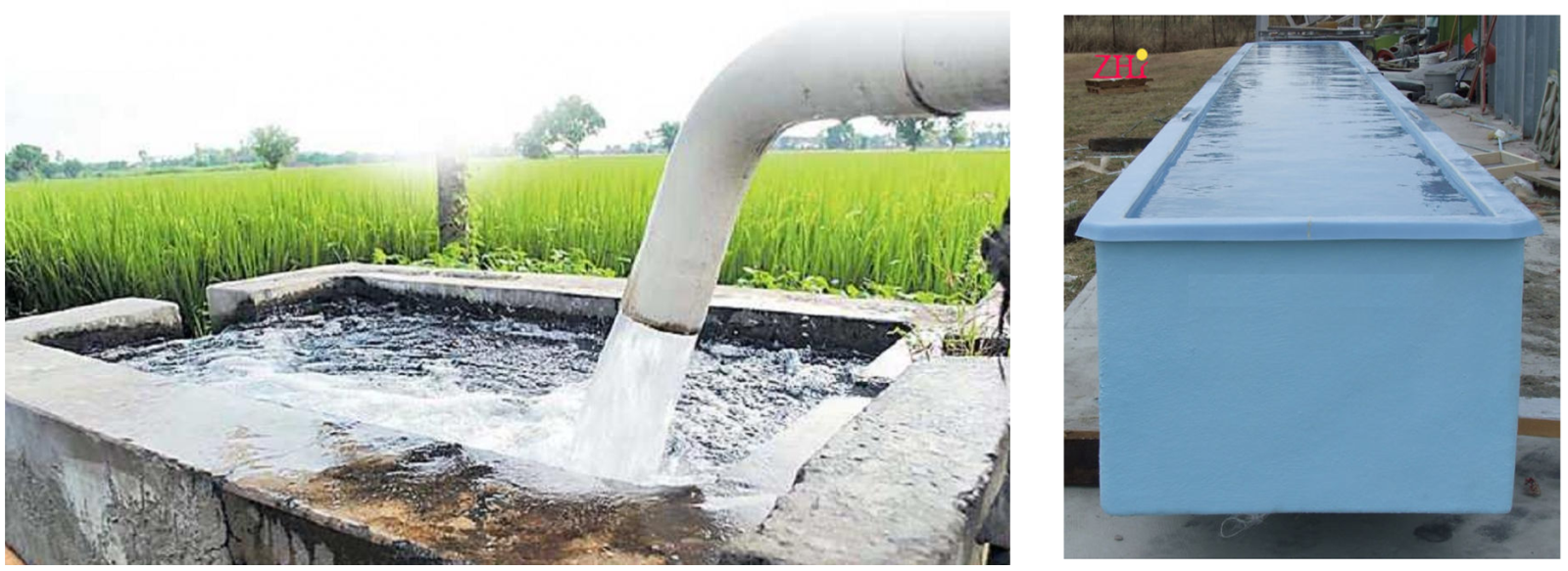
Based on above information, answer the following questions.
→Based on above information, answer the following questions.
- If the length, width, and height of the open tank be $x, x$ and $y$ $m$ respectively, then total surface area of tank is.
- $(x^2 + 2xy)m^2$
- $(2x^2 + 4xy)m^2$
- $(2x^2 + 2xy)m^2$
- $(2x^2 + 8xy)m^2$
- The relation between $x$ and $y$ is.
- $x^2y = 32$
- $xy^2 = 32$
- $x^2y^2 = 32$
- $xy = 32$
- The outer surface area of tank will be minimum when depth of tank is equal to.
- Half of its width.
- Its width.
- $\big(\frac{1}{4}\big)^\text{th}$ of its Width
- $\big(\frac{1}{3}\big)^\text{rd}$ of its Width
- The cost of material will be least when width of tank is equal to.
- Half of its depth
- Twice of its depth
- $\big(\frac{1}{4}\big)^\text{th}$ of its depth
- Thrice of its depth
- If cost of aluminium sheet is $ ₹ \frac{360}{\text{m}^2}$ then the minimum cost for the construction of tank will be.
- $₹\ 15, 000$
- $₹\ 16, 280$
- $₹\ 17, 280$
- $₹\ 18, 280$
If the equation is of the form $\frac{\text{dy}}{\text{dx}}=\frac{\text{f(x, y)}}{\text{g(x, y)}}$or $\frac{\text{dy}}{\text{dx}}=\text{F}\Big(\frac{\text{y}}{\text{x}}\Big),$ where f(x, y), g(x, y) are homogeneous functions of the same degree in x and y, then put y = vx and $\frac{\text{dy}}{\text{dx}}=\text{v+x}\Big(\frac{\text{dv}}{\text{dx}}\Big),$ so that the dependent variable y is changed to another variable v and then apply variable separable method.
Based on the above information, answer the following questions.
→Based on the above information, answer the following questions.
- The general solution of $\text{x}^2\frac{\text{dy}}{\text{dx}}=\text{x}^2+\text{xy}+\text{y}^2$ is:
- $\tan^{-1}\frac{\text{x}}{\text{y}}=\log|\text{x}|+\text{c}$
- $\tan^{-1}\frac{\text{y}}{\text{x}}=\log|\text{x}|+\text{c}$
- $\text{y}=\text{x}\log|\text{x}|+\text{c}$
- $\text{x}=\text{y}\log|\text{y}|+\text{c}$
- Solution of the differential equation $2\text{xy}\frac{\text{dy}}{\text{dx}}=\text{x}^2+3\text{y}^2$ is:
- $x^3 + y^2 = cx^2$
- $\frac{\text{x}^2}{2}+\frac{\text{y}^3}{3}=\text{y}^2+\text{c}$
- $x^2 + y^3 = cx^2$
- $x^2 + y^2 = cx^3$
- General solution of the differential equation $(x^2 + 3xy + y^2) dx - x^2 dy = 0$ is:
- $\frac{\text{x+y}}{\text{y}}-\log\text{x = c}$
- $\frac{\text{x+y}}{\text{y}}+\log\text{x = c}$
- $\frac{\text{x}}{\text{x+y}}-\log\text{x = c}$
- $\frac{\text{x}}{\text{x+y}}+\log\text{x = c}$
- General solution of the differential equation $\frac{\text{dy}}{\text{dx}}=\frac{\text{y}}{\text{x}}\bigg\{\log\Big(\frac{\text{y}}{\text{x}}\Big)+1\bigg\}$ is:
- $\log(\text{xy})=\text{c}$
- $\log\text{y}=\text{cx}$
- $\log\frac{\text{y}}{\text{x}}=\text{cx}$
- $\log\text{x}=\text{cy}$
- Solution of the differential equation $\Big(\text{x}\frac{\text{dy}}{\text{dx}}-\text{y}\Big)\text{e}^\frac{\text{y}}{\text{x}}=\text{x}^2\ \cos\text{x}$ is:
- $\text{e}^\frac{\text{y}}{\text{x}}-\sin\text{x = c}$
- $\text{e}^\frac{\text{y}}{\text{x}}+\sin\text{x = c}$
- $\text{e}^\frac{\text{-y}}{\text{x}}-\sin\text{x = c}$
- $\text{e}^\frac{\text{-y}}{\text{x}}+\sin\text{x = c}$
If a relation between $x$ and $y$ is such that y cannot be expressed in terms of $x$, then y is called an implicit function of $x$. When a given relation expresses $y$ as an implicit function of x and we want to find $\frac{\text{dy}}{\text{dx}},$ then we differentiate every term of the given relation w.r.t. $x$, remembering that a tenn in y is first differentiated w.r.t. y and then multiplied by $\frac{\text{dy}}{\text{dx}}.$
Based on the ab:ve information, find the value of $\frac{\text{dy}}{\text{dx}}$ in each of the following questions.
→Based on the ab:ve information, find the value of $\frac{\text{dy}}{\text{dx}}$ in each of the following questions.
- $x^3 + x^2y + xy^2 + y^3 = 81$
- $\frac{(3\text{x}^2+2\text{xy}+\text{y}^2)}{\text{x}^2+2\text{xy}+3\text{y}^2}$
- $\frac{-(3\text{x}^2+2\text{xy}+\text{y}^2)}{\text{x}^2+2\text{xy}+3\text{y}^2}$
- $\frac{(3\text{x}^2+2\text{xy}-\text{y}^2)}{\text{x}^2-2\text{xy}+3\text{y}^2}$
- $\frac{3\text{x}^2+\text{xy}+\text{y}^2}{\text{x}^2+\text{xy}+3\text{y}^2}$
- $x^y = e^{x-y}$
- $\frac{\text{x}-\text{y}}{(1+\log\text{x})}$
- $\frac{\text{x}+\text{y}}{(1+\log\text{x})}$
- $\frac{\text{x}-\text{y}}{\text{x}(1+\log\text{x})}$
- $\frac{\text{x}+\text{y}}{\text{x}(1+\log\text{x})}$
- $\text{e}^{\sin\text{y}}=\text{xy}$
- $\frac{-\text{y}}{\text{x}(\text{y}\cos\text{y}-1)}$
- $\frac{\text{y}}{\text{y}\cos\text{y}-1}$
- $\frac{\text{y}}{\text{y}\cos\text{y}+1}$
- $\frac{\text{y}}{\text{x}(\text{y}\cos\text{y}-1)}$
- $\sin^2\text{x}+\cos^2\text{y}=1$
- $\frac{\sin2\text{y}}{\sin2\text{x}}$
- $-\frac{\sin2\text{x}}{\sin2\text{y}}$
- $-\frac{\sin2\text{y}}{\sin2\text{x}}$
- $\frac{\sin2\text{x}}{\sin2\text{y}}$
- $\text{y}=(\sqrt{\text{x}})^{\sqrt{\text{x}}^\sqrt{\text{x}}...\infty}$
- $\frac{-\text{y}^2}{\text{x}(2-\text{y}\log\text{x})}$
- $\frac{\text{y}^2}{2+\text{y}\log\text{x}}$
- $\frac{\text{y}^2}{\text{x}(2+\text{y}\log\text{x})}$
- $\frac{\text{y}^2}{\text{x}(2-\text{y}\log\text{x})}$
Megha wants to prepare a handmade gift box for her friend's birthday at home. For making lower part of box, she takes a square piece of cardboard of side $20$cm.

Based on the above information, answer the following questions.
→Based on the above information, answer the following questions.
- If $x$ cm be the length of each side of the square cardboard which is to be cut off from corners of the square piece of side 20cm, then possible value of $x$ will be given by the interval.
- $[0, 20]$
- $(0, 10)$
- $(0, 3)$
- None of these
- Volume of the open box formed by folding up the cutting corner can be expressed as.
- $\text{V}=\text{x}(20-2\text{x})(20-2\text{x)}$
- $\text{V}=\frac{\text{x}}{2}(20+\text{x})(20-\text{x})$
- $\text{V}=\frac{\text{x}}{3}(20-\text{x})(20+\text{x})$
- $\text{V}=\text{x}(20-2\text{x})(20-\text{x)}$
- The values of $x$ for which $\frac{\text{dV}}{\text{dX}}=0$, are.
- $3, 4$
- $0,\frac{10}{3}$
- $0, 10$
- $10,\frac{10}{3}$
- Megha is interested in maximizing the volume of the box. So, what should be the side of the square to be cut off so that the volume of the box is maximum?
- $12$cm
- $8$cm
- $\frac{10}{3}\text{cm}$
- $2$cm
- The maximum value of the volume is.
- $\frac{17000}{27}\text{cm}^3$
- $\frac{11000}{27}\text{cm}^3$
- $\frac{8000}{27}\text{cm}^3$
- $\frac{16000}{27}\text{cm}^3$
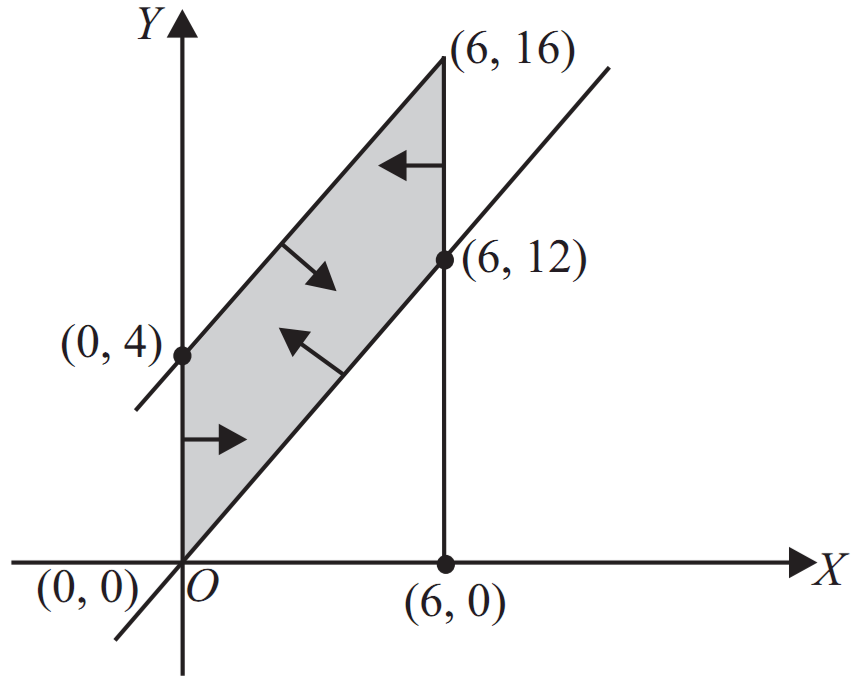
Let R be the feasible region (convex polygon) for a linear programming problem and let Z = ax + by be the objective function. When Z has an optimal value (maximum or minimum), where the variables x and y are subject to constraints described by linear inequalities, this optimal value must occur at a corner point (vertex) of the feasible region. Based on the above information, answer the following questions.
→- Objective function of a L.P.P. is:
- A constant.
- A function to be optimised.
- A relation between the variables.
- None of these.
- Which of the following statement is correct?
- Every LPP has at least one optimal solution.
- Every LPP has a unique optimal solution.
- If an LPP has two optimal solutions, then it has infinitely many solutions.
- None of these.
- In solving the LPP: "minimize f = 6x + 10y subject to constraints $\text{x}\geq6,\text{ y}\geq2,\text{ 2x}+\text{y}\geq10,\text{ x}\geq0,\text{ y}\geq0"$ redundant constraints are:
- $\text{x}\geq6,\text{ y}\geq2$
- $\text{2x}+\text{y}\geq10,\text{ x}\geq0,\text{ y}\geq0$
- $\text{x}\geq6$
- None of these
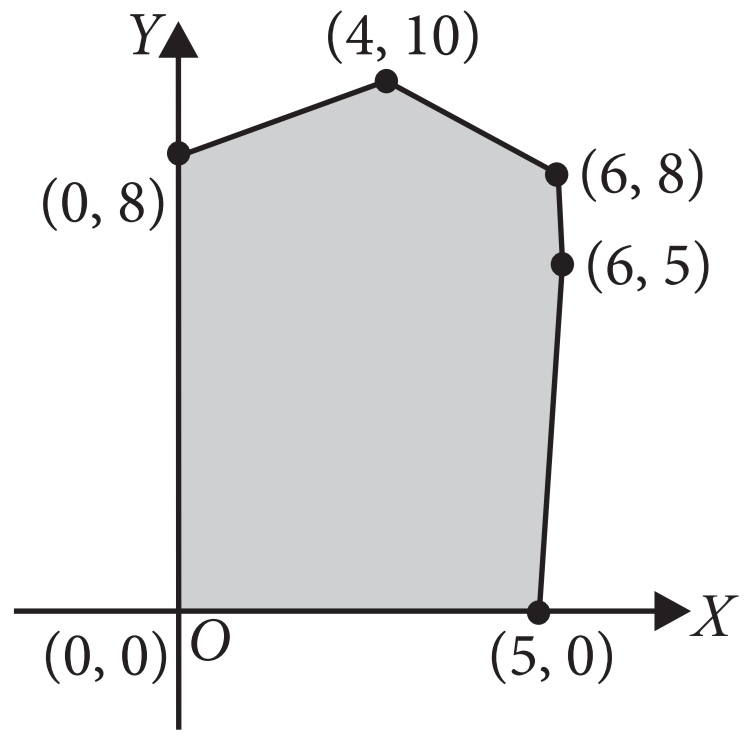
- The feasible region for a LPP is shown shaded in the figure. Let Z = 3x - 4y be the objective function. Minimum of Z occurs at:
- (0, 0)
- (0, 8)
- (5, 0)
- (4, 10)
- The feasible region for a LPP is shown shaded in the figure. Let F = 3x - 4y be the objective function. Maximum value of F is:
- 0
- 8
- 12
- -18
Let x = f(t) and y = g(t) be parametric forms with t as a parameter, then
$\frac{\text{dy}}{\text{dx}}=\frac{\text{dy}}{\text{dt}}\times\frac{\text{dt}}{\text{dx}}=\frac{\text{g}'(\text{t})}{\text{f}'(\text{t})},$ where $\text{f}'(\text{t})\neq0.$
On the basis of above information, answer the following questions.
→$\frac{\text{dy}}{\text{dx}}=\frac{\text{dy}}{\text{dt}}\times\frac{\text{dt}}{\text{dx}}=\frac{\text{g}'(\text{t})}{\text{f}'(\text{t})},$ where $\text{f}'(\text{t})\neq0.$
On the basis of above information, answer the following questions.
- The derivative of $\text{f}(\tan\text{x})\text{w.r.t.}\text{ g}(\sec\text{x})\text{ at}\text{ x}=\frac{\pi}{4},$ where f'(1) = 2 and $\text{g}'(\sqrt{2})=4,$ is:
- $\frac{1}{\sqrt{2}}$
- ${\sqrt{2}}$
- 1
- 0
- The derivative of $\sin^{-1}\Big(\frac{2\text{x}}{1+\text{x}^2}\Big)$ with respect to $\cos^{-1}\Big(\frac{1-\text{x}^2}{1+\text{x}^2}\Big)$ is:
- -1
- 1
- 2
- 4
- The derivative of $\text{e}^{\text{x}^3}$ with respect to log x is:
- $\text{e}^{\text{x}^3}$
- $3\text{x}^22\text{e}^{\text{x}^3}$
- $3\text{x}^3\text{e}^{\text{x}^3}$
- $3\text{x}^2\text{e}^{\text{x}^3}+3\text{x}$
- The derivative of $\cos^{-1}(2\text{x}^2-1)\text{w.r.t.}\cos^{-1}\text{x}$ is:
- $2$
- $\frac{-1}{2\sqrt{1-\text{x}^2}}$
- $\frac{2}{\text{x}}$
- $1-\text{x}^2$
- If $\text{y}=\frac{1}{4}\mu^4$ and $\mu=\frac{2}{3}\text{x}^3+5,$ then $\frac{\text{dy}}{\text{dx}}=$
- $\frac{2}{27}\text{x}^2(2\text{x}^3+15)^3$
- $\frac{2}{7}\text{x}^2(2\text{x}^3+15)^3$
- $\frac{2}{27}\text{x}(2\text{x}^3+5)^3$
- $\frac{2}{7}(2\text{x}^3+15)^3$
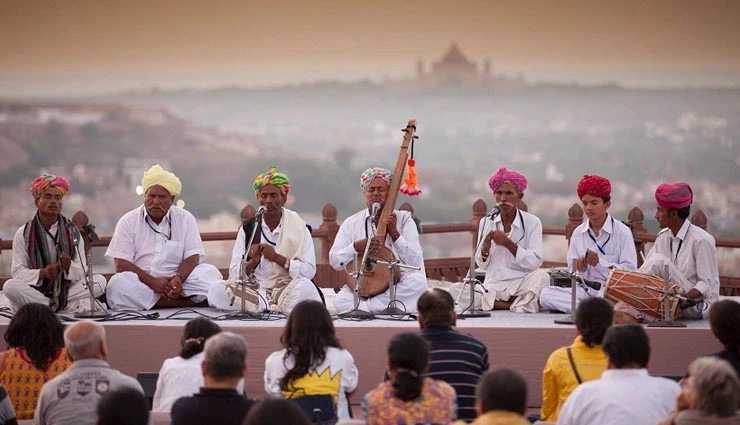
One day, a sangeet mahotsav is to be organised in an open area of Rajasthan. ln recent years, it has rained only 6 days each year. Also, it is given that when it actually rains, the weatherman correctly forecasts rain $80\%$ of the time. When it doesn't rain, he incorrectly forecasts rain $20\%$ of the time.
If leap year is considered, then answer the following questions.
→If leap year is considered, then answer the following questions.
- The probability that it rains on chosen day is:
- $\frac{1}{366}$
- $\frac{1}{73}$
- $\frac{1}{60}$
- $\frac{1}{61}$
- The probability that it does not rain on chosen day is:
- $\frac{1}{366}$
- $\frac{5}{366}$
- $\frac{360}{366}$
- None of these.
- The probability that the weatherman predicts correctly is:
- $\frac{5}{6}$
- $\frac{7}{8}$
- $\frac{4}{5}$
- $\frac{1}{5}$
- The probability that it will rain on the chosen day, if weatherman predict rain for that day, is:
- $0.0625$
- $0.0725$
- $0.0825$
- $0.0925$
- The probability that it will not rain on the chosen day, if weatherman predict rain for that day, is:
- $0.94$
- $0.84$
- $0.74$
- $0.64$
In a play zone, Aastha is playing crane game. It has 12 blue balls, 8 red balls, 10 yellow balls and 5 green balls. If Aastha draws two balls one after the other without replacement, then answer the following questions. 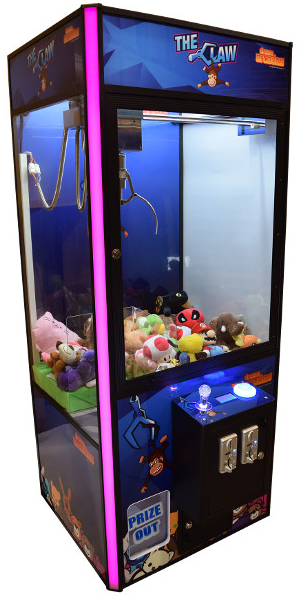
→
- What is the probability that the first ball is blue and the second ball is green?
- $\frac{5}{119}$
- $\frac{12}{119}$
- $\frac{6}{119}$
- $\frac{15}{119}$
- What is the probability that the first ball is yellow and the second ball is red?
- $\frac{16}{119}$
- $\frac{8}{119}$
- $\frac{24}{119}$
- None of these.
- What is the probability that both the balls are red?
- $\frac{4}{85}$
- $\frac{24}{595}$
- $\frac{12}{119}$
- $\frac{64}{119}$
- What is the probability that the first ball is green and the second ball is not yellow?
- $\frac{10}{119}$
- $\frac{6}{85}$
- $\frac{12}{119}$
- None of these.
- What is the probability that both the balls are not blue?
- $\frac{6}{595}$
- $\frac{12}{85}$
- $\frac{15}{17}$
- $\frac{253}{595}$